Few Answers on Why ProvPort Community Fund Money Spent without Residents’ Input
December 8, 2025
Share


Note: This story first appeared on the website of the Providence Preservation Society.
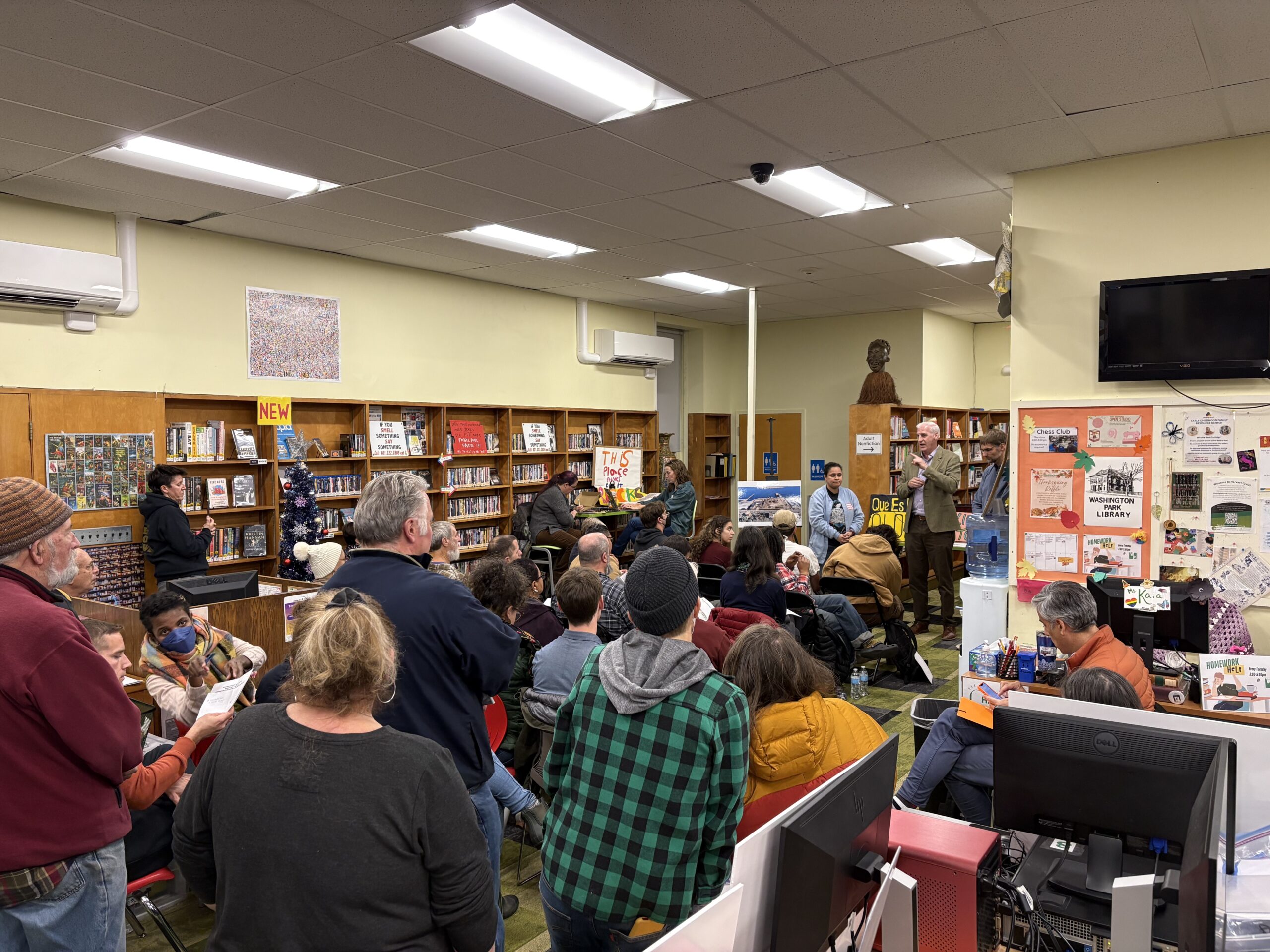
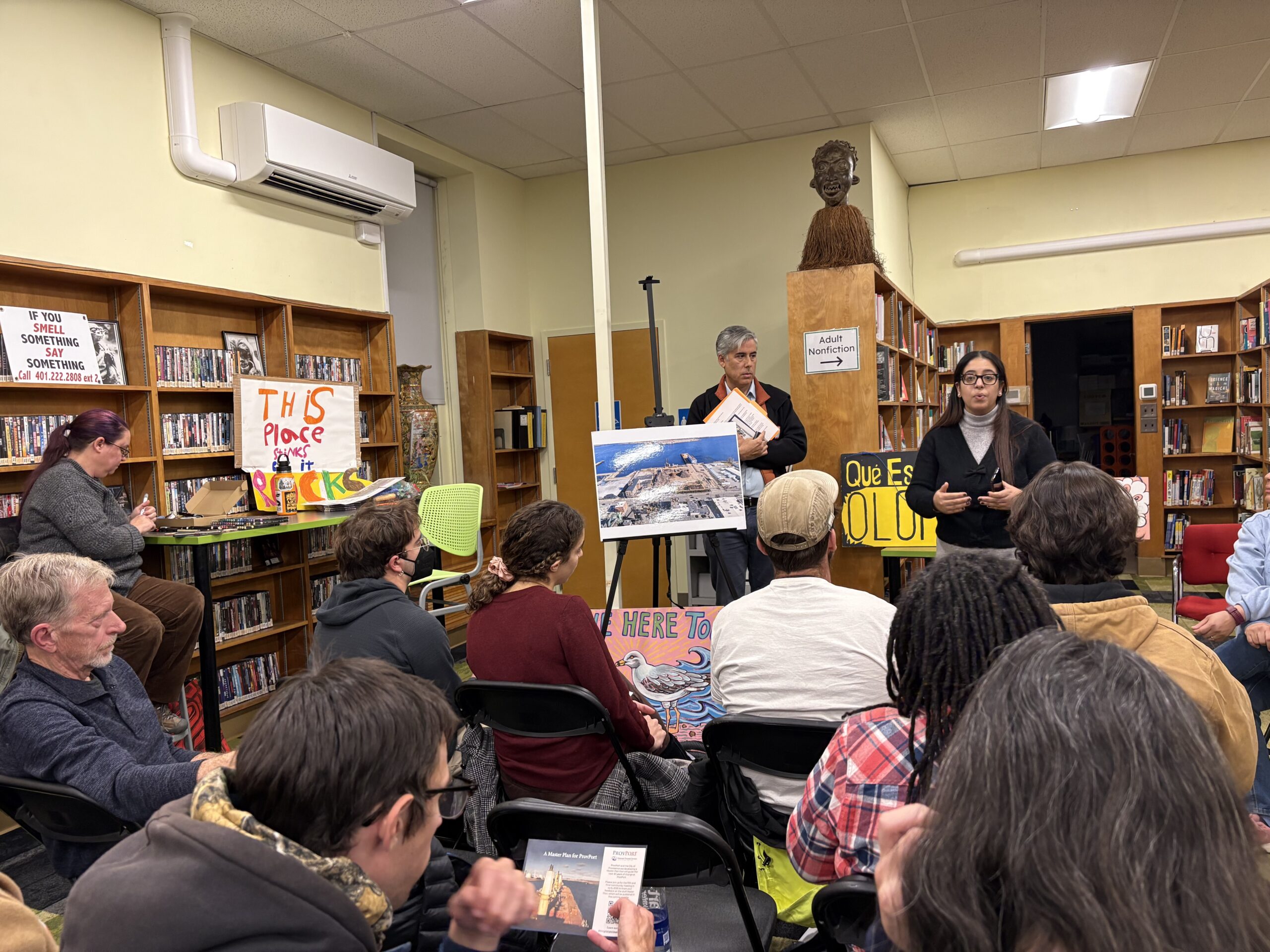
PROVIDENCE — There weren’t enough chairs in the Washington Park Library on Nov. 24 to accommodate all of the residents who crowded into the building to hear updates on the Port of Providence from the People’s Port Authority. Against a backdrop of handmade signs painted with slogans about environmental justice, representatives from the Providence Department of Sustainability, Planning Department, and Department of Public Works answered questions from community members about the port and Public Street waterfront access.
ProvPort Community Benefit Fund used without community input
Since the summer of 2024, members of the South Providence and Washington Park communities have been attending meetings to discuss what they would like to see in the forthcoming ProvPort Master Plan. ProvPort is the nonprofit organization that manages the Port of Providence, one of only two deep-water ports in all of New England.
Nine percent of ProvPort’s total annual revenue is paid back to city government, including 2% earmarked specifically for community benefits in Wards 10 and 11. That 2% is split between two different funds — the Sustainability Benefit Fund, managed by the Providence Department of Sustainability, and the Community Benefit Fund, overseen by the Providence Parks Department. Each fund receives roughly $125,000, and both funds are an acknowledgement of the public health and quality-of-life issues that affect nearby residents as a result of ProvPort’s business.
In theory, the ProvPort Master plan dictates the disbursement of money from both of these funds. As the master planning process is still unfolding, those accounts have been accumulating value since 2023.
“Or so we thought,” Monica Huertas, executive director of the People’s Port Authority, said at the meeting. “Until The Providence Eye did an investigation and found out that actually, the money has been spent already.”
The Providence Eye reported in mid-November that around $250,000 of the Community Benefit Fund, allegedly under the guidance of the Parks Department Board of Commissioners, went toward improvements at Richardson Street Park and Pearl Street Park without any community input.
“We’ve been working hard to make sure that there’s a process behind [the fund], and now to find out it was used without nobody — no community input whatsoever — after it was attached to this plan,” Huertas said. “It’s a slap in the face to say the very least.”
The Eye also reported that the council member for Ward 10, Pedro Espinal, had no knowledge that the funds were used. Espinal did not attend the Nov. 24 meeting, nor did Ward 11 council member Mary Kay Harris.
Huertas invited Manuel Cordero from CIVIC, the firm tasked with doing community engagement for the ProvPort Master Plan, to explain how this had happened. Cordero is also on the board of the Providence Redevelopment Agency. He didn’t have many answers.
“I don’t know [if] I can shed too much light,” he said.
Cordero and the city’s director of sustainability, Priscilla De La Cruz, spoke to plans for the other fund, which has yet to be touched. She explained that the Department of Sustainability plans to manage its fund through consultation with the Sustainability Commission and continued community engagement. After several months of listening to the community, De La Cruz shared that her office felt they had a good idea of what people would like to see and will be issuing a request for proposals shortly after the ProvPort Master Plan is approved, likely in early 2026.
“Sustainability always shows up,” Edwige Charlot, a South Providence resident, said during the meeting. Charlot is also one of the stewards of the South Providence People’s Archive, a project funded through the Providence Commemoration Lab. “You all are showing up and are at the table and listening to what we are saying. It’s the folks who are not currently in this meeting that need to be listening.”
Cordero said he got in contact with the Parks Department after learning it had spent a portion of its fund, and expressed a willingness to establish a process similar to the Department of Sustainability. However, no one from the Parks Department attended the latest meeting.
Linda Perri, president of the Washington Park Association and ProvPort Advisory Committee member, pointed out that the ordinance that designates the Sustainability Benefit Fund and Community Benefit Fund be disbursed to the community should be rewritten.
“If we change the basic structure of that 1% Community Benefit Fund to a more democratic process, we need to go back and change the ordinance in writing,” Perri said. “[The Parks Department Board of Commissioners] did it because they could. Because it was in writing that they were entitled to it.”
ProvPort Master Plan draft coming
After almost a year and a half of meetings with community members, local businesses, and city departments, the ProvPort Master Plan is coming soon. Cordero said the fifth and final community meeting on the plan will be in late January. Organizers for the People’s Port Authority have requested that the full draft of the master plan be made available a month in advance, so community members can consider any changes they’d like to see beforehand. Cordero said the team at CIVIC would do their best to accommodate the request.
“We’re getting close to the end and really starting to think about implementation,” he said. He asked that community members come to the January meeting with specific, actionable steps for his team to consider.
Ron Crosson, a Ward 11 resident and ProvPort Advisory Committee member, said it would be helpful for Cordero’s team to summarize all the improvement projects the community has proposed. Then, CIVIC’s team could determine which projects could be funded via means other than the Community Benefit Funds, such as through capital improvement grants or community block grants. That way, the community can better recognize which projects should be a priority for using ProvPort money.
Perri mentioned that CIVIC had discussed creating some kind of community advisory board to help oversee the Community Benefit Fund. She recommended that everyone put together a list of names for who should serve on that board before the final master plan meeting.
Public Street waterfront access preliminary design plans
According to the Coastal Resources Management Council, the Public Street waterfront access point is one of only four designated right-of-way access points in the entire city of Providence — and the only access point on the South Side. (The others are all on the East Side.) However, situated between two brownfields, a tire warehouse, and a metal recycling facility, the small gravel strip is not particularly welcoming to the public.
Since the Public Street access point was officially designated in 2021, community members have been working with the Providence Sustainability Department to make the area more welcoming. Kevin Proft, deputy director of the department, summarized what his office has heard from the community over the past three years and presented a few preliminary designs for a new pedestrian walkway.
“The idea is to create a streetscape that separates trucks from pedestrians [and] from green space or green infrastructure,” Proft said. “If you’ve been on Public Street now, you know there’s not really any natural environment to speak of.”
The design shows vehicle access ending about two-thirds of the way to the water. Then the pedestrian walkway, lined on both sides of the street with trees, widens.
Proft explained that his office had investigated constructing a small dock, as some residents use the access point for fishing. However, he said a dock would ultimately be too expensive.
So far, the city has invested about $100,000 and utilized a $125,000 Narragansett Bay Estuary Program grant into the design phase of the project. Construction will be funded through a $1 million Rhode Island Infrastructure Bank grant and a $481,750 Watershed Implementation Grant from the Environmental Protection Agency’s Southeast New England Program. At this point, the Sustainability Department is not planning to use any of the ProvPort Sustainability Benefit Fund for the project, though Proft said it could be an option if the community was interested.
With the final design being developed over the next few months, he said the project should wrap up sometime in late 2026 or early 2027.
Concerns about Sims Metal expansion
While community members were receptive to the design for Public Street, many remained concerned about whether the abutting property owners would continue to use that road for business. In particular, residents said they did not like the idea of trucks from Sims Metal — which owns two of the neighboring parcels on the south side of the street and may purchase a third on Public Street — swinging out of their facility so close to a pedestrian walkway.
Currently, trucks from Sims Metal use the company’s entrance on Allen’s Avenue. However, at the meeting Mulligan confirmed that the business is planning on reconfiguring the campus to more effectively utilize the land. Should it purchase the third parcel, community members worried that Sims would switch the entrance to Public Street, right across from the walkway and waterfront access point that has been in the works since 2022.
“I spent a long afternoon down there this summer … [the trucks] swing wide — all the way toward the abutting tire barn,” said Rachel Maeve, a South Providence resident. “I’ve got kids. I don’t want her even going from the car where I’ve parked down to the water with these huge trucks swinging in and out.”
Residents wanted to know if there was a way to prevent heavy industrial vehicles from using the road. Mulligan said the road is public, and any vehicle can use it as needed.
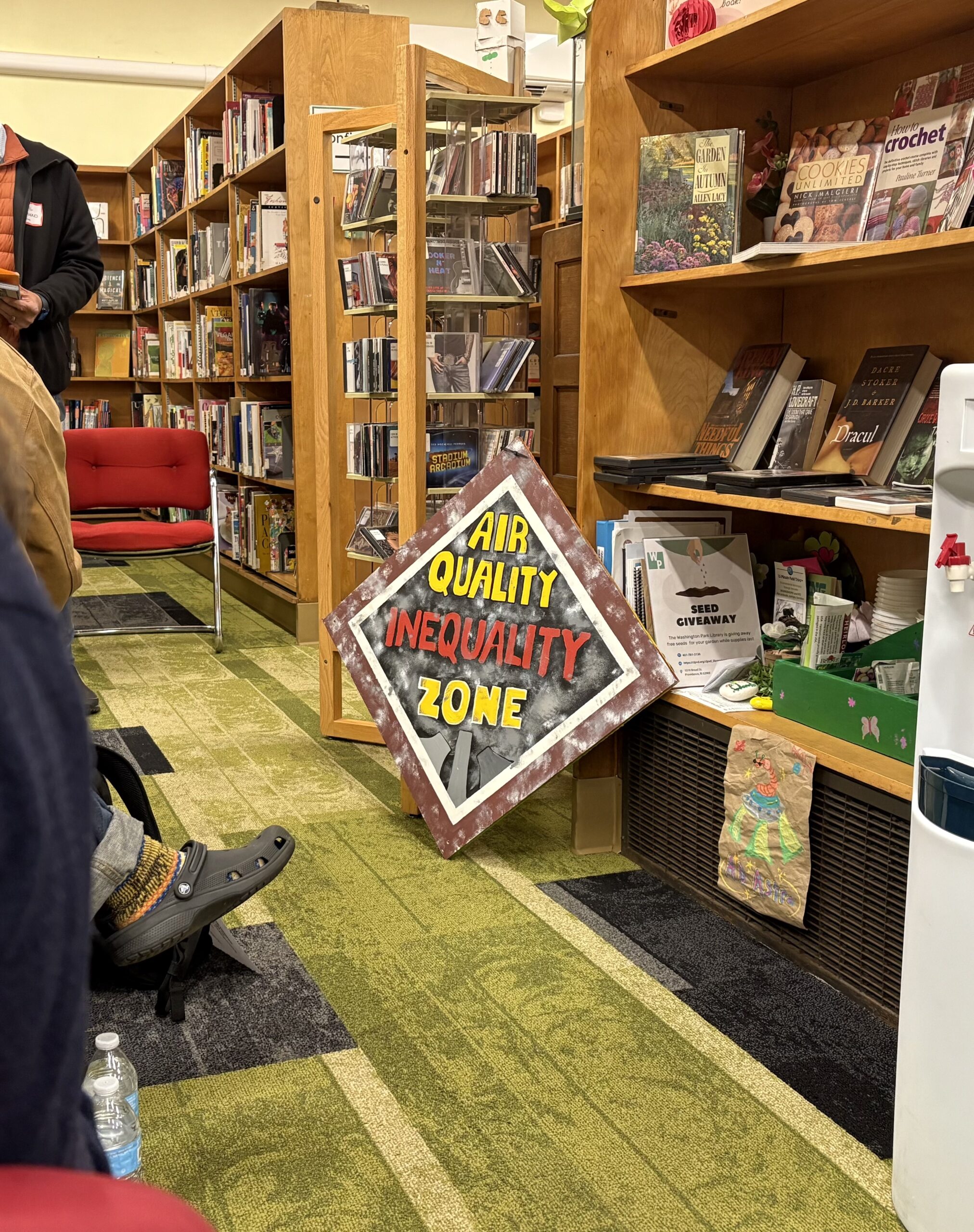
“My daughter was hospitalized because of asthma complications,” one Public Street resident shared. “You’re talking about a potential of increasing smog, pollutant-producing vehicles, heavy-duty vehicles, right next to a pedestrian right-of-way. That just doesn’t make sense as a public health [and] safety concern.”
Perri brought up going through the Ordinance Committee to put a weight limit on the road, preventing large industrial vehicles from using it. Another resident said that from his perspective, the city’s new Comprehensive Plan should prevent Sims Metal from using Public Street as an entrance for heavy industrial vehicles, due to provisions about the preservation of green space.
The mysterious oily pipe investigation continues
Months ago, community members utilizing the access point noticed an oily sheen on the surface of the water after it drained from a pipe at the end of Public Street. One resident asked for an update on the investigation, though Proft was not able to provide many details.
“There’s known to be oil in the soil and groundwater on either side [of Public Street] that lingers even though they’ve been capped and it’s safe to be on top of them now,” Proft said. “We’re trying to figure out where the oil is getting into that pipe so we can address that.”
Edwige Charlot asked who was conducting the investigation. Proft said that while the Rhode Island Department of Environmental Management has the authority to decide who is responsible for polluting the pipe, the actual field samples are collected and tested by Rhode Island Energy, which also owns the parcel where the pipe is located.
“So it’s a self-reported investigation?” Charlot asked.
“They monitor their own brownfield site, that’s right. And they report that up to DEM,” Proft said.