
Don’t Let Perfect be the Enemy of Good: Why We Need Offshore Wind Now
August 25, 2025
Share


In a recent opinion piece, Michael Lombardi suggested that we abandon offshore wind because it has downsides and is not perfect. But if you’re waiting for perfection in the realm of electricity production, you’re going to be waiting forever. Meanwhile, our failure to address climate change caused by CO2 emissions from fossil fuel dependence drives more violent storms, cataclysmic wildfires, and destruction of marine ecosystems from rapidly warming oceans.
We have a choice: We can act to do something, though imperfect, or wait while the problem gets worse.
Every source of electricity technology has downsides. Our task is not to wait for perfection – it is to find the best combined technologies available right now that can deliver reliable energy without the environmental damages of fossil fuel combustion.
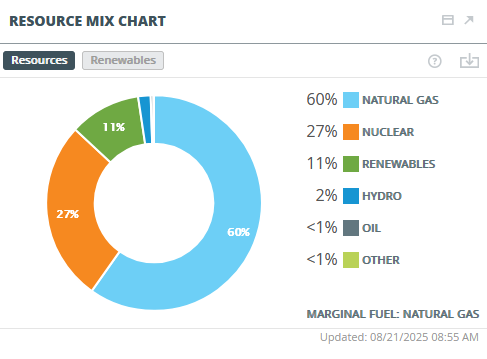
Investing in renewables, both wind and solar, offers our best approach to reducing our dependence on natural gas generation. These graphs from ISO-NE, (the grid management operator for New England) show why. The first graph shows the energy sources on the grid this morning and how much we rely on natural gas energy. You can also see that the existing New England nuclear plants, which don’t typically vary their output, provide a steady supply of baseload energy. Renewables rank third these times.
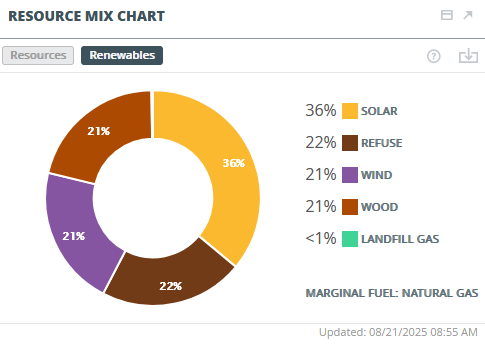
The second graph shows the breakdown of renewables in our current energy mix. Although solar provides considerably more power than wind, almost all of the wind production is from land-based turbines. When all of Vineyard Wind and Revolution Wind turbines are on-grid next year, wind production will likely surpass solar during daytime hours, including the “phantom” supply hidden behind rooftop solar meters. This will increase our overall renewable percentage on the grid and thereby decrease our reliance on natural gas sources. Over days and over seasons, offshore wind and solar balance each other well since wind is more effective at night and in the winter when solar is least effective.
The combination of offshore wind and solar is key to a healthy planet since, even adjusting for offshore wind project construction, it will produce a very small fraction of the greenhouse gases produced by alternatively burning fossil fuels and involve none of the environmental risks like methane leaks and the disasters we have already endured with drilling for and shipping oil.
Michael Lombardi did not mention alternate energy sources to reduce dependence on fossil fuel generation. Some opponents of offshore wind suggest that nuclear energy is the answer. At present, the two Millstone plants in Connecticut and the Seabrook plant in New Hampshire provide baseload supply.
However, building plants similar to the existing ones would take more than a decade, as would building the SMR (small modular reactor) nuclear plants that many see as a future. Neither option is a realistic option in the near-term, and in both cases, there is still no plan for disposing of radioactive waste.
This is no time to let the naysayers distract us from the urgent task at hand. Every month and year we fail to take action to slow climate change, the storms grow more violent, the wildfires more destructive, and our oceans ecosystems more vulnerable.
It’s true that offshore wind is not perfect, but paired with solar it is far better than the available alternatives. Both are ready now. Saying no to one is not environmentally responsible.
Tom Clemow is a retired scientist and engineer. Bill Ibelle is a freelance journalist and author of “Into the Inferno.“
Categories
Join the Discussion
View CommentsRecent Comments
Leave a Reply


Your support keeps our reporters on the environmental beat.
Reader support is at the core of our nonprofit news model. Together, we can keep the environment in the headlines.
That’s actually not what I said – to abandon wi d because it’s imperfect. I’m saying to abandon heavy industrial activity off of the New England coast because it’s inherently damaging and a major setback in preserving and protecting the environment, opening a can of worms like never seen before.
We don’t have an energy production problem, we have a consumption problem which used to be the focus of environmental concern and activism. Now the same ‘environmentalists’ believe industry will save them.
Shut off your lights and stop posting garbage at 0.015g CO2 per post. Just making things worse.
The US and the rest of the nations have a significant CO2 emissions problem caused by a dependence on fossil fuel energy. Turning off lights or even switching to LEDs is an ineffective solution to the scale of the global energy use problem. Transitioning to renewables for electricity generation technologies, despite their limited downsides, is the lowest hanging fruit to get off fossil fuels. Their use for transportation and building heating segments are tougher nuts but they heat and acidify the oceans too. It is urgent to start with renewables on the grid. Conservation has been advocated for decades and it is not resulting in the needed change. Do you have another solution that we can begin to implement right now?
As a self-proclaimed environmental advocate for many decades now, I find it disingenuous of anti-renewable energy folks to fret about “heavy industrial activity” off our coast yet not worry about the pipelines and tanker trucks travelling through our fragile ocean ecosystems.
With offshore wind, Rhode Island has an opportunity to produce clean, renewable energy locally that does not, like oil and gas, contribute to warming waters or acidification. It also creates union construction jobs in the process, and boosts our economy so we don’t have to send $4 billion to out of state oil and gas suppliers each year.
Offshore wind projects go through years and years of permitting. Public comment periods are long and thorough. But here in Rhode Island, that long, fair process was disappointing to some, so they decry it as unfair.
As I witness the evolution of the anti-offshore wind campaigns in Rhode Island and elsewhere, I see how desperately people try to convert feelings and speculation—often wild speculation—into facts, and I have how misinformation circulates online. I have also sat through hours and hours of testimonies where opponents of offshore wind misquote government officials, claim that something that happened over 10 years’ time occurred in one year, and in one case, say that settled science about rising global temperatures can be overturned because brick buildings and sidewalks do… something. I have learned to live fact-check every anti-OSW statement, and when I do, the claims just don’t check out, because outrage, feelings and false correlations are at the center of this spectacle. Torrents of data are used to flood the zone of attention. Folks can’t say things simply because if they were to do so, people would understand the argument is a house of cards.
At one hearing, I sat behind two people who were opposed to offshore wind. At the close of the hearing, I asked them what brought them there. Someone from their town was holding misinformation sessions at her house, and she had told them all sorts of alarming stories, and then invited them to the hearing. These two people were kind and interested in preserving their community. They said that we needed some kind of renewable energy, but they weren’t sure what it should be, and they just didn’t feel right about the turbines after what they’d heard. Living by the water felt different to them now, because of course it is different. Climate change from burning fossil fuels means waters have warmed and now we see in the news that we need to watch out for a Vibrio vulnificus bacteria in Buzzards Bay. Fish stocks that used to flourish in Rhode Island waters are moving north. The ocean is more acidic, threatening shellfish. Climate change is affecting the feeding grounds of whales. To solve this, we don’t need to delay sound projects or double-down on fossil fuels. I agree with Michael Lombardi on one thing – energy overconsumption is a problem. But in an era where the Trump Administration is rolling back commonsense efficiency standards and keeping dirty, expensive coal plants alive, energy conservation alone won’t be enough. We need clean energy. We need offshore wind.
Yes – the solution is to properly site new energy facilities in proximity to existing industrial areas zoned for such activity, as is consistent with environmental law, including the CZMA which has been leveraged to review offshore wind. This approach limits the industrial sprawl that comes with all development. There is no good reason, nor justification, to site energy facilities across millions of acres of continental shelf. Those areas are far more valuable left untouched to allow science to fully understand their role in our global ecosystem.
Turbines can be planted within existing industrial corridors, at landfills, across existing superfund or brownfield sites, and between and among existing oil and gas platforms – all areas already impacted by human greed and consumerism.
Rhode Islanders have been duped by an ideological and picturesque view of clean turbines reaching out from the deep blue sea. It’s all BS, and a significant disservice to our community.
Michael: As co-author of the above article, I agree with your assertion that we have an energy consumption problem. While we should continue to fight to reduce consumption, I think it’s fair to say that genie is never going back in the bottle. We need to find clean ways to produce energy and wind is one that’s readily available. As for industrialization, we don’t seem to have much problem as a society sticking heavily polluting fossil fuel plants out of our sight in poor neighborhoods, but when a windmill pops up on the edge of the horizon in our lovely coastal view we throw a fit. All energy production is industrialization, whether it’s within our view or not.
Putting all of our marbles into new nuclear power – none of which will come on line for more than 10 years (if ever) is a recipe for disaster. No communities have stepped up to offer to host them, and no active interest group is promoting them to actual communities.
It could be great – if it ever happened, and was truly clean. But if you want to promote nuclear – please bring to the table a community that will have it. Otherwise- you’re just hoping.
We need to base our answers on the reasonably possible and foreseeable – and nuclear is neither.
Stopping our other efforts now – and hoping that the pipe dream of nuclear will somehow save us twenty years from now is not a responsible answer to our climate crisis.
You are both making the very point of my article – you are willing to concede the environment because industry fed you a solution that, at face value, looks green. It is not.
I don’t care about the view on the horizon (well, I do but not for aesthetic reasons). I care about the millions of acres of materially altered marine habitat that will now never be the same, and having altered it without knowing what’s been compromised, nor how the change to the system will impact us long term – that’s why we do science, but it’s science that has been omitted here in a very big way, despite having capabilities to do so. If you look at the port of Providence you will see industry and a cornucopia of environmental issues stemming from the Industrial Revolution. Why should we extend that out into open ocean?
Wind turbines can be sited adjacent to existing industrial facilities, at landfills, within transmission corridors, at superfund sites and brownfields, and across very windy mountain ridges. All places where they can be more cost effectively serviced than 30 miles offshore. All the reasons why people might not like that concept (which is actually the law) is precisely why they don’t belong offshore where the problems are hidden from plain sight.
Another 0.015 g CO2 wasted
…. And before someone comes back with ‘we need to reduce emissions’ as the reason for offshore wind….
Offshore wind has existed, at scale, across Europe and elsewhere for decades. Global emissions have not reduced. They’ve gone up. They’ve gone up because we have a consumption problem. Intermittent wind energy will never catch this up. It’s very basic physics.
The US produces 20% of its energy via an existing 50+ nuclear facilities. This isn’t anything new. It works, has not been cause for any radiation based fatalities, and can be scaled very efficiently with massive power output. If you’re conceding to consumerism, it’s the only way.
The notion that each state has to meet an arbitrary goal is the problem. The best thing RI can do is shut off their lights. We do not have the space for anything on land, and shouldn’t be sacrificing our greatest asset – the ocean. It gives us far more than a place to plant turbines.
Hurrah for renewable energies like wind, solar, geothermal, hydrogen, etc. which may all be employed to help wean us off the finite and polluting fossil fuels. We have the answers to climate change! We are so lucky to have these non-pollutive choices…majorly, the sun! We can save our planet by switching to renewable energies! Let’s do it for the love of our children and grandchildren! The cleaner technologies have advanced and we ignore these gifts at our children’s peril! Putting windmills off the coast, also, creates harbors for more ocean creatures, as we have seen. Windmills are a win-win for the environment! Fish don’t like the heated waters from climate change, either! Go wind and other renewable energies! Huzzah!
Do the fish like the hot chlorinated discharged at the offshore substations that by design kills a variety of organisms? (Yes, that’s a real thing, thank you EPA).
Another 0.015 g CO2 wasted.
Thank you, Michael Lombardi for speaking the truth, You are an expert in your field with first-hand knowledge and no agenda, other than your true environmentalist’s perspective.
Michael, I trust you are aware that the three nuclear plants that power the New England baseload supply suck in nearly three million gallons per minute or 72 million gallons per day for cooling. Agreed, cooling offshore substation is a downside of offshore wind but offshore substations will heat a tiny fraction of that. Also consider one large container ship uses about a half million gallons per day to cool its engines, which is roughly comparable to the volume that a substation would use. Offshore substations are 1-2 percent efficient in converting AC from the turbines to DC. Nuclear plants and diesel engines produce about 70 percent as heat waste. Offshore renewables are highly favorable in heat energy comparison. It is the time to urgently transition off fossil fuels for the favorable physics of renewables.
Modern reactor technology eliminates the thermal discharge. I am not against renewables – I am against turning the continental shelf into a construction site. It isn’t necessary with proper siting that follows the law.
“Uh, arithmetic error. 3 million gallons per minute from regional nuclear plants x60 x24 is 4 billion gallons per day. Here’s a little more relevant science on efficiencies of electricity generation: AC to DC conversion wastes 1-2 percent energy and it will be dissipated with some environment consequences at offshore substations. It is drops in the ocean compared to nuclear plant heating. And ships like containers emit 70 percent of fuel energy as heat also warming the ocean. Similar to nuclear and ship inefficiencies, consider that the most efficient natural gas generation plants emit 40 percent of the chemical energy as heat not electricity. Worse, the exhaust is water vapor and CO2, the major gas forcing planetary warming. Moving to renewables as quickly as possible is the only way to avoid continuing to heat the oceans. I concur with Michael’s encouragement for maximizing terrestrial renewables. However, there aren’t enough brownfields or suitable sites for solar and land based turbines in RI to markedly reduce natural gas use to power the grid. To achieve Act on Climate and 100 percent renewable mandates, offshore wind must be part of the the mix. Lastly on conservation, the OBBBA will end all energy conservation tax credits and solar tax credits on December 31, 2025. The administration does not care about conservation. That’s why they are also trying to end the Energy Star program.”
SMR designs will emit most of the nuclear energy as heat just like the ocean cooled ones. The difference is it is dissipated to the atmosphere. The new Vogtle plants dissipate to the atmosphere with the assistance of water cooled towers.
You are correct – very few care about conservation. The needle only moves when there are dollars to be had. Industrial sprawl and conservation do not belong in the same sentence. Fear has been incited for decades, leaving an opportunity to profit on alleged solutions.
Shut the lights off, and consider this another 0.015 g CO2 contributed to the crisis, with no resolution. Ri Is not going to solve global emissions issues, certainly not with offshore wind. Shut the faucet at the source – greed and consumerism. Out.
Advocating for reduced energy use is not helpful or realistic. Energy use provides value. Sure there are gains to be made through technological efficiency measures, but when they come with tradeoffs there is little appetite for them.
Also, it is exactly the playbook that Brown is fairly calling out to set up nonsense strawmen like “Offshore wind has existed, at scale, across Europe and elsewhere for decades. Global emissions have not reduced.” Why would actions in Europe be expected to offset the entire globe’s emissions?
Emissions per energy unit of power generation produced in Europe have gone down 60% since 1990 (https://www.eea.europa.eu/en/analysis/indicators/greenhouse-gas-emission-intensity-of-1) and net greenhouse gas emissions have dropped by 30% (https://www.eea.europa.eu/en/analysis/indicators/total-greenhouse-gas-emission-trends). Over that period renewables increased 143% while fossil fuels and nuclear sources in the EU generation mix have contracted by 28% and 33% respectively (https://www.eea.europa.eu/en/analysis/publications/renewables-electrification-and-flexibility-for-a-competitive-eu-energy-system).
I have yet to see a single argument Michael Lombardi has produced across several opeds and associated comments here that has much support in reality or good faith engagement with the facts.
And exactly how much energy consumption can the planet handle? We have been over carrying capacity for some time, and it will not be fixed with more of different, only less.
Energy is not free. If the world’s energy resources were balled up and squeezed, a concession will pop out in any given direction. Shift your grip, it’s a different concession – but with laws of physics applied it’s an equal but opposite reaction. So while CO2 emissions may reduce as some small relative piece of the big pie, you are sacrificing habitat and promoting biodiversity loss with the move offshore. Yes, it’s an offshore oil/gas platform problem as well – and this was the genesis of OCSLA, NEPA, the CZMA, and others. IF protecting the planet is the objective, then we should be following the spirit of these laws and not promoting additional sprawl, for any purpose. That’s what the law is designed to prevent, and by design limits development to areas adjacent to existing development.
Proper siting is everything. The problems created here on land, by our consumer habits, need to be fixed on land. Sending them to sea is a recipe for disaster – that much I know for certain. It’s where I live, work, and play every single day.
And while I appreciate RGs continued commentary, his hot air only adds 0.015 g CO2 per post, as did this one, and solves nothing. Just leave the ocean alone. It’s worth far more to all of us than a construction site.
We need all the renewables available. And those now in the works. We already know that fossil fuels are detrimental to the Earth’s health and thus to ours!
Michael Lombardi wants to close out these comments. Enough expressed and I also want that. For that purpose and in the constructive interest of saving the biodiversity and health of the oceans, I will sign off with a quote from a retired oceanographer that I’ve known for the better part of a decade, “Would it not be more beneficial to all if we worked together to discuss how we can stop global heating and its associated harms and costs? The warming and its associated perils will continue to worsen until we reduce the flow of greenhouse gases. No one wants that. Can we all work together to create a better world instead of a more angry world”?
Michael you are once again knit picking the negatives and shielding the positives of offshore wind, while simultaneously promoting siting ideologies that are impossible to abide by. Suggesting that developers turn their backs on the countless surveys, studies and permits (each to the tune of millions of dollars) for proven technology is borderline incompetent.
Moreover, your recommendations to site projects in pre-disturbed areas sounds logical, but if you review siting regulations from any agency website (EFSB, EPA, BLM, FAA) you’re suggestions are unequivocally wrong. Building turbines in a transmission ROW? That is not only illegal, it’s impractical and limits opportunities for transmission developers to upgrade their out of date assets (Moving energy from high generation areas to high demand areas is just as important as generation itself).
And finally, lets all grow up about energy consumption. Turning off the lights may save you money on your monthly electric bill, but the residential demand of energy is not our energy consumption problem. It’s the massive corporations, AI data centers and fossil explorations from Oil and Gas conglomerates (which I love, because I am Donald J Trump, First King of the USA.)