
Deconstruction & Salvage: When Historic Buildings Come Down, Can the Materials Find New Life?
March 31, 2025
Share


Note: This story was originally published by the Providence Preservation Society, a nonprofit historic preservation organization.
Not all historic buildings can be saved.
It’s an unfortunate truth in the preservation business. Sometimes, buildings that have been left vacant for decades or have suffered significant damage from flooding or fire may be beyond rescue, while other times, historic building owners make decisions to demolish to build differently. Depending on the circumstances, preservationists may oppose a demolition or may see it as inevitable.
But when a building has to come down, how should it come down?
There have been some high-profile demolitions in Providence over the past few years — to the dismay of preservationists and some local residents — sparking a conversation about demolition delay ordinances and the extent to which the public should be informed when a privately owned building is demolished. But so far, there has been little public conversation about building deconstruction — the process of manually taking buildings down piece by piece — as a way to preserve and reuse significant elements of historic buildings, while decreasing the pressure on landfills.
When it comes to deconstruction and salvaging materials, San Antonio is leading the way. Residential buildings and accessory structures built before 1946 — and homes in historic districts or that are designated local historic landmarks built before 1961 — must be manually deconstructed piece by piece, so the parts can be salvaged and reused in other buildings.
“We’re trying to operate an organ donor mentality,” said Stephanie Phillips, senior deconstruction and circular economy program manager for San Antonio’s Office of Historic Preservation. “A house may reach the end of its life, but its parts and pieces can help sustain the lives of other houses to prevent demotion in the first place.”
San Antonio’s deconstruction ordinance officially went into effect in 2022, but the Texas city has been working in this field for roughly eight years now.
San Antonio has created a local ecosystem of contractors who work on these deconstruction projects, most of whom are certified by the city’s training programs with the Living Heritage Trades Academy, launched in 2018. The salvaged materials may go to local contractors, the city-run Material Innovation Center, or individuals working on renovation projects for reuse.
“We’re diverting waste from the landfill, but that’s actually not the main driver for it,” Phillips said. “It’s more rooted in historic preservation, like neighborhood continuity, mitigating the public health disparities with demolition. The waste diversion is actually just a co-benefit.”
Around the world, construction and demolition waste comprises roughly a third of all waste going to landfills. It is estimated that more than 75% of waste “generated by the construction industry has a residual value and is not currently reused nor recycled.”
Since the San Antonio ordinance officially went into effect three years ago, 112 homes and hundreds of tons of waste have been diverted from landfills. Other cities including Portland, Pittsburgh, Boise, San Jose, and Palo Alto have implemented deconstruction ordinances to divert construction waste from landfills and promote the reuse of these materials.
In Providence, deconstruction happens — but more by chance than by intentional policymaking.
Casa Buena Builders is doing a partial deconstruction in a three-story, multi-family house on River Avenue in Elmhurst. The home is slated for renovation, and as a result, everything with lead paint needs to be removed and replaced.
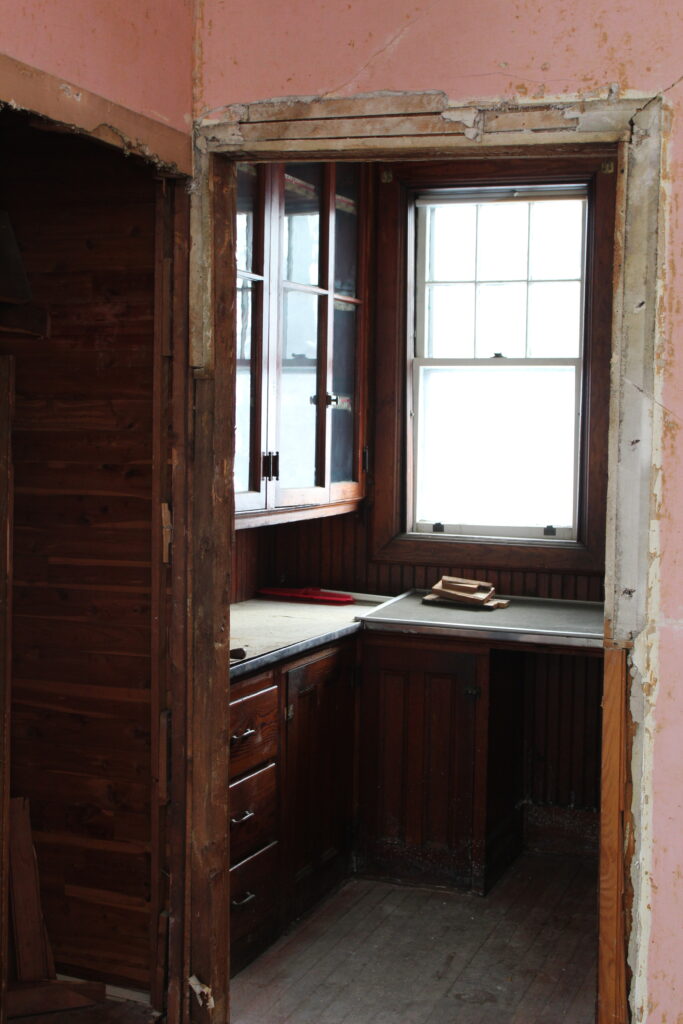
Casa Buena’s team of contractors is pulling up floors, exposing hardwood that had been covered by tiles for decades. Baseboards, painted cabinetry, and, eventually, all of the original wooden windows will be removed from the building. Some of those materials, such as the wooden panels, mantel pieces, and doorways, could be remediated (made lead-safe, not lead-free) and reused in other projects, Noel Sanchez, founder and president of Casa Buena Builders, explained.
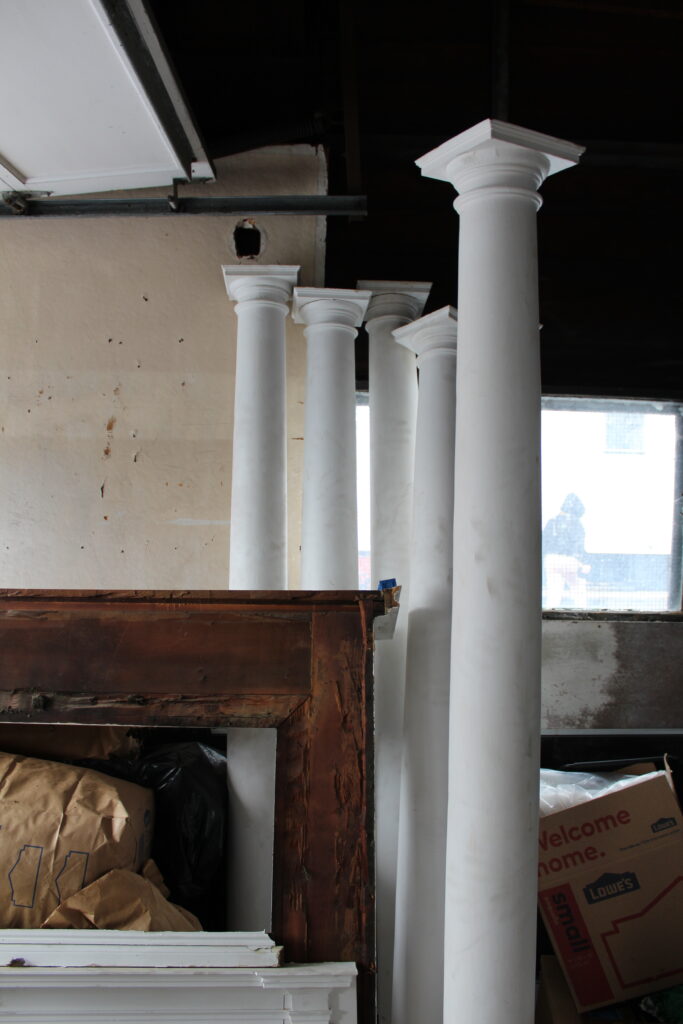
The garage on the house’s lot was full of doors, wood, columns, sinks, and other appliances that were removed from the building.
The windows all have to go to the landfill, as do the remaining lumber and details that cannot be conveniently used in an upcoming project.
Deconstruction and salvage currently happen in Providence on an ad hoc basis. The Providence Revolving Fund (PRF) has a salvage room that you can visit (by appointment) to browse the doorknobs, mantel pieces, doors, and shutters — endless shutters, according to Carrie Zaslow, PRF’s executive director.
Sometimes institutions like Brown University call the PRF if they are taking down historic buildings, allowing them to come in and pick out the materials and details they can remove and reuse.
When some of the buildings in Eagle Square were demolished in 2002, “the demolition produced a total of 59,701 tons of waste, of which only 349 tons (less than 1%) went to landfill. Old factory buildings were typically constructed in a way that is ideal for reclamation,” according to ArtInRuins. “The buildings were full of old-growth yellow pine. The timbers in this project were milled into flooring, the bricks that were in good shape for resale were sold, and the rest were crushed for on-site fill.”
Some of that flooring was reused in the Monohasset Mills.
San Antonio’s deconstruction program, according to Phillips, addresses the issue of environmental impact, waste diversion, and circularity. It also incorporates workforce development and is deeply rooted in history and an ethic of preservation. Deconstruction also minimizes public health hazards that mechanical demolition can incur, such as lead clouds or the spread of asbestos into the air.
Federal requirements only necessitate asbestos abatement for commercial demolitions, but not residential ones. Some places (like Rhode Island) have state or local requirements so all buildings have to be abated prior to demolition. But in San Antonio, residential buildings don’t need to be abated before they’re mechanically demolished since it is not federally mandated. Deconstruction makes it much safer to deal with these hazards.
Deconstruction, however, can be more labor-intensive and time-consuming. Some of that investment can be recouped by reselling the salvaged materials, which depends on sufficient demand for refurbished items, and by claiming a tax credit for donated materials, which is becoming increasingly common. Without demand, salvage materials may sit unused. Some cities are starting to develop and grow hyperlocal, circular economies with their deconstruction programs. Others predominantly focus on waste diversion.
The Providence Preservation Society spoke with experts and practitioners in three different cities — Portland, San Antonio, and Savannah — about salvage, as well as the benefits and challenges of deconstruction.
Each described the multifaceted components of their deconstruction programs, from workforce development, local economies and circularity, and environmental impact to historic preservation.
Katie Fitzhugh, director of deconstruction for Re:Purpose Savannah, loves that she gets to spend every day doing fieldwork, boots on the ground. “My crew and I are in the field. We’re deconstructing historic buildings,” she said. “We’re doing the salvage ourselves, we’re doing the material management.”
The crew carefully removes and catalogs all the components of a structure, removes nails from all the boards, packages them up for easy reuse, and ultimately resells the materials.
Re:Purpose trains “women+, including women-identified, trans, non-binary, and other underrepresented people, for careers in construction,” according to its website. The firm offers deconstruction services, which include intensive documentation and research on a given structure — including property records, family trees, and even virtual tours of the spaces prior to deconstruction.
A reverence for history and respect for these buildings and the people who created and stewarded them shapes every step of the process. When Re:Purpose’s crews salvage materials, they sell to contractors and preservation companies working on historic homes, in addition to individuals working on home renovations or trying to learn new skills.
Storage can be a significant issue when it comes to salvaging building materials — but Re:Purpose has plenty of space. “Our warehouse itself is 8,000 square feet, and probably about five or six thousand square feet of that is actually rented to tenants who run their companies out of them,” Fitzhugh said. The space is called Emergent Studios, and several preservation and contracting companies work out of the business incubator.
“They all use reclaimed materials in their restorations, rehabs, and preservation projects,” Fitzhugh said. “And that’s a really cool example of a true circular economy — we take out the materials, they buy the materials, and they go back into historic homes in Savannah or any home in Savannah.”
“It just does the full loop,” she said. Savannah at present doesn’t have a deconstruction ordinance on the books, but Re:Purpose has salvaged and recycled thousands of tons of material since 2018.
Portland became the first city in the country to enact a deconstruction ordinance in 2016.
“We have several companies dedicated to deconstruction, and then we have probably twice as many that just offer it as an extra service in addition to abatement, hauling, and demolition,” said Lauren Zimmermann Onstad, a sustainable building and deconstruction specialist for Portland’s Bureau of Planning and Sustainability. “We purposely left the program pretty open for private or small businesses to step in and then figure out a niche for themselves, and that has served the program really well.”
She added that though deconstruction can be more expensive than demolition in other parts of the country, in Portland “the price is pretty comparable at this point. Because of huge competition among all the deconstruction contractors, they’ve all had to innovate in their process and how they’re reselling the materials or other things.” Now, the city is looking to expand opportunities to salvage materials.
The ordinance originally applied to residential buildings built prior to 1916. Now the city requires that any exterior surfaces from 1978 or earlier have to be manually deconstructed due to the presumed presence of lead. Zimmermann Onstad said the city is now hoping to explore commercial deconstruction in addition to enacting measures to make the reuse process as simple as possible.
“My dream is that we’re able to take houses down and make a kit of parts for an ADU [accessory dwelling unit] or something like that,” she said. Portland has one of the most ADU-friendly zoning codes in the country.
To date, the program in Portland has seen some 600 houses deconstructed and saved about 4.2 million pounds of salvaged lumber for reuse. Zimmerman Onstad noted that more than 30 jobs in deconstruction, fabrication, and retail, as well as three new salvaged material storefronts, have emerged since the program began.
Like Portland, other cities have been looking to expand their deconstruction policies to include commercial properties — Boulder, Colo., piloted the deconstruction of a hospital in 2023. Portland is currently beginning deconstruction on a historic school building that couldn’t reasonably be adapted or rehabbed.
Andrew Ellsworth, founder of Doors Unhinged in Pittsburgh, told Bloomberg that the big consideration with commercial salvage is whether there would be a reasonable way to put the deconstructed materials to use.
“The problem with commercial [deconstruction] is we don’t have adequate demand, but we have infinite supply,” Ellsworth said. “Ordinances don’t work, because you’re just putting a lot of supply out there that isn’t being used. It’s like what happened with recycling in the early ’90s. Everyone was collecting recycling and then there were literally barges driving around the world, trying to figure out where to dump stuff.”
And in Providence, Casa Buena Builders founder Noel Sanchez noted the reuse question can be especially difficult, whether residential or commercial projects are being deconstructed. Given how labor-intensive deconstruction can be compared to mechanical demolition, the finances have to align to make it feasible and sustainable.
Wayne Trissler, former senior construction manager for the Providence Revolving Fund, oversaw the nonprofit’s salvage room for many years. He explained that the PRF has a lot of columns, moldings, and handrails, in addition to smaller objects.
“Demand was primarily for doors to replace and match doors. High demand was [for] door hardware that was missing from doors,” he said. “The lowest demand was for the mantle pieces, which is kind of surprising.”
Trissler noted that in Providence especially, many older homes still have those original details.
“Everything was intact,” he said. “You don’t need to go get a door if you’ve got all the doors and hardware sitting here when you buy it by the house.”
Zaslow, the executive director of PRF, said its salvage program has subsisted mostly on donated materials, allowing it to keep costs low. But space and staffing constraints limit the scale of the program.
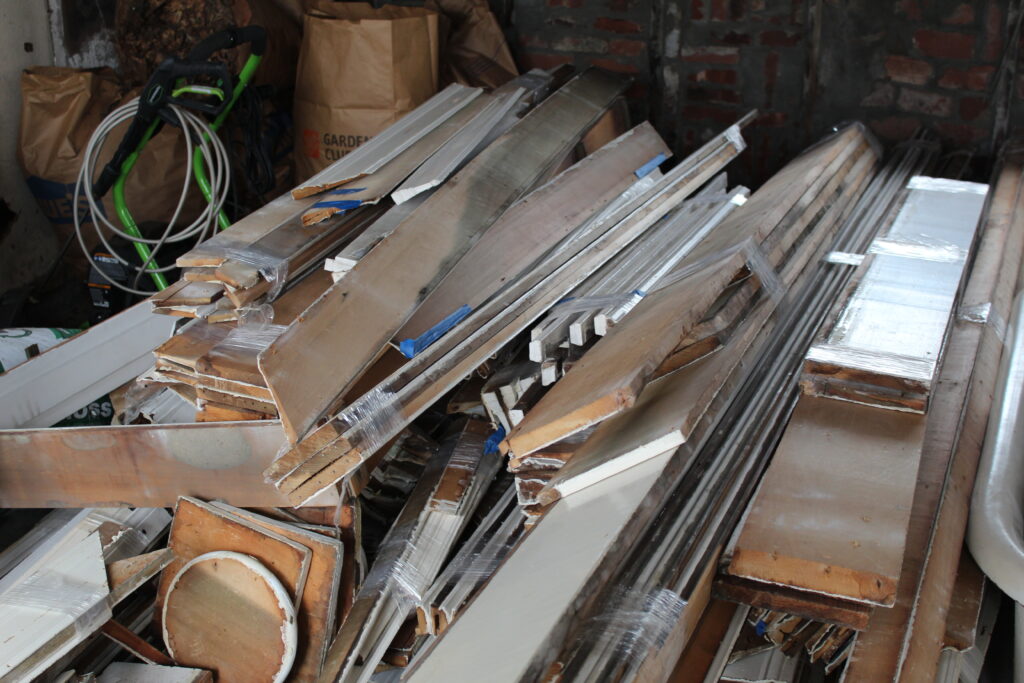
The Casa Buena crew pulled out wood boards, mouldings, and other details that will hopefully find another use at a project in South Providence, Sanchez said.
Walking through the home, we could see the traces left behind by baseboards and mouldings, and adhesive leftover from layers of wallpaper from the home’s lifetime. Sanchez pointed toward a board, formerly part of a door frame, that would need to have dozens of nails pulled out of it for safety and usability purposes.
The crew had been at it for a few weeks and would continue until the job was done. Though full-scale circular economies and deconstruction ordinances aren’t on the immediate horizon in Providence, small-scale salvage projects can make a meaningful difference in the amount of material wasted, all while continuing the lifetime of valuable historic material that can be costly to construct today.
Small projects, pilots, and studies have kick-started deconstruction programs throughout the country. Many have decided to take it back to basics and slow down the process of demolition for the environment, for historic documentation, and to foster workforce development.
Fitzhugh, of Re:Purpose Savannah, mentioned that even though deconstruction seems like a novel concept, it’s not actually so new. It’s the way buildings came down before mechanical demolition was an option.
“It’s not new,” she said. “It’s just becoming popular again.”
Katy Pickens is the planning and preservation writer for the Providence Preservation Society.



When i was a carpenter in my youth I built several buildings with materials I obtained by deconstructing other buildings. it shold be mandatory to deconstruct buildings instead of trashing them and sending them to ther landfill.
This is such an insightful piece on the importance of deconstruction in preserving historic materials and reducing waste. I love how San Antonio is leading the way by turning demolition into a thoughtful process—almost like an “organ donor” approach for buildings. It’s not just about preserving architecture; it’s about sustainability and neighborhood continuity. I hope more cities start to adopt similar strategies! The focus on mitigating public health disparities is particularly important, too. Thanks for sharing this valuable perspective!