
Cross-Country Move Leads to Epic Waste Diversion
Pawtucket couple digs Rhode Island’s composting ecosystem
April 30, 2025
Share



PROVIDENCE — Their journey, so far, has been epic, from Pawtucket to Los Angeles back to Rhode Island. They left for the City of Angels with an idea borrowed from ecoRI News and returned with a business model to help the Ocean State get out from under all its food waste.
Tess Feigenbaum and Brendan Baba co-founded Epic Renewal soon after landing in Los Angeles in late August 2016. They left three years later, but not before keeping some 23,000 pounds (11.5 tons) of L.A. food scrap from being landfilled or incinerated.
Their for-profit operation, now run out of a 3,000-square-foot space on Acorn Street, provides low-cost composting services for events, businesses, and homes. Epic Renewal also offers zero-waste consulting services, products such as vermicompost and red wiggler worms, and software that helps other composting businesses track the amount of organic matter they are keeping out of the waste stream.
“Our big focus area is zero-waste events,” Feigenbaum said. “We do a little bit of commercial and residential, but we very intentionally lean out of residential because of the density there … we’re not interested in competing with all of our friends. The events are really our fun place. They also let us reach a ton of people who otherwise might not really care about it.”
Feigenbaum and Baba are part of an unofficial composting collaborative that Michael Merner, founder of Earth Care Farm in Charlestown and godfather of Rhode Island composting, unknowingly started in the mid-1980s. For years, Earth Care Farm went at it alone.
Now, four decades later, about a dozen composting operations, including Epic Renewal, are helping Earth Care Farm take a bite out of the amount of food scrap being unnecessarily wasted.
“We had three generations of Merners at the last compost fund bill hearing,” Feigenbaum said. “It was awesome.”
The bill (H5195) would create a compost fund that would award composting and waste-diversion grants to help reduce the amount of material being sent to the getting-crowded Central Landfill in Johnston. The bill is stuck in the House Finance Committee.
“We’re pretty aware as a community ecosystem of composters,” Baba said. “We need every single solution at the table, but what we really firmly believe in is hyper local, many sites that are smaller, especially knowing we have the most expensive farmland in the country, and we want those to be farms. It’s pretty critical when we’re thinking about urban spaces and creating a resilient network that we create more sites, not just one or two big ones.”
Other members of Rhode Island’s unratified composting collaborative include Harvest Cycle Compost, Bootstrap Compost, ReMix Organics, Earth Appliance Organics, and Providence GardenWorks.
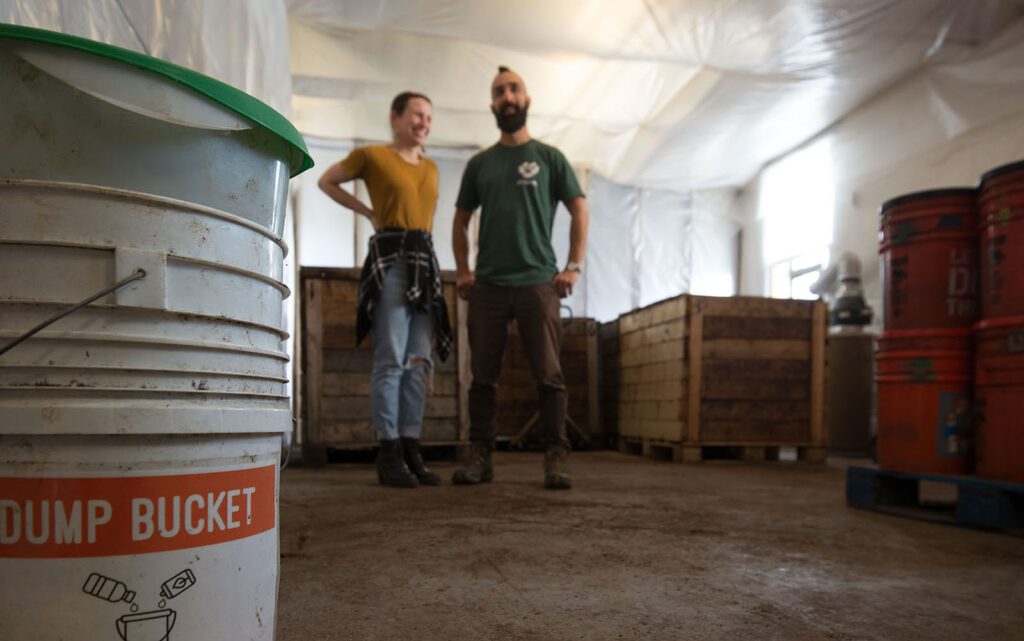
Feigenbaum, 32, graduated from the Rhode Island School of Design with a degree in industrial design. Baba, 38, graduated from the Community College of Rhode Island/the University of Rhode Island with a degree in psychology.
They got married in June 2024, at Hurricane Hill Farm in Cranston, a few days before they would have celebrated their 10th anniversary as a couple. Naturally, their wedding was a low-waste affair, as the newlyweds and their 75 guests produced just 6 pounds of landfill-bound trash.
Five months later, in November, they experienced a life- and career-changing event: they moved their composting operation from a Central Falls basement — Feigenbaum called the space “depressing” — to a roomy, industrial space in Providence’s Valley neighborhood. Epic Renewal was born in an extra bedroom in the couple’s Los Angeles apartment.
Their newish Acorn Street workspace includes room to store the operation’s 300 or so containers of various sizes, hot-composting boxes made of wood, and parking for their biodiesel-powered truck, a van, and two trailers.
Feigenbaum, a New York native, and Baba, a Connecticut native, met in Rhode Island, introduced to each other by a mutual friend. They moved to Los Angeles for Feigenbaum’s non-composting job. Baba arrived on the West Coast without work.
He found his motivation in ecoRI News’ composting operation, ecoRI Earth, which, in 2013, became Rhode Island’s first residential food scrap-collection program. It served Providence, some of Pawtucket, and a sliver of Cranston. Feigenbaum and Baba, living in an apartment on Mineral Spring Avenue in Pawtucket, were among Earth’s original clients.
(ecoRI News sold the route in 2016 to better focus its attention on journalism. The route now belongs to Bootstrap Compost.)
Baba, with help from LA Compost founder Michael Martinez, replicated something similar to ecoRI Earth. By the time the duo left Los Angeles, Epic Renewal had 200 residential and 16 commercial customers.
“Baba didn’t have work lined up, so one of the last meetings he had here was with Kevin Proft [former ecoRI News staffer and current deputy director of sustainability for the city of Providence] about what he learned doing and hauling with you guys,” Feigenbaum told ecoRI News. “And then Baba just kind of launched it … in L.A. in our second bedroom.”
(Feigenbaum doesn’t call her husband by his last name to be rude. That’s the name he prefers. Coincidentally, Baba’s Auto Body & Repair Center across the street from Epic Renewal isn’t his or a relative’s.)
When the couple isn’t collecting food scrap and other organic material and making compost with it, Feigenbaum works part-time at the Social Enterprise Greenhouse in Davol Square and Baba works full-time as a financial technology consultant. He wrote the material-tracking software Epic Renewal is sharing with other composting business for free while he works on putting the final touches on the tech.
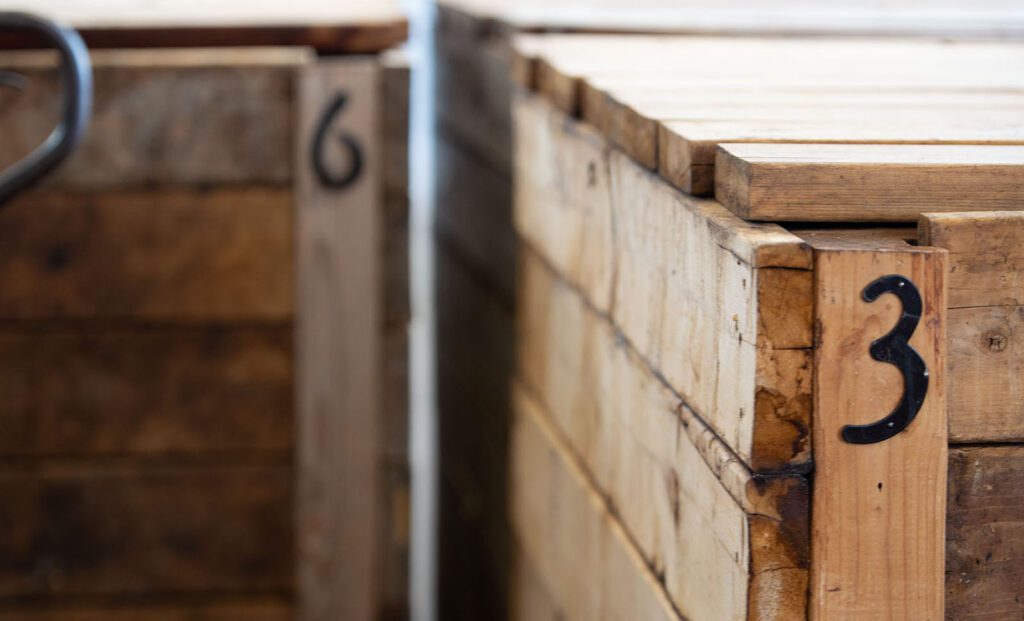
Feigenbaum explained Epic Renewal as a community-scale composting organization designed to help keep food scrap out of landfills and use the rescued material to build nutrient-rich soil. The organization also promotes and supports equitable and resilient food systems.
She noted local composting creates local jobs and reduces the industry’s hauling footprint. Epic Renewal employs five part-time workers, with plans to expand its workforce.
Epic Renewal diverts about three-quarters of a ton of organic matter monthly from the waste stream. Since 2022, the operation has diverted 35.6 tons. Feigenbaum and Baba work with offices, food service and retail businesses, gyms, cosmetic producers, weddings, marathons, and festivals to reduce their waste.
All of Epic Renewal’s magic is done indoors, thanks to bokashi composting. This anaerobic process, using a culture of bacteria that thrive in an oxygen-free environment, doesn’t produce off-gassing and is “ideal for indoor composting.”
Feigenbaum noted this method requires less space, offers more input options, and is better suited for an urban environment or anywhere with limited green space. There is no runoff. The little liquid that is produced is recycled back into the process, which avoids the need to add tap water.
“We’ve kind of always focused on working indoors like when we started in LA,” Baba said. “Green space is such a scarcity and such a privilege that a), it’s impossible to come by and b), when we do have access to it, we want to make sure it’s being saved for an education, community engagement, and hands-on activities. We want to stay out of the way and preserve those spaces as best we can and use underutilized industrial spaces.”
Feigenbaum explained the process.
“Our first stage is bokashi, which is fermentation, like making kombucha, and then we do anaerobic platform processing, and then vermicast is our newest stage. We added that in right around the same time in December when we acquired Magic Tree Vermicast [in South Kingstown],” she said as we stood in the operation’s hot room. “When we get food scraps, we weigh them, we unload them here, and process them, load them into five-gallon fermenters layered with bokashi. At the end of the fermentation stage, that can be 11 days in an airtight container, it’s like golden to go on the ground.
“What we do, though, is we switch into hot composting, and that allows us to ensure we’re hitting safe temps for sanitation and health guidelines.”
As a final touch, they let the red wigglers poop in the material, before selling it by the gallon or cubic yard. Epic Renewal also sells bokashi home composting kits.
Working other jobs while running a business and teaching Rhode Island about the importance of composting and waste reduction, can be daunting — if you allow it.
“We try really hard to put the toddler to bed,” Baba said.
Feigenbaum noted their metaphor for Epic Renewal works well in keeping them grounded. “It can’t crawl into bed with us at 2 a.m. and start talking about what it wants to do tomorrow. It can’t interrupt the movie and start talking about the billing we didn’t get done.”
Like any parents, though, they’re not always perfect.
Efforts to reduce Rhode Island’s waste stream start at home, and then they wind their way through the rest of the state, through actions, results, education, and communication.
For instance, the first Rhode Races marathon Epic Renewal worked saw 300 pounds of edible food wasted. By the next marathon, that number was reduced to close to zero.
Since Epic Renewal has been collecting, sorting, and processing food scrap, the amount of non-composting material and edible food that makes it into the business’ 5-, 32-, and 96-gallon containers has dramatically decreased through awareness and education.
Feigenbaum, however, did recall her tedious experience of having to handpick tiny pieces of a cut-up nylon reusable bag from one bin.
“Someone took one of those fake fabric shopping bags and, with the best intentions, cut it into one-inch pieces,” she said. “I sat there and pulled out pieces of this synthetic fabric. It’s the cutting it up into pieces — like the love and intentionality of that gesture — that was just like, ‘Oh, you were so close.’”
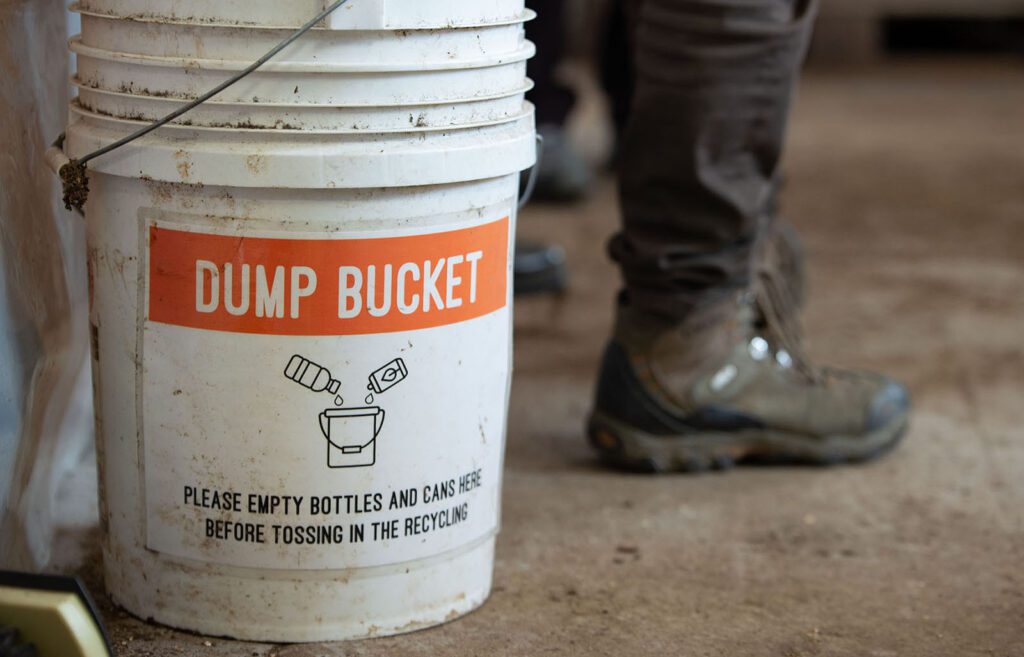
Most of the items that now need to be removed are silverware, cups, and plates that accidentally got tossed into an Epic Renewal bucket. A knife pulled from one is still used in the couple’s Pawtucket kitchen.
“The biggest thing is demystifying it for people,” Feigenbaum said of getting folks to compost. “We just need to get people exposed to it.”
This story is part of a series “Black Gold Rush: The Race to Reduce Food Waste and Save Soil.” The series is sponsored by 11th Hour Racing.

Thank you Tess and Baba for coming back to RI and giving us all your hard work and great ideas. We are so lucky to have the two of you in RI.