
Climate Action Group Tackles Gas Pipeline Expansion Proposal
March 15, 2026
Share


TIVERTON, R.I. — Rev. K Casenhiser was one of a handful of people who spent their Thursday evening at the library learning about the impact an expansion to the Algonquin gas transmission pipelines would have on the quality of life in Tiverton.
The 31-year-old rector of Holy Trinity Episcopal Church said the church’s property is less than 3 miles from the pipeline that runs through Tiverton and Little Compton.
“I was concerned particularly about how the land around the waterways would be impacted by the pipes,” they said.
The reverend was able to ask questions to Climate Action Rhode Island (CARI) and Pipeline Awareness Network for the Northeast members, who teamed up to host an educational series to help residents understand an Enbridge proposal moving through the Federal Energy Regulatory Commission (FERC).
The agency regulates interstate transmissions of electricity, natural gas, and oil.
Enbridge Inc. owns the Algonquin gas pipeline system that runs from New Jersey through New York, Connecticut, Rhode Island, and into Massachusetts. The Alberta, Canada-based company wants to upgrade a portion of its existing pipeline to reduce infrastructure constraints that have contributed to rising energy prices in the Northeast.
The upgrades include:
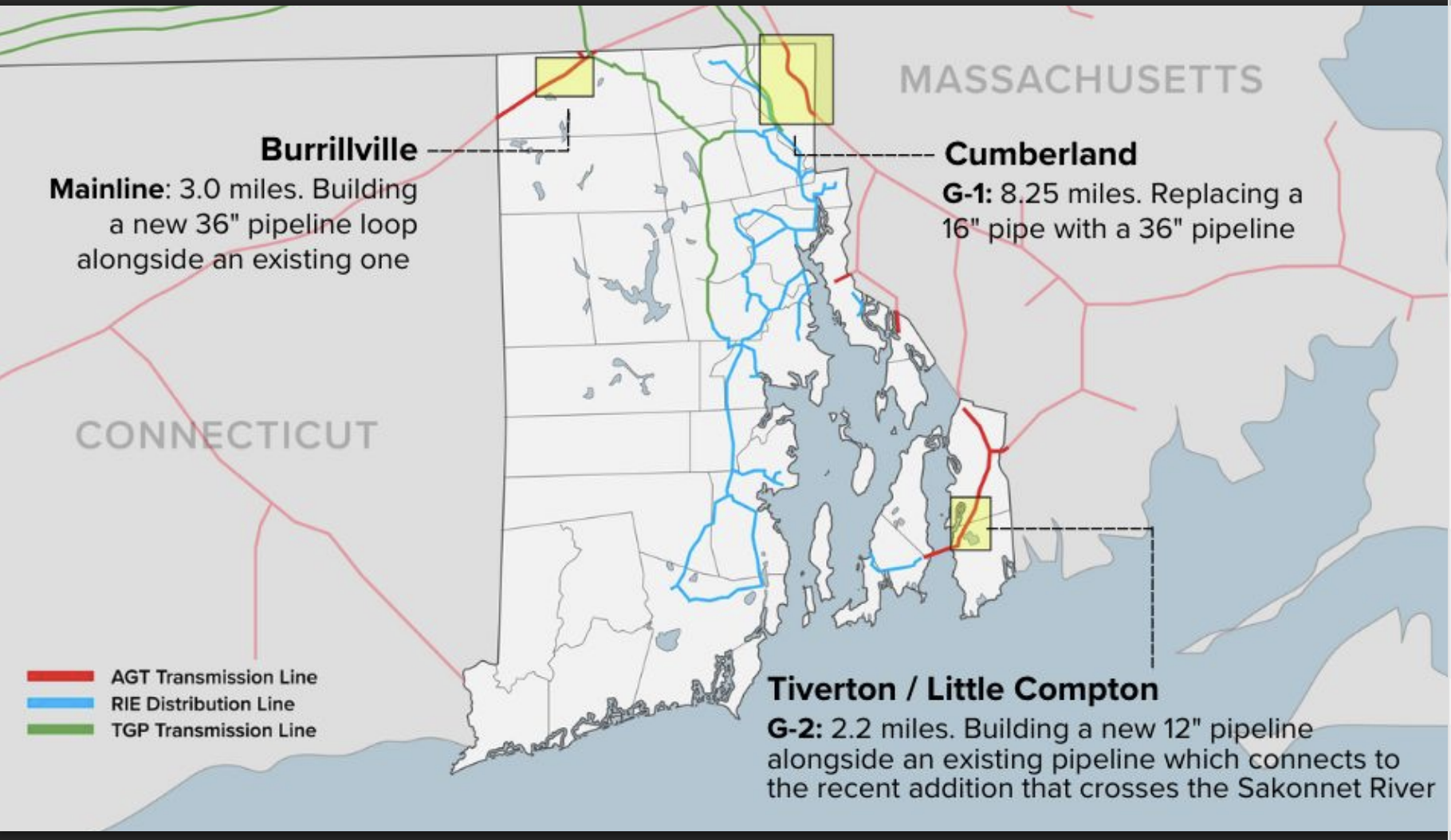
Replacing 8.25 miles of a 16-inch diameter pipeline that crosses through four southeastern Massachusetts towns and Cumberland, R.I., with a 36-inch diameter pipeline that would allow more than five times the volume of gas to travel through, according to CARI.
Adding 2.2 miles of a 12-inch diameter pipeline loop to an existing pipeline that crosses the Sakonnet River. (A loop is when a new pipeline is laid down parallel to an existing pipeline connected at both ends, according to the climate advocacy group.)
Installing 3 miles of a 36-inch diameter pipeline loop in parallel to an existing 24-inch diameter pipeline beginning at the Burrillville compressor station.
Updating software at a compressor station in Connecticut.
As Enbridge officials sent letters to landowners in 2025 requesting permission to survey properties abutting Algonquin’s existing easements, some Rhode Islanders emailed the No Pipeline Expansion Northeast coalition expressing their concerns and questions about their rights.
Some 319 tracts of land interact with the pipeline corridor, according to FERC documents, and 71% of landowners have granted Algonquin permission to survey their property.
However, a person can rescind their permission if the company hasn’t yet surveyed their property, according to Avery Robertson, assistant director and communications manager of CARI, adding that people can also deny permission for a survey.
Cathy Kristofferson, co-founder of the Pipeline Awareness Network for the Northeast, said sometimes people buy homes without realizing there’s a pipeline beneath their property.
“When you get a letter from Algonquin, please open it and see what they’re trying to tell you,” she said.
Robertson and Kristofferson host the information sessions to demystify industry jargon and help people understand how to engage in the approval process. They also explain the proposal’s construction, health, safety, and financial impacts.
The two remind residents of the state’s pledge to phase out reliance on natural gas under the Renewable Energy Standard and the Act on Climate, which respectively require electricity to be offset by renewable energy sources by 2033 and commit to reducing greenhouse gas emissions to net-zero by 2050.
Nancy Robinson said she needed to go home and decompress after listening to the presentation.
The 72-year-old Tiverton resident said she opposes the expansion and knows the commission will approve Enbridge’s proposal.
“I’m just really aggravated,” Robinson said, adding that pipelines are destructive and scare her. “The damage they do is crazy.”
Upcoming sessions will be held at the Jesse M. Smith Memorial and Cumberland Public libraries on March 16 and March 24, respectively, which contain Enbridge environmental resource reports about the proposal. The company plans to ensure public libraries in Burrillville, Cumberland, Little Compton, Tiverton, and Woonsocket will hold its FERC certificate application and final reports.
Enbridge plans to hold public meetings in April at the Lodge at Diamond Hill in Cumberland, the Crystal Lake Golf Club in Mapleville, and the Little Compton Community Center.
The company will submit a formal application in October, and construction will begin at the start of 2028 and finish in November, according to documents the company submitted to FERC.

Why no mention of how outrageously expensive the foolish green new scam really is?
Why no mention of how our electricity bills have DOUBLED in the last winter?
The financial suicide some hyper liberals promote is beyond comprehension.
It’s not thoughtful opposition. It’s insanity. Pure ignorance based on a herd mentality that is bankrupting our nation-one blue state at a time.
Here in the “Ocean State” not one kilowatt of electricity is generated by water. Think of it. The power source that started the world’s most powerful economy. That propelled RI to be THE MOST PROSPEROUS state is ignored in favor of Chinese made-one use, uneconomical, rarely used wind and solar generation.
People are suffering and moving away due to this political tyranny.
Wake up
So the company intends to update their current infrastructure which is good for safety and individuals complain.
Extraordinary, how barnacle-like and indeed fossilized are the views of coal, oil and natural gas advocates. And how ironic…
To begin with, exactly like the water power that began Rhode Island’s rise to national industrial prominence, the “fuel” for wind and solar electric generation is free. (And free of drought as well.) Nor are there any jugular points in their flow subject to malign restriction; no Straits of Hormuz. And so, while the price paid for fossil fuel generated electricity must be adjusted up or down regularly—every six months in Rhode Island—wind and solar power is contracted at set prices for periods of years.
And considering the geopolitical effects of fuel fossilization so much in the news today, it is as plain as the nose on one’s face that the great nation which first frees itself from fossil fuel dependence, and all the political, economic and military entangledments and vulnerabilities that entails, will have the whip hand over all others. And since Ignorance-is-Bliss has become a powerful American ideology, seriously bent on extra-constitutional domination of our government and economy, odds are growing in Vegas that the mailed fist receiving the prize will be Chinese.
if we got thru this winter with adequate gas supply as I think we did, why is there a need to expand the pipe infrastructure whose costs will be paid by ratepayers?
Makes good sense to improve and fortify existing infrastructure. Most households and businesses here are heated by natural gas appliances. Those fighting to eliminate natural gas better have a ‘net-zero’ cost increase plan for all of these people to convert systems to heat pumps or whatever. Most can’t afford such upgrades, and why should they if existing systems are working.
Ironically, still, there is no mention from anyone about actually conserving energy (which includes heat). Conservation measures would save everyone far more than the added costs being proposed everywhere, so it’s a complete swing. Shut off your lights, get better insulation, keep your windows closed in the winter, and stop playing video games.