
An Electric Ride: What Happened When I Rented an EV
June 5, 2025
Share


Consider this a cautionary tale about how not to drive an electric vehicle. Or a story about how, with just a little bit of planning and know-how, a road trip with an EV can be successful.
It started out so promisingly. Although when I arranged to rent a car from Hertz for two days in May I wasn’t intending to get an EV, when I got to the Providence location I was told all they had for rentals was a Tesla or a Kia Niro EV. I quickly nixed the Tesla (a decision I’d later regret) and agreed to try the Kia once John, the Hertz employee, convinced me I would have enough charge for the entirety of my trip. I was traveling from Johnston, R.I., to an event in Orange, Conn., then to a friend’s condo in Old Saybrook, Conn., for the night. The next day I would be traveling to Westerly, R.I., for an ecoRI News event (spoiler alert: I didn’t make it), followed by a trip back home to Johnston and then a short trip to Providence to drop the car off the next morning.
After calculating the mileage, John showed me that my total trip would be roughly 245 miles, and said the fully charged Niro had a range of 260 miles. Perfect, I thought, and paid the extra $28 that would allow me to return the car without a full charge.
So convinced was I that I wouldn’t need to charge the car that I only listened with one ear as John showed me how to open the charging port, which in this case was located near the front license plate.
Delighted to be reducing my carbon footprint, and to be driving a newer (2022) car — my car is a 2007 Acura, and while I love it, I didn’t trust it to carry me safely on this road trip — I plugged my phone into Apple car play, cranked the tunes, and headed out.
The drive to Orange was smooth. I hit barely any traffic on the notoriously awful stretch of Interstate 95 between the Rhode Island border and New Haven, Conn. I made it to the event on time and to my friend’s condo in Old Saybrook afterward, all the while marveling at how quietly and smoothly my EV was operating.
Thursday, May 22, is when things got tricky.
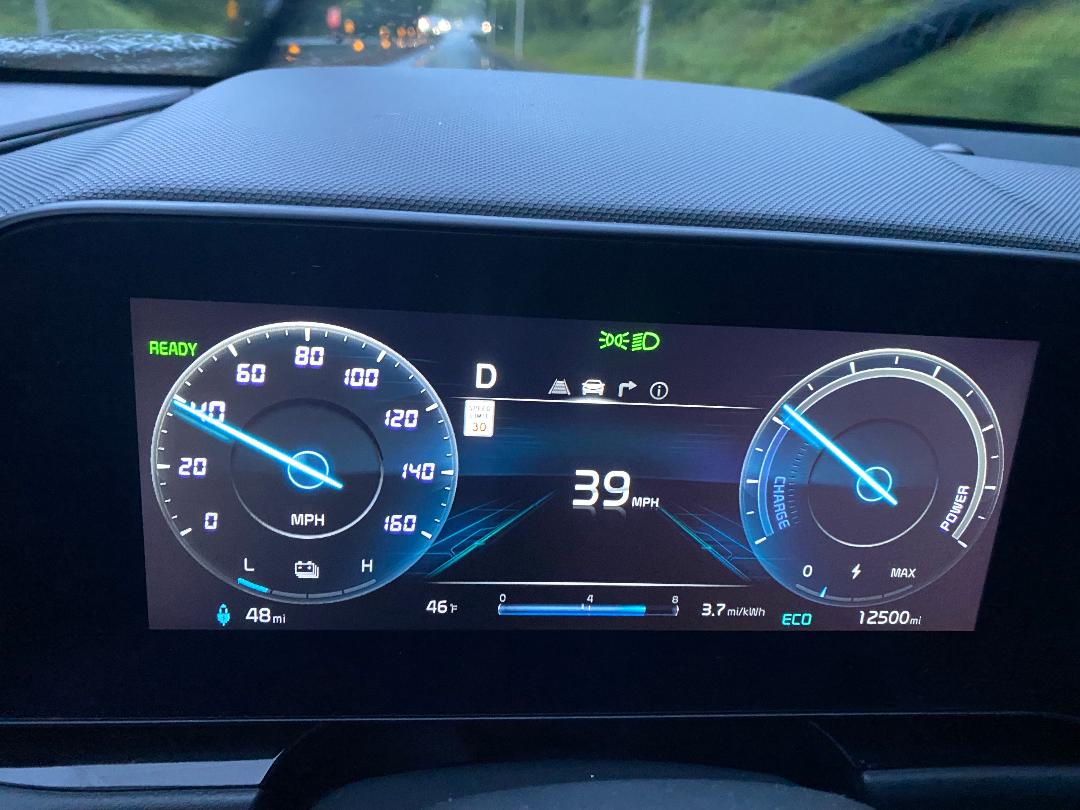
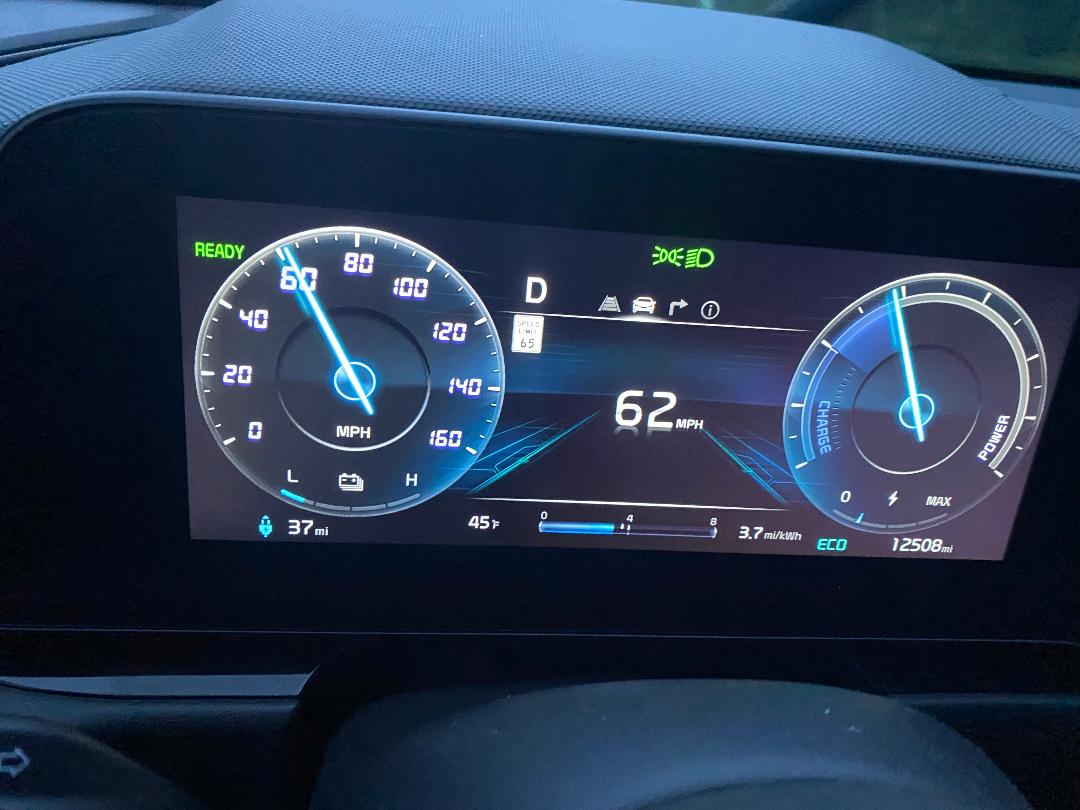
I woke up to a nor’easter, with wind, rain, and temps in the 40s. I wanted to get to Westerly by 4:30 p.m. to help set up at the Westerly Armory for the ecoRI News forum on shoreline access that began at 5:30 that night. So I left Old Saybrook at 3:30, giving myself more than an hour to get there. Once in the car, though, I noticed the range estimator at the bottom left of the dashboard said I had 58 miles left. A quick check on Waze for the distance from Westerly to Johnston showed it was roughly 49 miles, so I knew I’d need to charge the car if I wanted to make it to Westerly and then on to Johnston.
The cool thing about the Niro was that it had a giant touch screen and among the many things it could tell me was where charging stations were located. I found one in the parking lot of Misquamicut State Beach in Westerly. So I set my navigation and headed there.
It was cold, and windy, and pouring rain, so I had the heater, windshield wipers, and defroster all running. As I drove, I could see the battery range dropping and I got increasingly worried about making it home. My joy at driving an EV began to dissipate rapidly.
I pulled into the parking lot at Misquamicut and, at first, couldn’t see a charging station. A few parked cars, a row of port-a-potties (which would come in handy later), but no charging station. Finally, I found it — a single small post, not clearly marked, with two charging plugs. Thank God, I thought. I’ll just plug in the car, wait a few minutes, and off I’ll go with a better battery charge.
Ha.
I got out of the car to read the instructions on the charging station and from what I could tell through the wind and lashing rain, I needed to pay. So I got out a credit card and tapped it where it told me to. Then it told me I needed to download an app in order to pay. So I went back into the car and attempted to do so. As always when you’re slightly panicked and in a hurry, the app wouldn’t cooperate. This is when I began screaming — at my phone, the car, the weather. Finally, I got back out to see if I could somehow bully the charging station into cooperating with me. Lo and behold, there was a button I could push that would allow me to charge without an app. So I did so, plugged in the charging cord, and got back in the car, overjoyed and certain that I’d be on my way shortly.
Then I saw the little readout on the dash that showed how long it would take for me to charge the car: 8 hours. “Eight hours,” I yelled. “I don’t have eight hours!”
***
Since my experience I have learned so much about EV charging and the infrastructure necessary to keep such vehicles running. Rather than a gas tank, EVs have a large battery pack that powers the motor and must be recharged via an outside source. There are three ways to charge an EV, according to the state Office of Energy Resources (OER):
Level 1 charging, which can be done using a standard three-prong connector, so the EVs can be connected to a standard wall outlet in a home or business. This type of charging provides an average of 5 miles of driving range per hour of charging and can take up to 24 hours to fully charge a vehicle.
Level 2 charging, which uses dedicated charging stations, provides an average of 25 miles of range per hour of charging, and requires higher voltage ports, either 208V or 240V. It uses a type of connector that is standard on most EVs, and this manner of charging is more common in public and workplace applications; according to the U.S. Department of Energy, Level 2 charging currently makes up about 79.5% of public charging ports across the United States.
DC fast charging, which can charge a vehicle to 80% capacity in as little as 30 minutes. There are far fewer of these stations in R.I. and the U.S. — 18.5% of public charging ports across the U.S. are DC stations — and charging this way sometimes requires a special connector, depending on the type of EV.
According to the most recent data from the federal energy department, Rhode Island has a total of 341 charging stations with 835 charging ports, 20 of which are Level 1, 700 of which are Level 2, and 115 of which are DC fast chargers.
The state’s Electrify RI Program, an EV charging station incentive program started in 2019 and overseen by OER, has made $1.4 million available to Rhode Island companies, government entities, nonprofits, and multi-unit dwellings, on a first-come first-served basis, to install Level 2 and DC charging stations. As of March 2023, according to OER, the program has installed 70 Level 2 charging stations with 140 ports and 23 DC charging stations with 23 ports.
There are a number of websites and apps that can locate EV charging stations in Rhode Island (none of which I knew about during my odyssey), including the state’s charging locator and Plugshare.
***
Back at Misquamicut, I watched impatiently as the battery charge ticked up, slowly, to 40 … 45 … 50 … 58. My initial charging session lasted from about 4:30 to 5:45. Finally, I decided I had enough charge at 58 miles to head over to the Westerly event. When I pulled the cord out and got back in the car, though, the range immediately dropped to 50 again. I started to pull out of the parking lot but decided that I had better continue to charge the car and would have to miss the event. I texted my very understanding publisher, Joanna Detz, (not unaware of the irony that I would be missing an ecoRI News event because I was having trouble charging my electric car) and told her I was going to stay at the charging station until I felt I had enough charge to get home.
I pulled back up to the charging station and got out, ready to resume charging. But this time the charging port wouldn’t open. The first time it had opened smoothly when I pressed on a corner of the port’s cover. This time, nope. I pressed, banged, kicked — nothing. Got back in the car, took out the owner’s manual, and tried to find out what I was doing wrong. Car in park, yes. Car off, yes. Parking brake on, yes. Got out, pushed the port again — nothing. Screamed into the wind, got back in the car, and fiddled with the parking brake again. Got out, tried again — still nope. By now I was starting to both cry and question why anyone would buy an EV.
Finally, after some more fiddling (and I can’t tell you, to be honest, that I know exactly what worked), the port opened and I plugged the charger back in.
Back in the car, I watched as the charge slowly trickled upward. Then I thought I’d call AAA, of which I’m a member, to see if they maybe had a faster charger in their vehicles. They must, I thought, with the growth of the EV industry. But, of course, you can’t just call AAA and speak to a person anymore. You have to do it all online. So I filled out the form on my phone saying I needed a tow (since that was the closest option to what I actually needed) and that I had an EV.
When the driver showed up in a giant tow truck, I was so relieved. He must have a fast charger on there! I jumped out of the car and explained, rather frantically and looking like a drowned rat by this time, my concerns. His reply was decidedly unsatisfactory.
“If you had a gas car, I could give you some gas and you’d drive to a gas station and fill up. But with EVs, all we can do is tow you to the nearest charging station,” he said, kindly, since I was clearly distressed. Pointing out that I was, in fact, already at a charging station, he said all I could do was wait while the battery charged. He checked the plug and said it was working at the correct pace, and I’d just have to be patient.
Somewhat calmer, I got back in the car and resigned myself to waiting. I was somehow back at 45 miles of range, and I wanted to get to at least 60 so I could have enough charge to drive myself home and to the Hertz rental center in Providence the next morning to drop off the car.
Finally, the range got to 60. By now it was 7:30 p.m. I’d used the port-a-potties twice and was more than ready to head home.
Once back on the highway, I noticed the range dropping again. Don’t forget, it was still storming out, and the temperature was a balmy 48 degrees. So I had the wipers, heater, and defrost all running.
Between Westerly and Cranston, the range plummeted until it read 5 miles. I knew from my frantic Googling of “what happens when an EV runs out of charge” that the vehicle just stops. Panicked, I used the car’s touchscreen to see if I could locate a nearby charging station. Luckily, one popped up at the Cranston Whole Foods, not more than a couple miles away. Whew. One more charging session and then I’d be home.

[Fun fact: In my 2022 Kia Niro, when the charge was low, the warning appeared in the form of a turtle with the words “Power limited” above it — I am not making this up. It’s known as the “turtle of death” in one Kia EV forum online.]
I pulled into the lot and found the charging station. Got out and then noticed the sign taped to the thing: "CHARGING STATION OUT OF ORDER."
Again, the irony of being unable to charge my EV in a Whole Foods parking lot was not lost on me. I feel bad for any shoppers parked nearby who heard my, well, let’s just say they weren’t words of affirmation.
I pulled out of the spot at the charging station, moved the car under a light pole in the parking lot, and called an Uber. A total of six hours later and $48 poorer since I’d left Old Saybrook, I made it home.
***
Admittedly, the majority of errors in this story are mine. I agreed to rent the EV without doing any due diligence at all once I thought I could make the trip without having to charge the car.
But, said Anna Vanderspek, the electric vehicle program director for the Green Energy Consumers Alliance, it seemed as though the Hertz employee who glibly assured me I’d have enough charge was probably not very familiar with electric vehicles.
“There are a lot of things people should know before they make the switch” to an EV, she said.
Among them, Vanderspek said, is that the range estimate is just that, and not set in stone. “The car will determine an estimate but doesn’t know if the driving will be on a highway or stop-and-go,” she said.
And guess what? Driving on the highway, which is what I was doing, uses more electricity because the drag on the car requires more electricity “to push that heavy vehicle forward,” she said.
The weather also plays a factor in the range of an electric car.
According to Geotab, a company that studies fleet performance, safety, and sustainability, outdoor temperatures can significantly impact an EV’s range, both positively and negatively. In optimal temperatures, true range is on average 15% better than the vehicle’s rated range. On extremely cold days, the range can be reduced by as much as 50%.
In my case, it was in the 40s, windy, and raining — all of which required me to run the defroster, windshield wipers, and heater, which further drained the battery.
Vanderspek gave me a tip: if it’s cold out and you’re driving an EV, it’s better for the battery charge to use the heated seats and steering wheel (if you have them) than turning on the heater.
Another error I made was the lack of planning when it came to my trip once I knew I would be driving an EV. As I know now, there are lots of apps that help EV owners plan for a long drive, including the touch screen on my Niro, which, had I known it, could have shown me how far I could go before needing a charge, what type of charge I would need, and much more information. And, had I chosen to rent the Tesla, I could have plugged into a Tesla Supercharger station and added up to 150-200 miles of range in 30 minutes.
Vanderspek also showed me A Better Route Planner, which allows EV drivers to plan their route based on a number of factors, including the make and year of the vehicle, whether they want long charging stops, short but frequent charging stops, or quickest arrival. The first time we plugged my trip into the site, it said I could do it with no charging stops, but when we adjusted a few things, it told me that I’d need at least one charge. And with a subscription, drivers can make even more tweaks to a trip to determine how many times they’ll need to charge and where they can do so. The site also includes photos, physical locations and descriptions of the actual charging stations and number of plugs available. (This would have been handy when I pulled into the Misquamicut parking lot and couldn't find the charging station.)
“EVs can work for a lot of people right now,” Vanderspek said. “There’s a lot more public charging than people think.”
But, she said, most EV drivers need someone with experience to walk them through what it’s like to drive one.
Would I rent an EV again? (There’s no chance of me buying one on a journalist’s salary.) If you’d asked me once I finally got home that night, I’d have said absolutely not.
Now that I know more about traveling in an EV, I would say probably yes. But I do think the state needs more charging stations, and certainly more DC fast-charging stations. For example, in the massive Misquamicut Beach parking lot, there was only one charging station with two ports. The ports are available for four hours max, and while the charging itself is free, if the beach is charging for parking (as it does during the summer months), you must pay the parking fee in order to access a charger.
The state joined the National Electric Vehicle Infrastructure (NEVI) Program in 2024, which was slated to provide $28.5 million in combined federal and state funding to develop an "Alternative Fuel Corridor" that would position charging stations in up to 50-mile increments along the route. Using funding from the program, R.I. became the first state in the nation to complete Phase 1 by installing four fast chargers at two Park & Ride locations last summer. But the program has since been paused because of funding cuts by the Trump administration.
The statistics on the benefits of EVs vs. gas-powered cars are also convincing.
Charging an EV is cheaper than filling a gas-powered vehicle. A study by the University of Michigan Transportation Institute found that in Rhode Island, the average fuel cost per year for gas vehicles was just over 1.5 times the average fuel cost for battery-electric vehicles.
EVs have no tailpipe emissions and emit only water vapor and warm air. They also emit far less nitrogen dioxide, carbon monoxide, and hydrocarbons than traditional gas and diesel-powered vehicles, thanks to increased fuel efficiency.
While electric vehicles tend to be more expensive than gas-powered vehicles, there are a number of tax rebates and other support for buyers, although the Trump administration is trying to roll back some of them.
The OER has a list of EV-related resources here, and information on rebates here.
Glad to hear you made it home, but what a nightmare! Ideally, plugging in overnight at your friend’s condo could have given you some additional range. Our experience with an EV has been great. We bought a Tesla Model 3 in 2017 for environmental reasons. We are seniors, and the Tesla was the first new car we ever purchased after a lifetime of buying the most fuel efficient used cars we could afford (Toyota Corollas and Honda Civics). We charge at home most of the time. When we’re on a road trip, it’s rare that we have to go out of our way to find a super charger; they’re almost always located along a main route in an area where you can go grab a coffee while you wait the 20 minutes or so to charge, not in the middle of nowhere (like Misquamicut off season). We despise Musk, but he really got the infrastructure right (too bad POTUS didn’t put him on that!). Like every car we’ve ever owned, we won’t be parting with the Tesla until it dies of old age (or we do). However, as many are dumping their Teslas in protest, and you can probably pick up a pretty cheap used Model 3 if you ever want to switch from an internal combustion engine. Just don’t buy it from a Tesla dealership, and an anti-Musk bumper sticker is essential 😉
Right now used EVs are a real bargin. You can get a low mileage Model 3 for less that $30 K. Usually mid $20s. If you need to replace an old ICE car, the opportunity to get a great car for low $$ is now.
Hate to say it, but you were beyond ignorant about EV charging. Traveling from Old Saybrook to Westerly there were probably several Level 3 chargers in route. Your story suggests adapting to an EV is a substantial challenge. It is isn’t. An app in your car would have told you where the DC chargers were. With just a little awareness you would’ve avoided your troubles.