
Leaky, Old Pipe Spoils Waterfront Access
March 19, 2026
Share


PROVIDENCE — Five years ago this coming summer, the end of Public Street was designated a shoreline public right of way by the Coastal Resources Management Council. Residents of South Providence and Washington Park were jazzed about the possibilities this decision presented to their long-neglected and long-polluted neighborhoods.
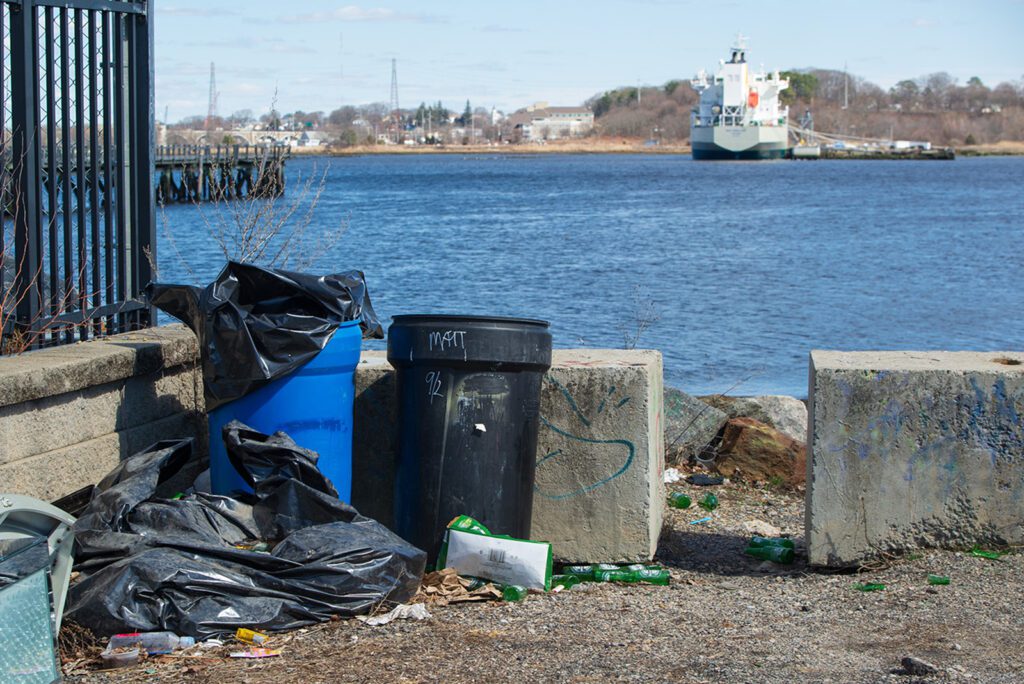
Conceptual drawings were created and plans made to beautify the dumpy street and its trash-caked shoreline and make the dead-end road that splits less-than-neighborly properties between Allens Avenue and the Providence River pedestrian friendly.
Currently, the Public Street right of way is the only access to the river for South Providence residents. It’s a filthy, unwelcoming patch of gritty, broken pavement that leads to a dirtier and wetter space. But there are plans for a small park with a walkway, park benches, and native plants.
It’s a small step in the right direction for two forgotten neighborhoods.
The plans, however, are on hold. A petroleum leak at the end of Public Street is jeopardizing grant funding for a public waterfront access project. The city is struggling to get Rhode Island Energy to take responsibility — a predictable development along Allens Avenue and the Port of Providence, where industry has long abandoned the idea of being good neighbors and local and state government have long been afraid to intervene with any urgency.
The pipe at the end of Public Street, just below the waterline, is leaking a petroleum-based discharge, Jed Thorp, Save The Bay’s advocacy director, told those who attended a March 9 meeting of the People’s Port Authority. Steve Ahlquist covered the meeting.
“The complicated part is that it’s the city’s very old pipe, but it’s probably Rhode Island Energy’s pollution that’s getting into that pipe and then finding its way into the river,” Thorp said. “Frankly, this has been going on for too long, a few years. … The city is trying to get Rhode Island Energy to split the bill to fix the pipe, but I don’t believe that they’ve come to a resolution. The negative thing here is that we have some grant dollars that have been allocated to improve the end of Public Street, and we’re at risk of losing those grant dollars if this issue doesn’t get resolved quickly.”
The Rhode Island Department of Environmental Management became aware of the problem in late April 2022, about nine months after the right of way was designated.
“The sheen periodically observed floating on the surface of the water from the storm drain appears to be petroleum based,” a DEM spokesperson wrote in an email to me. “The source of the petroleum sheen has not been conclusively identified.”
To mitigate the potential discharge of additional petroleum-tainted runoff, Rhode Island Energy has installed and maintains an absorbent boom in the manhole directly upstream of the outfall, according to DEM.
A November 2025 environmental report from consultants Fuss & O’Neill commissioned by the city found samples in the pipe were similar to light non-aqueous phase liquids (LNAPL) such as petroleum oil, gasoline, and diesel fuel.
Evidence of LNAPL migration into the antiquated pipe has been supported by the presence of these fuels in various manholes along the length of the pipe, as well as a sheen regularly observed in the Providence River at the pipe discharge location, according to the report.
Dense non-aqueous phase liquids are also present adjacent to and within the Public Street right of way. These contaminants, such as chlorinated solvents (trichloroethylene and perchloroethylene), coal tar, and creosote, are denser than water, sinking through aquifers to create persistent, hard-to-remediate pollution sources.
Port of Providence pollution is easy to find. Accountability isn’t.
Kevin Proft, the city’s deputy director of sustainability, told last week’s audience he has been working on the Public Street project for a few years. He said the goal of the project is to create an attractive and welcoming public access point to the waterfront.
“Right now, if you go to Public Street, it’s not a great place to spend a lot of time,” Proft said. “We want to introduce nature-based solutions, like trees, and add amenities when you get out to the shore, so you can sit and enjoy the waterfront area within the port, which generally cuts off residents and neighboring neighborhoods from the waterfront.”
Besides severely limiting access to the Providence waterfront for two neighborhoods, the industries that dominate the Port of Providence also foul the air, the land, and upper Narragansett Bay. Little has been done to lessen the public health impacts on the combined 15,000 people who live in the South Providence (Upper and Lower) and Washington Park neighborhoods.
The 38-inch pipe in question is made of brick and mortar and was installed in 1898. It used to be connected to the city’s sewer system as recently as 2010, but now only channels contaminated stormwater runoff into the Providence River.
To get the city’s waterfront project permitted, CRMC requires a resolution to this polluted stormwater runoff issue, according to Proft.
Local officials claim the pollution comes from neighboring property now owned by Rhode Island Energy. Sites to the north and south of Public Street were used for petroleum storage and distribution between the 1920s and the early 2000s.
DEM told me the city is responsible for the maintenance and upkeep of the pipe. The agency spokesperson said Rhode Island Energy (RIE) tried to conduct a video assessment of the interior of the pipe, but sediment and debris blocked the camera and the results were inconclusive.
“RIE has indicated that if the City cleans out the pipe, they will complete the video assessment and if it’s determined that RIE’s property is the source of the water impacts, they will take remedial actions to resolve the problem,” the DEM spokesperson wrote. “To date, the City has not cleaned out the pipe and has expressed the view that it is RIE’s responsibility to clean the pipe, complete the investigation, and remediate the problem.”
Proft said the city is “working with DEM to get Rhode Island Energy to take responsibility for the contamination that’s finding its way into the pipe from their property, which is a former brownfield, a site that’s highly polluted.”
He said the city put together “what we think is a pretty compelling case that Rhode Island Energy is at least contributing to the petroleum discharges occurring at Public Street.”
“I think DEM was hoping that Rhode Island Energy would be more collaborative in their response,” Proft continued. “The city offered to pay part of the cost of cleaning the pipe, about $120,000 or $130,000 total, so Rhode Island Energy can go in and do whatever they need to do to stop that oil from getting in. But in the end, Rhode Island Energy didn’t take responsibility for the pipe.”
Rhode Island Energy is a subsidiary of the Pennsylvania Power and Light Corp., which reported $1.18 billion in earnings last year. The parent company’s CEO is Vincent Sorgi. In 2024, Sorgi’s compensation package was worth $11,355,743 — 68 times the company’s median employee pay. The median household income in Rhode Island is $86,372, or 131 times less than Sorgi’s pay. In 2023, the first full year after the PPL Corp. acquired National Grid, Sorgi’s compensation package was worth $11,969,556.
The Allens Avenue business model is take no responsibility and then never be fully held accountable. The city’s trashed waterfront and the two neighborhoods that survive on this toxic landscape have been sacrificed by decades of corruption and/or gutlessness.
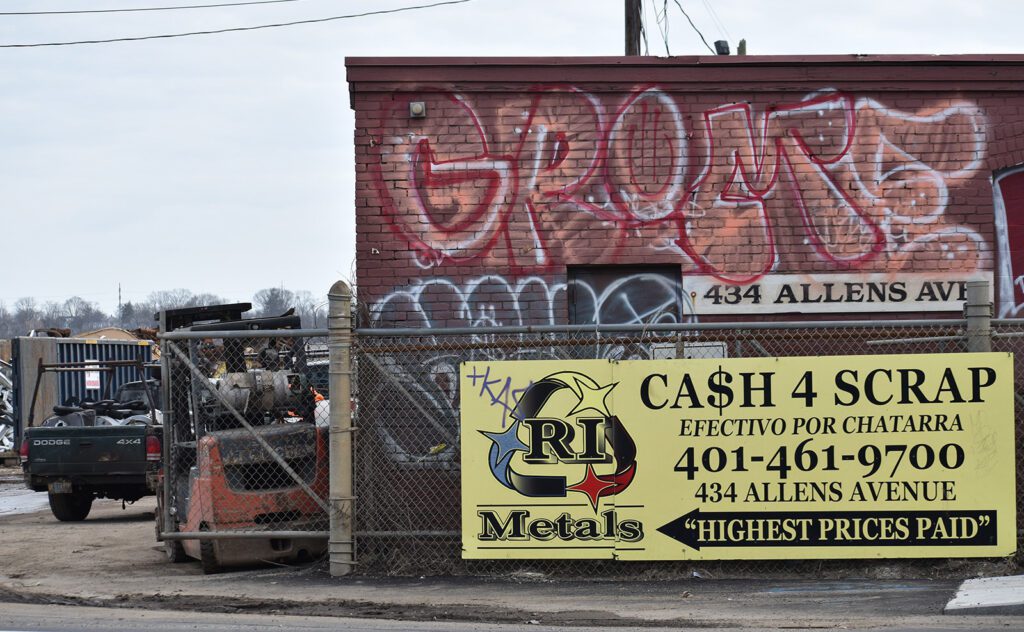
Take the case of Rhode Island Recycled Metals, just down Allens Avenue from the Public Street leaking pipe that is polluting one of the few shoreline rights of way in the area.
The waterfront scrap yard at 434 Allens Ave. began polluting in 2009 when it opened without all of the required permits. City and state officials did nothing for six years. It wasn’t until 2015 that the state took legal action against the illegal operation.
In 2024, the business was shut down, temporarily anyway, by a Rhode Island Superior Court order after another scrapyard fire. Last week Rhode Island Recycled Metals applied for a municipal junk license. Despite the company’s long history of operating and expanding illegally and causing public health and environmental issues, local officials will likely roll over, again.
The site was contaminated during the 1980s by a computer and electronics shredding company that conducted its toxic operations on bare soil. The property has tested positive for toxins such as polychlorinated biphenyls, better known as PCBs and a carcinogen commonly used in electronics. The site was capped after some of the contaminants were removed.
Rhode Island Recycled Metals has been cited by DEM for disturbing the soil cap at the site with trucks and heavy machinery and for releasing pollutants into the Providence River from dismantled vehicles, including a Russian submarine, it wasn’t authorized to have on the property. Two years ago, the city issued a cease-and-desist order that stopped nothing.
This ill-mannered scrapyard is hardly the only unneighborly operation in and around the Port of Providence. Residents, schools, and health clinics in the area are forced to deal with a headache-inducing stink, heavy truck traffic, illegally idling vehicles, and government officials who have long done little to nothing to reduce the unfair burden placed on these communities in the name of economic growth.
In fact, residents and advocates are routinely forced to beg just to be heard, even as Rhode Island Recycled Metals, the Sprague Energy Terminal, and other polluting operations fail to address serious problems, ignore notices of violation, and tie up remediation efforts in the courts.
Operations along the Allens Avenue waterfront include a hot-mix asphalt plant that emits compounds linked to child development disorders and to cancer, and a fossil fuel terminal that emits similar pollutants and other toxins linked to neurological and respiratory disorders.
The area is also home to chemical-processing plants. At one facility operated by a packager and distributor of specialty chemicals, some 3 million pounds of chemicals, such as ammonium, chlorine, and formaldehyde, are stored.
Inspections at Univar’s two Port of Providence facilities found 22 chemical-related safety violations. A 2022 consent agreement between the Environmental Protection Agency and Univar Solutions Inc. came after allegations that the Illinois-based corporation failed to follow industrial accident-prevention requirements in the Clean Air Act, putting the local neighborhoods at a higher risk.
Shell’s 75-acre property and ethanol railcar terminal on Allens Avenue contains 25 petroleum storage tanks that sit directly in a flood zone, which, unsurprisingly, has flooded. The facility discharges petroleum and other toxic chemicals into the Providence River during flooding and stormwater runoff events.
The Conservation Law Foundation has sued London-based Shell Oil and a host of its subsidiary companies of dodging basic questions about company involvement in its terminal in the Port of Providence. The case is still matriculating through a cumbersome court system that is slow to bequeath justice.
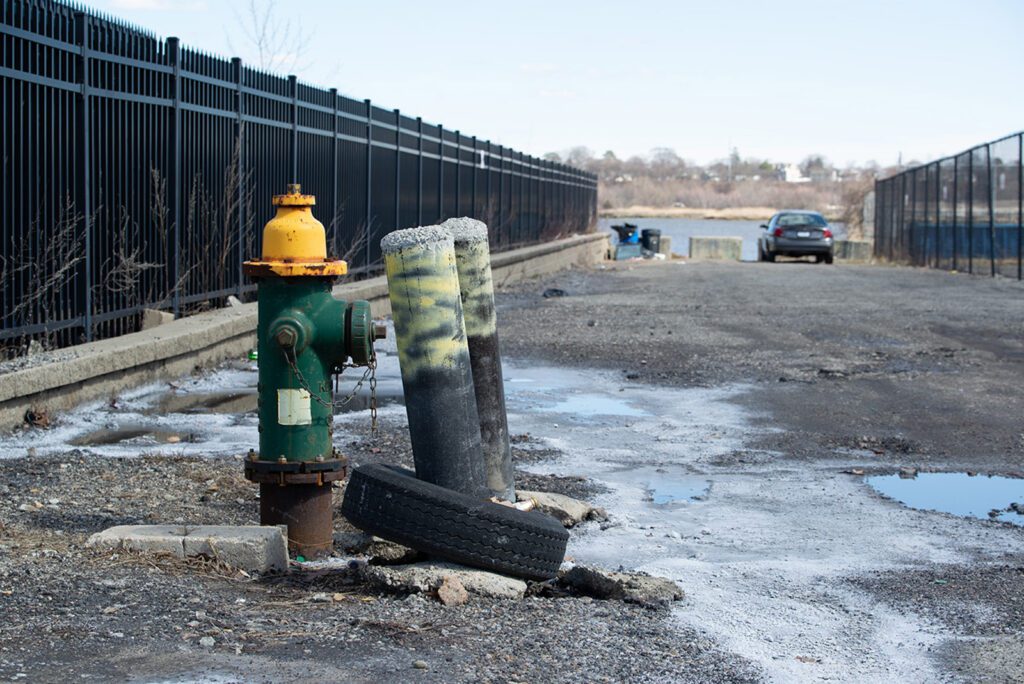
From Davol Square to the north and Washington Park to the south, this abused area is or has been home to dilapidated buildings tagged with graffiti, mountains of scrap metal, illegally piled asphalt, mounds of coal, liquefied natural gas and propane storage tanks, chain-link fences topped with barbed wire, vacant and neglected properties trashed with all sorts of debris, and a buffet of stored chemicals, many of them combustible and/or toxic.
Industrial actives in the Port of Providence that pollute the environment and people’s lungs are afforded more rights than those who suffer the consequences. It should surprise no one that South Providence’s population is 90% people of color: 55.8% Latino and 34.2% Black. Washington Park’s population is nearly 61% people of color: 46.9% Latino and 14% Black.
The people who live in these neighborhoods didn’t seek these unhealthy conditions. All this pollution is forced upon them for different reasons, none of them just. The inequities expand around them, despite their fears, because those in power have deemed these neighborhoods can be defiled in the name of economic growth. Low wages and a lack of affordable housing outside of this sacrifice zone leaves few options for single parents, those living on fixed incomes, and families struggling financially.
About a dozen polluters are routinely listed in the Environmental Protection Agency’s Toxics Release Inventory for the city’s 02905 zip code, which includes South Providence and much of Washington Park. This section of Providence contains a greater number of polluting facilities than any other zip code in Providence County.
Air pollution from the Port of Providence and Interstate 95 has caused these two marginalized neighborhoods to endure some of the highest rates of asthma in southern New England.
In a 2018 letter to the Federal Energy Regulatory Commission from the Rhode Island Department of Health critical of a National Grid liquefied natural gas project in the Port of Providence, then-director Dr. Nicole Alexander-Scott wrote:
“The Port of Providence has a long history of environmental problems that concentrate many of Rhode Island’s most concerning pollution and safety issues in neighborhoods that are economically and racially disadvantaged. Because of that history, the residents of the area feel disenfranchised and believe that their voices and health do not matter to government. Although the current project does not appear to make those pollution and safety problems substantially worse, it continues that historical pattern of discounting the voices of the people that live in the region and sets a precedent that may lead to additional, more concerning, projects in the future.”
Then-Gov. Gina Raimondo wasn’t moved by the letter or the neighborhoods’ plight. She ditched the letter before it was to be submitted to the federal agency. The project was approved, and local and state officials said they were powerless to stop it.
Since Raimondo’s nonchalant concern for constituent health, the tide has slowly turned. Projects such as an expansion of a liquefied petroleum gas operation and the construction of a waste-processing and transfer facility drew intense opposition from neighbors, businesses, and environmental groups. Their staunch resistance pulled politicians and bureaucrats into the fight.
Projects were withdrawn or rejected, but the fight for a healthy and vibrant place to live and work is far from over. The polluting businesses that mar most of the Port of Providence put profit over people. They cut corners, take advantage of a system that is designed to better protect their bottom lines than public health, and wait for taxpayers to pay to clean up whatever damage was/is caused by their for-profit enterprises.
Rhode Island Energy, its Pennsylvania parent, and its filthy rich CEO could easily cover the cost of fixing the leaking pipe that is delaying a small beautification/access project that could have a major impact on two disenfranchised neighborhoods.
Heck, this triad of greed could even help fund the city’s plans to create a small park. That’s what a good neighbor would do. Unfortunately, there’s a dearth of neighborly industry up and down Allens Avenue.
Frank Carini can be reached at [email protected]. His opinions don’t reflect those of ecoRI News.
On a visit to Baltimore a couple of years ago, I spent time walking on an extensive, wide, brick waterfront walkway. It had lots of benches, historical exhibits, restaurants and food stands where I stood in line twice to get the best frozen custard imaginable. It was crowded with people who were out and about enjoying the good weather. When I returned to Providence I wondered why we hadn’t built something similar. We have the perfect location for it. I think it would be a gold mine.
As usual these conditions are attributed to corporate greed, and that is true to a degree. Businesses aim to make a profit, and they believe it is better to ask forgiveness than to ask for permission. However, it is the elected officials and their appointees who are not doing their jobs while collecting fat paychecks as they lounge comfortably in their offices. None of these things happen in a vacuum and are frequently reported to those who are tasked with prevention and remedial action. The reports are immediately shelved as being too difficult or politically unpalatable and nothing is done. There are a plethora of Federal, State and local laws that could and should be enforced. It just requires political will and supervision of those tasked with enforcement. If they are acted upon immediately and with a vengeance these issues would not become entrenched. And as a side note, it is not the businesses leaving bags of trash, tires and graffiti, it is the residents.
Hmmm…why is the RIE CEO’s salary mentioned in the article? As Mr. Edward’s stated, “Elected officials and their appointees are not doing their job”. Shouldn’t their salaries be included in the story?
After reading this article, my husband and I drove to the site to take a look. As Mr. Edwards indicated, it is full of trash, tires, etc. Yes, the businesses are not leaving the trash, but let’s not blame the residents either. People dumping their trash happens in every community. While some may assume residents do not care about their surroundings, research suggests that the accumulation of trash is more often a result of systemic neglect and a lack of proper waste disposal infrastructure rather than the actions of residents themselves.
Besides the trash, this space is a pathway for large vehicles and tractor trailer trucks maneuvering through the area – how will public safety be addressed?