
Portsmouth Has Gas Problem and It Stinks
March 11, 2026
Share


PORTSMOUTH, R.I. — Like many politicians, elected officials, and appointed board members here and everywhere, the Portsmouth Economic Development Committee is unfamiliar with the climate crisis. The 15-member committee recently urged the Town Council to oppose any moratorium or other restrictions on natural gas infrastructure.
They argued that reliable and cost-effective natural gas (methane) remains essential to the town’s economic stability, public safety, and long-term competitiveness, the Portsmouth Times reported last month.
In a Jan. 28 memorandum, the committee recommended the council support policies that improve the availability, redundancy, and reliability of gas service on Aquidneck Island. The committee also recommended the town resist efforts to limit new gas hookups or infrastructure expansion.
The five-page memorandum doesn’t mention the climate crisis or fossil fuel pollution. It’s a junior-high book report written without actually reading the book.
“Dependable, dispatchable, and cost-effective energy is essential to maintaining Portsmouth’s economic competitiveness, supporting local businesses, protecting public safety, and stabilizing the residential tax base,” the committee wrote.
The failed book report doesn’t make mention of sea level rise or coastal flooding for an island town surrounded by Narragansett Bay and the Sakonnet River. It ignores the fact the East Coast is a recognized sea level rise hot spot, experiencing rates of rise significantly higher than the global average.
To make matters more concerning, a study published last week found most coastal risk assessments have underestimated current sea levels, meaning tens of millions of people face losing their homes to rising waters earlier than expected. Insurance companies are well aware.
A different study published last week found the rate of global warming has surged since 2015 and is now nearly double what it was in the 1970s. The past three years have shattered temperature records.
Apparently, it is up to others to protect Portsmouth from the burning of more fossil fuels.
The committee acknowledged renewable energy exists, but cautioned against relying on the cleaner alternative.
“While renewable energy sources may play an increasing role over time, current technology does not permit exclusive reliance on renewables without significant cost, land-use, and reliability challenges,” wrote a committee unfamiliar with rooftop solar, battery storage technology, and the concept of solar carports. “Natural gas must remain a necessary component of the local and regional energy mix for the foreseeable future.”
It is up to others to transition Portsmouth from fossil fuels to renewable energy. Aquidneck Island can wait, because the dirty fuel it burns originates in someone else’s community.
By the way, while U.S. natural gas prices are on the rise — even before we started a war based on a gut feeling by someone who pounds Diet Cokes and Big Macs — about 90% of 2024’s new global renewable energy capacity was cheaper than a fossil fuel alternative. In 2024, solar photovoltaics were, on average, 41% cheaper than the lowest-cost fossil fuel alternative. Also, renewable energy (solar and wind) prices aren’t impacted by war.
Perhaps Portsmouth officials could approve an ordinance that requires all the new unaffordable vacation and second homes being built along the East Passage of Narragansett Bay to have rooftop solar arrays and heat pumps. If some of these oversized homes can feature elevators, buyers can certainly afford solar panels and heat pumps to lessen our reliance on gas, oil, and propane.
The committee claimed “natural gas remains among the lowest‑cost sources of energy when evaluated on a cost‑per‑BTU basis.” It claimed “natural gas facilities provide reliable power at a lower total system cost than intermittent renewable alternatives when full construction, integration, and reliability costs are considered.”
The committee, of course, disregards the adverse impacts the burning of fossil fuels has on public heath, the natural world, and the climate. Asthma, cancer, heart disease, air and water pollution, ocean acidification, flooding, drought, wildfires, and heat waves don’t cost anything.
If you don’t read the book, you can’t make informed decisions. Instead, juvenile CliffsNotes are provided without context: wind and solar power depend on weather and time of day; natural gas supplies the majority of electricity generation in Rhode Island and a large share across New England; natural gas is critical for winter heating and public safety.
Some of that missing context: offshore wind energy in the Northeast is highest during the winter, when winds are strongest and most consistent and demand for energy is high; battery storage technology is rapidly developing; renewable energy is significantly cleaner and safer; expanding gas infrastructure will prolong our addiction to fossil fuels and conflicts with Rhode Island’s climate mandates.
But the committee, at least some of its members, hold renewable energy infrastructure and expansion to stricter standards. While the committee supports building a second fossil fuel pipeline beneath Narragansett Bay, or developing a direct pipeline connection to Portsmouth, a few members have expressed concern about a wind turbine cable beneath the Sakonnet River.
In June 2023, committee chair Joe Forgione spoke out against a SouthCoast Wind project at a public workshop. The offshore wind project cable would stretch 90 miles through federal waters, 16 miles up the Sakonnet River, over land in Portsmouth, and 6 miles through Mount Hope Bay.
“Portsmouth is not the best route. There are other routes that will have less impact on the environment,” he said. “Massachusetts will get 90% of the power that runs through our beach; Portsmouth will get 2%. That is a fact that you cannot debate. The U.S. Navy in Middletown rejected the initial route. Maybe our military knows something about safety. If it is not safe for our men and women in the military, it certainly is not safe for the kids who swim and kayak off of Island Park.”
He also made this senseless comment: “I do not take the position that we should harm the environment today in order to fulfill the promise of improving the environment in the future, and that’s what this project could do.”
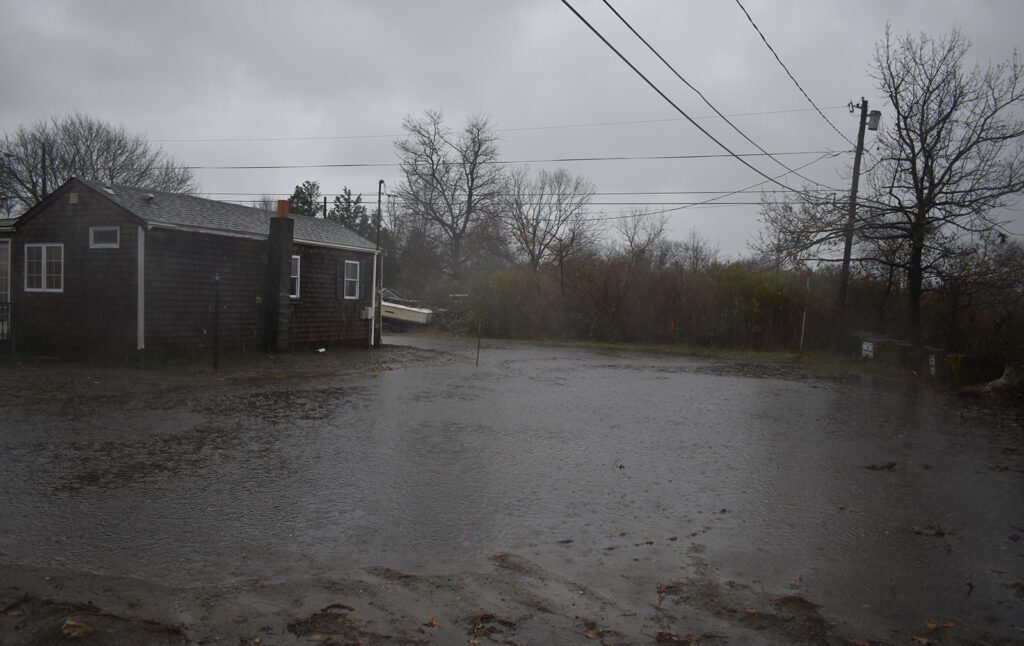
Sea level rise and more intense rainfalls are frequently flooding the Common Fence Point and Island Park neighborhoods. An underwater gas pipeline is fine, but be afraid, very afraid, of an underwater electric cable. Potential swimmers and kayakers need not worry about the electric lines that run above our heads and crisscross our communities.
A continued and expanding reliance on fossil fuels will harm the environment today, tomorrow, and long into the future.
The U.S. Department of Defense has long had concerns about sea level rise and other climate change impacts on Naval Station Newport. In fact, the Navy views climate change as a critical national security threat and an existential risk.
The energy generated by the SouthCoast Wind project, like any offshore wind project off the New England coast, would be absorbed into the regional power grid and help reduce utility costs, especially in the winter.
In May 2023, Forgione sent a three-page letter to the Coastal Resources Management Council in opposition to the proposed cable route. It’s filled with tired anti-wind rhetoric that is never applied to fossil fuel extraction, transportation, and burning.
Committee member Emil Cipolla testified at a February 2024 Department of Environmental Management workshop regarding the same SouthCoast Wind project. He said there are a lot of important issues regarding the impact of offshore wind on mammals and fishing. The same and more can be said about offshore fossil fuel infrastructure — just ask Rice’s whales and fishers in the Gulf of Mexico.
He also said these wind towers are “going to fall some day.” Better than blowing up like the Deepwater Horizon, or crashing like the Exxon Valdez or the North Cape oil tanker off the Rhode Island coast. It’s more likely a Rhode Island bridge will fall first.
The committee’s January memorandum built on a divided council vote last fall, when the Town Council voted, 4-3, to notify the Energy Facility Siting Board that Portsmouth opposes a moratorium on new gas hookups on Aquidneck Island.
Sticking your head in beach sand isn’t an effective way to address the climate crisis.
Frank Carini can be reached at [email protected]. His opinions don’t reflect those of ecoRI News.



Thank you Frank for this blunt and true assessment. And a reminder to all that most Public Utility Commissions are in the hands of fossil fuel companies, so of course they will advocate for gas and oil first. And they put many obstacles in place to make it difficult and expensive to hook up to solar. We can encourage balcony solar and encourage the legislature to fast track an existing bill to remove impediments to it’s use, like the state of Utah has done.
Sounds like ther Town of Pottsmouth is run by uneducated fools who have no clue about climate change nand how fossil fuels cause it. This is a new book on Climate change and the economy tht they might want to look it
https://drive.google.com/file/d/1IZsCvrszY9bO0DaeB-jRDQZaz5Ti3kdP/view?usp=sharing
Joe Forgiones’ comment was not “senseless”. This letter is. It is based on false computer generated information put forth by the wind power industry that fuels the biggest energy scam in history.
To think that Rhode Island’s practices or even that of the U.S. overall could have any affect on climate change that has been going on for millions of years is insanity. And to think we can reduce global pollution, which of course we should, when we have driven virtually all of our manufacturing to Asia, which will not cooperate, is a dream on steroids. Every scientific study based on actual data, not projections, has shown that for every Kilowatt produced by wind, twice the amount of gas is needed to level out the fluctuations. And very dangerous lithium batteries will not help a bit.
You have jumped on the wrong horse Ben Riggs, the sustainable future has left you behind. You should know that nothing has pushed American manufacturing to Asia. Countries, such as China, have simply created a technological vacuum, an attractive climate that works more efficiently than ours. Simply put, Asia has built a more intelligent and sustainable foundation, one that is now superior to our antiquated fossil fuel driven infrastructure.
In fact, 74% of its power is derived from solar/wind compared to the US which is stalled at only 6%. You recognize the inherent imbalance here; China can produce a greater output at a lower cost than America’s fossil fuel factories ever will. Coal, oil, gas… really?
No wonder, Asia is more sustainably competitive than the US in manufacturing, as our production costs increased, China’s were and continue to be substantially cheaper, not to speak of being environmentally sustainable. If you dare to read a left-leaning authority, you might find this November 2025 NPR article to be enlightening: https://www.npr.org/2025/11/18/nx-s1-5525934/as-china-becomes-the-global-leader-in-renewable-energy-the-u-s-is-falling-behind.
Rhode Island, and Aquidneck Island in particular, has such an incredible history of civic and religious leadership. Considering it’s wealth of natural, energy producing resources, it should be at the forefront America’s America’s conversion from fossil fuel to renewable energy.
Please rethink your opposition Ben. Jump in the saddle to support this growing patriotic movement to hasten a better future for American manufacturing and everyday life. Help to lead Rhode Island and America to a better, more sustainable future.