
Scary Problem: Ghost Gear Haunts New England’s Salt Waters
February 23, 2026
Share


Commercial fishing for shellfish, lobster, and finfish is an economic driver for many coastal communities along the Atlantic Coast, including ports in southern New England. Much of the gear now used in these fisheries is made of plastic, and lots of it is lost at sea every year.
It has been estimated, for example, that between 5% and 15% of lobster gear is lost annually to storms, propellers, and accidents. Since commercial fishing gear is used in harsh conditions it requires frequent replacement and is expensive to dispose of, some of it is deliberately dumped. Either way, all the fisheries are represented in the world’s stock of derelict fishing gear, more commonly called ghost gear.
Some 500,000 to a million tons of fishing gear is estimated to be lost at sea every year, and this ghost gear makes up 10% of all marine debris. The National Oceanic and Atmospheric Administration’s Marine Debris Program has collected 2,000 tons (4 million pounds) of gear from 56 locations in U.S. waters.
This lost gear ranges from monofilament and braided fishing lines to ropes and nets to pots and traps. This jumble of commercial fishing equipment can be catastrophic for ocean life, ensnaring fish and marine mammals and endangering sea turtles.
Derelict traps, for instance, can be a death sentence for commercially valuable fish and lobster caught long after the traps were lost, abandoned, or dumped. Studies have shown that about 90% of species caught in ghost gear are of commercial value, according to the World Wildlife Fund (WWF). These derelict traps also kill species we don’t value.
Sea life that gets caught or entangled in ghost gear can die a slow and painful death via suffocation or exhaustion. In the upper Gulf of California, abandoned gillnets have contributed to driving the vaquita porpoise to the brink of extinction. The WWF has removed about 62 tons of gillnetting in those waters in an effort to save the world’s smallest porpoise. As few as 10 individuals could remain.
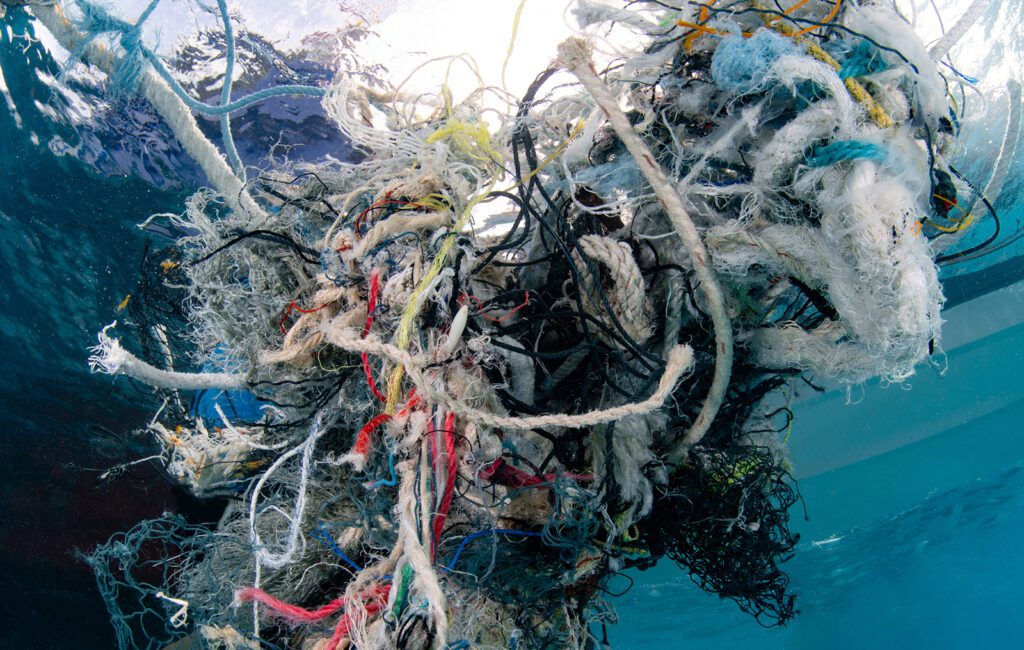
Ghost gear can also damage valuable marine habitats, such as coral reefs and mangroves. Gear that is made of plastic — over the past five decades there has been an explosion of plastic used in fishing nets, traps, and line — breaks down into smaller and smaller pieces over decades and is often ingested by marine life and seabirds.
Wind, surf, currents, and tides end up tangling much of this lost equipment together, creating massive knots of gear that can weigh tons. Large and meager snarls often end up wrapped around marine life both big and small.
Laura Ludwig, director of the Marine Debris and Plastics Program for the Provincetown, Mass.-based Center for Coastal Studies, focuses much of her work on the ghost gear that pollutes the Gulf of Maine from Cape Cod Bay to the Bay of Fundy.
She said millions of lobster traps, both active and lost, are in coastal waters off the New England coast. She noted about 3 million lobster trap tags are issued annually for the Gulf of Maine alone. Thousands are lost every year.
“There’s millions of dead lobster traps on the Gulf of Maine bottom,” Ludwig said.
It has been estimated that 175,000 lobster traps are lost in the Gulf of Maine annually. The corresponding economic value of this loss is “staggering,” according to the Gulf of Maine Lobster Foundation. It has noted that between loss in revenue and the need to pay for replacement equipment, derelict fishing gear causes a combined loss to the lobster industry of about $16 million.
In 2009, the Kennebunk-based nonprofit was one of 14 organizations to receive funding for a cooperative two-year pilot project to recover, document, and properly dispose of ghost gear.
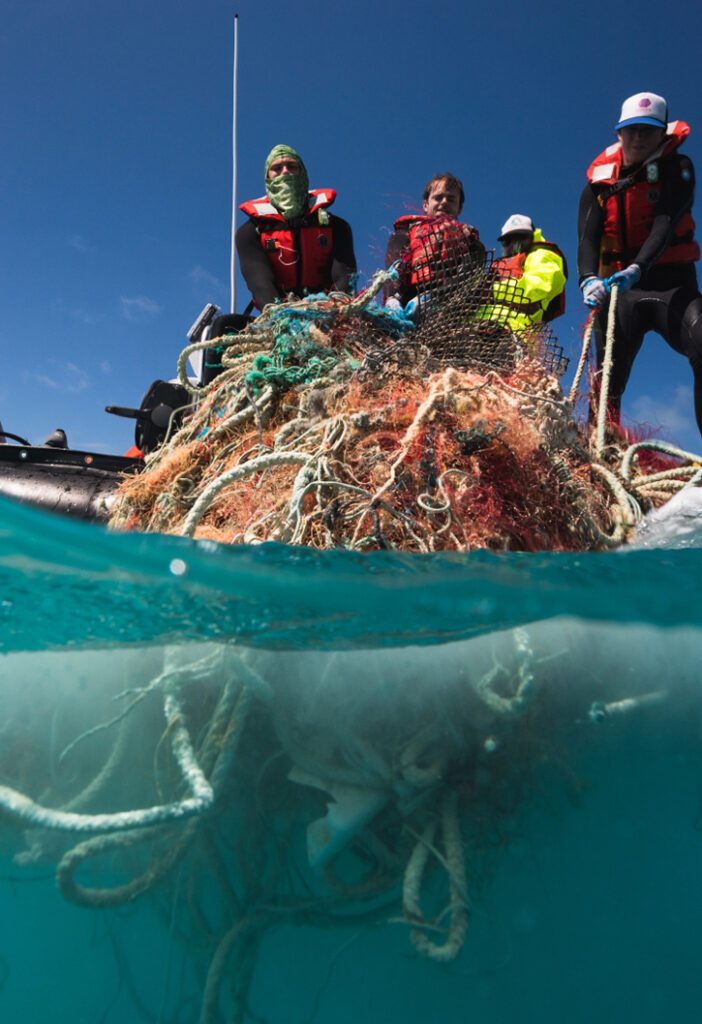
To recover this lost equipment, the Gulf of Maine Lobster Foundation contracted with fishers to drag specially made grapple gear in certain areas where traps are known to be lost and where grappling is a viable retrieval method. Ten vessels were hired in each of the seven Gulf of Maine lobster management zones.
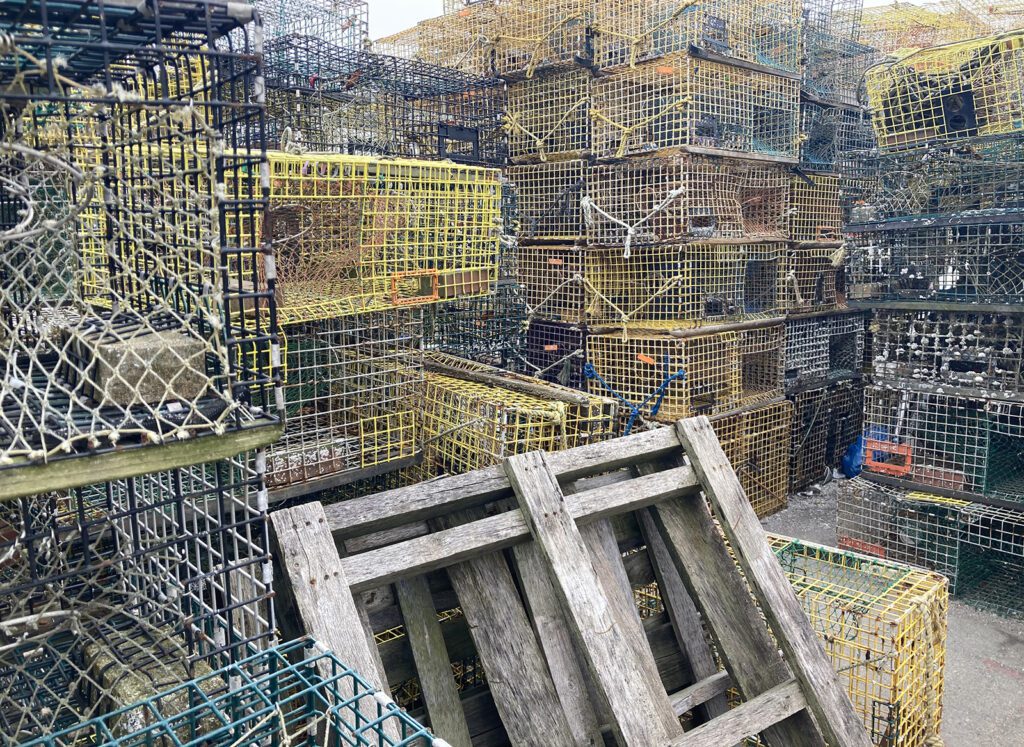
Recovered gear was brought to a central wharf for sorting and processing. Information about bycatch, escape vent functionality, and age of traps were recorded for each device. Traps that were unusable were crushed and sold to a metal recycling company; fishable traps were returned to their owners or stored for future reclamation.
“Salvaging the recovered derelict fishing gear can save thousands of dollars for local fishermen and protect the marine habitat,” according to the Gulf of Maine Lobster Foundation.
Lugwig’s Center for Coastal Studies extraction program removes “fishing gear at sea in any manner we can, using either divers or salvage lifts for these massive gear balls.” She said the program removes hundreds to thousands of tons of debris from local marine waters annually.
The program works closely with the fishing industry. It also contracts with commercial fishers to remove ghost gear. Ludwig herself has been working with the commercial fishing industry since 1990.
“It’s really critical and a big piece of our success is that we are working with people who know how to handle this stuff,” Ludwig recently told ecoRI News. “We’ve got a lot of buy-in, a lot of encouragement, a lot of participation from the industry. I work with guys and girls that are pretty concerned about the environment. They understand their impacts. They get it. They’re not trying to take advantage of my system.
“I do pay them because, quite frankly, it’s not easy. You need people with experience that aren’t going to kill themselves going out there to grapple back a few-ton ball of gear.”
The efforts required to retrieve and dispose of lost gear are costly. The Biden administration’s Inflation Reduction Act had supplied some funding for this work.
“It’s really expensive,” Ludwig said. “The thing that’s expensive is the disposal, and it’s very hard to get rid of. We are constantly scheming and dreaming of how to divert it from the waste stream, because it costs so much by weight to dispose of.”
Ludwig works with a diverse group of people, including artists, who are interested in repurposing ghost gear. For instance, some of the fishing rope Ludwig’s team has collected was given to an artist who incorporated the material into a recent exhibit hosted at Salve Regina University about North Atlantic right whale extinction.
Others are also interested in finding a purpose for this lost gear.
Through a new partnership with the Rhode Island-based Commercial Fisheries Research Foundation, Izabela Ciesielska-Wrobel, an assistant professor in textiles, fashion merchandising, and design in the University of Rhode Island College of Business, is working to find a use for ghost gear.
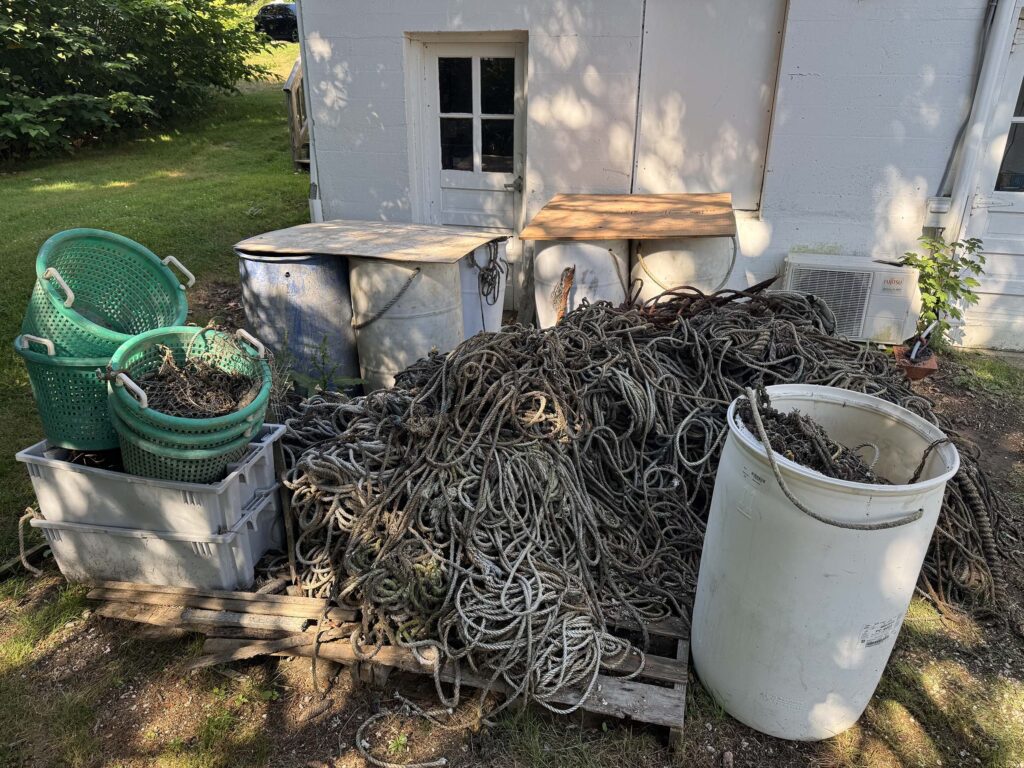
Ciesielska-Wrobel has about 30 pounds of retrieved gear in her lab, but estimates she has taken in some 300 pounds of lost gear collected from local marine waters. She is exploring ways to resurrect this gear into potential new uses.
“As a textile scientist, I see this as a unique category of marine pollution that still retains recoverable material value,” Ciesielska-Wrobel said. “Unlike microfibers dispersed throughout water, which are impossible to scoop and remove on a larger scale, ghost gear can often be physically retrieved and potentially repurposed after cleaning and processing.”
While she has shown that it’s possible to restore and repurpose ghost gear, Ciesielska-Wrobel is now investigating the economic feasibility of the process, by installing meters in her lab to get a handle on water and cleaning product consumption, and examining the cost versus the output.
“Removing and repurposing abandoned fishing gear helps protect marine ecosystems by preventing continued entanglement of wildlife and reducing plastic pollution,” Ciesielska-Wrobel said. “At the same time, recovered materials may be reused or recycled into new products, supporting circular economy efforts.”
For now, though, most of the ghost gear fished out of local waters is landfilled. Ludwig said her program and its partners recycle what they can, most of which is metal.
“You can’t incinerate it. It’s too difficult, expensive to chop,” Ludwig said. “When you send stuff to a waste-to-energy facility, it has to be a certain size. It can’t be a big clump. You need a specialized piece of equipment to chop it up. … We’ve done a lot with the solid waste industry to try to figure out how can we dispose of all of this stuff that’s completely contaminated, not recyclable, has rocks and seaweed all over it, and ruins equipment.”
As for the illegal dumping of gear, Ludwig said it does happen, because it’s cheap and effective, despite all the problems it causes.
“They don’t have to bring it to shore. They don’t have to deal with the crane. They don’t have to deal with cost. They just, you know, deep-six it,” she said. “They’ll choose a location that’s not going to impact anybody’s harvesting, usually, but this is an age-old issue of disposing of retired gear at sea.”
She noted illegal dumping is the exception, not the rule.
“Most operations dispose of it responsibly,” Ludwig said. “We’ve been working very hard to divert this stuff from being dumped overboard.”
Besides injuring and strangling marine life and polluting the ocean, these tangles of fishing gear can become navigation hazards, as the older they are, the bigger they are.
“You’ve got all this stuff tumble-weeding around out there. Things just roll around and catch into each other,” Lugwig said. “One time, we had a gear ball so big the Coast Guard tried to help us and busted their equipment. I mean, it is big stuff. I think the biggest ball they’ve gotten out of the water, and it damaged the crane, was 12 tons.”
In Narragansett Bay, ghost gear is often caught in trawl nets and discarded at the end of trawl lines, damaging fishing nets and leaving piles of abandoned gear in channels, according to the Commercial Fisheries Research Foundation. Since 2023, the Kingston-based nonprofit has removed about 14,000 pounds of ghost gear from Narragansett Bay.
Since November 2022, three Connecticut conservation groups — Save the Sound, the Maritime Aquarium, and Project Oceanology — have teamed up to remove 3,300 abandoned lobster traps from the bottom of Long Island Sound, where an estimated 1 million derelict traps sit.
A new Massachusetts Division of Marine Fisheries regulation, effective Jan. 30, allows the public to remove abandoned fishing gear debris from coastlines and intertidal zones without prior authorization. The law aims to mitigate ghost gear pollution and protect marine life by easing restrictions on cleaning up derelict gear, which previously was considered private property.
“I’ve been doing this since 2007, so almost 20 years of getting shit out of the water, and we’re still not done,” Lugwig said. “We’ll be going at it for a while.”


this stuff is a nightmare. glad to see all the interest. the polypropylene nets must be a real challenge. they re indestructible.