
Plastic Tsunami Bears Down on Bay State
South Coast of Massachusetts, Cape Cod swimming in microplastics
February 4, 2026
Share


Nearly 200 volunteers from across the South Coast of Massachusetts spent five days in early November hauling tires, oil booms, and dock sections out of a trashed Fairhaven peninsula.
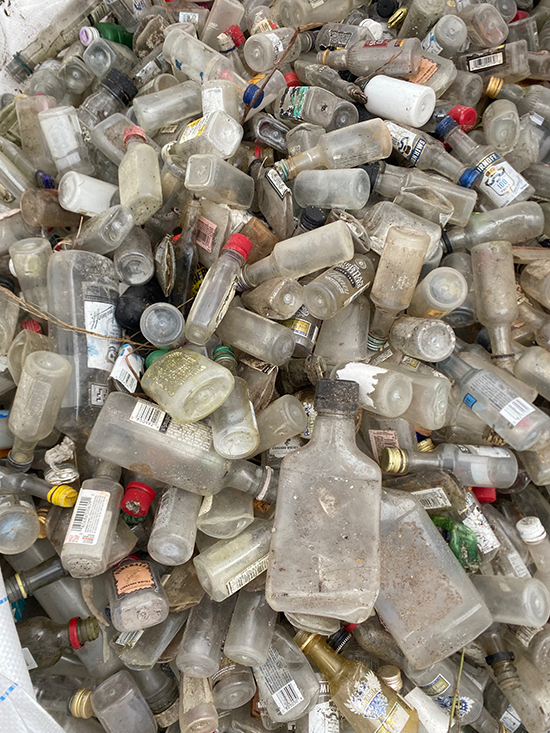
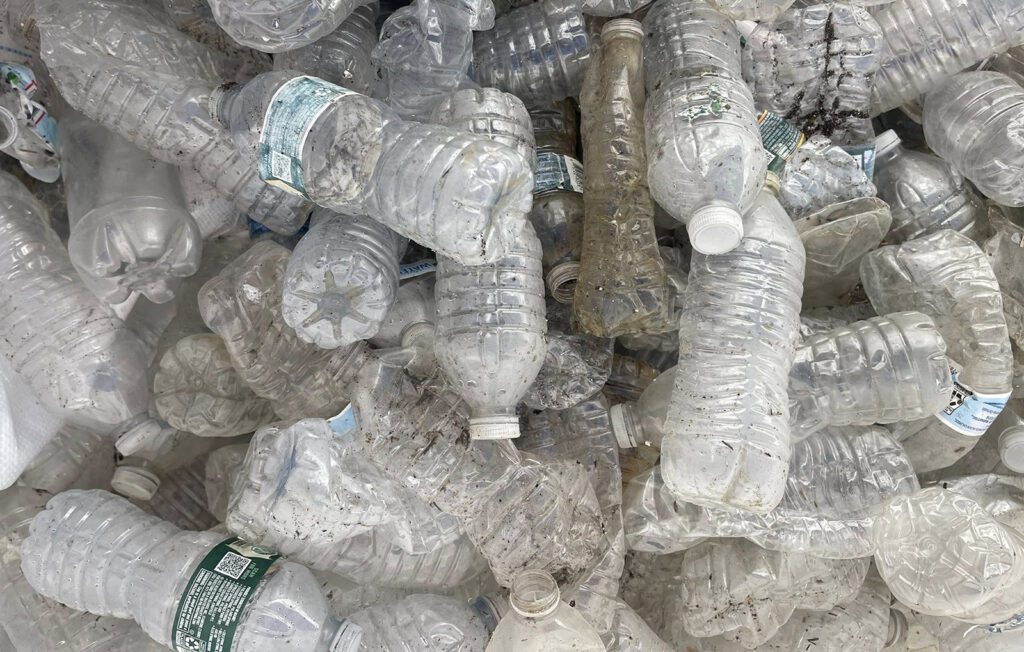
While these large items received much of the attention, it was the smaller plastic pollution — cups, water bottles, straws, bags, nips, and Styrofoam — that registered the bigger concern. The larger items weighed more, but the plastic pollution was omnipresent and more difficult to remove, or even identify.
The cleanup was supported by several organizations and municipalities, including the Buzzards Bay Coalition and the Center for Coastal Studies, and was part of the reopening of 22-acre Marsh Island to the public.
Sara da Silva Quintal, senior restoration ecologist for the New Bedford-based Buzzards Bay Coalition, was among those, on hands and knees, who deliberately picked bits of plastic from shoreline sand and soil. The veteran Coalition staffer noted there are multiple outfalls that empty stormwater runoff into New Bedford Harbor.
“All along its shoreline, there’s a lot of ways in which debris can end up in the harbor, and it seems to have a heavily pronounced plastics problem,” Quintal said.

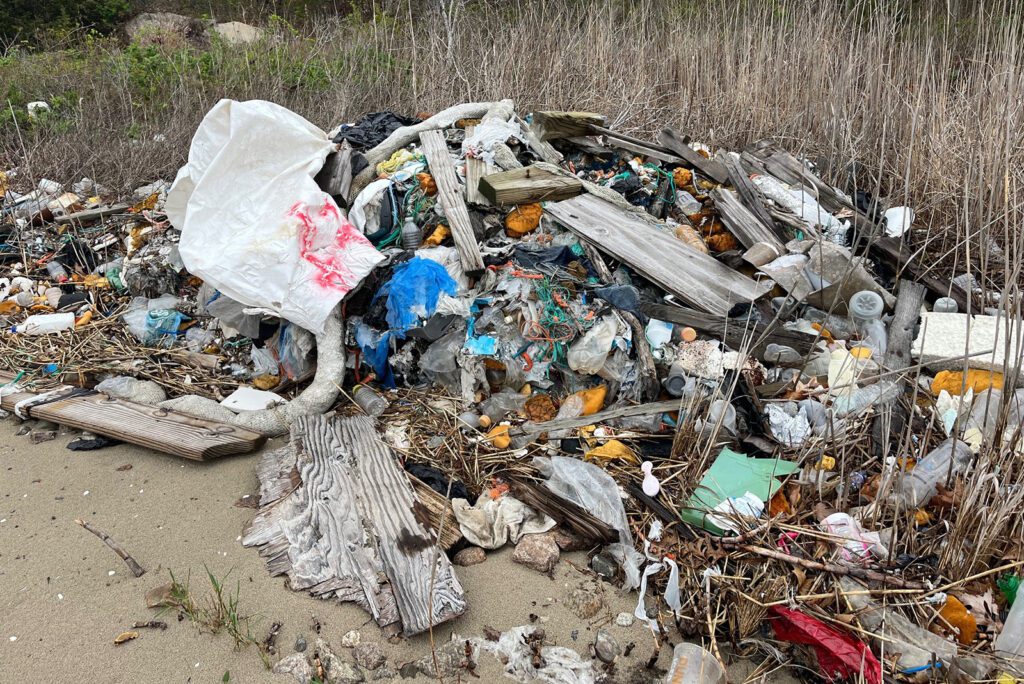
Much of the debris flushed into New Bedford Harbor ends up stranded on the Marsh Island shoreline. Debris had — and will continue to despite last fall’s noble effort — accumulated along the shore of the peninsula for decades. The refuse was so plentiful that cleanup work began each day in the morning and lasted until nearly sundown.
The collected plastic debris was categorized, placed in sacks, weighed, and then dumped into a dumpster. The 194 volunteers collected 12.3 tons of debris, including 70.8 pounds of nips, 167.9 pounds of water bottles, and some 10,000 pounds of “recognizable” plastic litter. Quintal said they arrived expecting to collect about 3 tons of debris.
She noted 7,116 pounds of debris was nondescript trash so heavily degraded into small pieces and mixed in with sand and soil that it wasn’t readily recognizable. The vast majority turned out to be plastic bits.

“You’re picking through the sand and the dirt and you’re having a hard time picking it up, having a hard time discerning what it is or was,” she said. “Crabs and the fish are eating it, so that’s a huge concern. Styrofoam, for that reason, is such a concern because it breaks down into tiny, tiny little balls of pellets that look just like fish eggs that is such a common food source for the estuary environment.”
Volunteers collected 11.9 pounds of Styrofoam cups and pieces.
“Think about how light that stuff is and how much it would take to make 12 pounds of that stuff,” Quintal said.
The five-day cleanup also included a smoking section, where cigarette butts, lighters, weed packets, and other smoking paraphernalia were collected in buckets.

The depth of the mess generated plenty of volunteer and staff head-shaking, according to Quintal.
“I was there at the cleanup myself,” Scott Lajoie, the Buzzards Bay Coalition’s communications director, wrote in an email to ecoRI News. “There were so many tiny plastic particles that the team was trying to vacuum up out of the wood debris and from the sand. We still have a major polystyrene problem in coastal communities as the marine industry still uses, and sometime loses into the water, lots of styrofoam.”
Plastics don’t decompose. Instead, they break down into smaller and smaller pieces that end up ingested by marine life and eventually consumed by people, or left to accumulate on the bottom of local marine waters. These microplastics are found in plankton, Arctic sea ice, and in seafood.
While Buzzards Bay Coalition staff and volunteers continue to collect heaps of plastic trash, Lajoie noted it may be time to do more. “We have not done any studies on the effects of microplastics, but with the amount of plastics we’ve collected on our shores lately, it may be more of a focus going forward.”
The Center for Coastal Studies has noted marine plastic pollution represents one of the greatest threats to the world’s oceans.
“It is a global problem affecting every coast and ocean in the world,” according to the Provincetown-based nonprofit. “It affects everything from the environment to the economy; from fishing and navigation to human health and safety; from the tiniest coral polyps to giant blue whales.”
Laura Ludwig, director of the Center for Coastal Studies’ Marine Debris and Plastics Program, focuses much of her work on macroplastics, most notably ghost gear that pollutes the Gulf of Maine from Cape Cod Bay to the Bay of Fundy.
“The gear that we remove, which is pretty much lobster gear and a little bit of dragger and gillnet gear, is all plastic,” she said.
Ludwig noted what’s left behind when commercial fishing gear is lost to storms, accidents, or deliberately dumped — beyond massive tangles of gear balls weighing tons — is “everything that has sloughed off of this gear.” Much of what is shed are microplastics and particulates from polyvinyl chloride (PVC).
“They are everywhere,” she said. “And it’s very industry specific in that the fishing industry does contribute an awful lot of microplastics to the benthic community.”

Lobster fishery gear is loaded and coated with plastics, according to Ludwig.
“Pretty much every lobster trap in the 21st century is coated with PVC. It’s all galvanized wire or steel that’s been hot-dipped into PVC,” she said. “It works great, except for two things. One, chemically speaking, when it’s new, it is so potent and so smelly that it’s almost not fishable. Lobsters don’t go near brand-new lobster traps. So it tells you one thing in terms of the chemical scent. And number two is anytime the coating is breached, like if a lobster claws — lobsters are super strong — and they try to get out, and they’re always trying to, they breach the PVC coating. Anytime there’s a breach oxidation can happen, and then rust happens, and then the rust on the steel undermines the PVC coating.”
The result? PVC particles are let loose on the marine environment.
“I can almost guarantee you every trap in the water has some breach somewhere,” Ludwig said. “PVC is heavy so it doesn’t float. It just sinks to the bottom. That’s something I’ve always wanted to look at, and I’ve never gotten the funding for it, but I will guarantee you that there are millions and millions of PVC microplastics on the bottom of the ocean.”

She noted this plastic pollution is visible during certain tides.
“You can sometimes walk along certain shorelines and just see rows of little, tiny pieces of PVC in green and yellow,” the Provincetown resident said.
PVC is just one polymer that is used in the lobster fishery. Ludwig said the entire rest of the gear, aside from wood runners and the metal underneath the PVC coating, is plastic. The buoys are plastic. The rope is plastic. Nearly all of the parts on a lobster trap are plastic.
“All of that rope is shedding microfibers anytime it comes up against anything, and as a result of both mechanical degradation and UV degradation,” Ludwig said. “So if it’s sitting on the deck, if it’s sitting in the backyard, and then you go out, you fish it, all the microplastics are just like flying everywhere.”

The National Park Service has noted single-use plastics and fishing gear are two of the bigger pollution problems along the coastline of the Cape Cod National Seashore.
Marine debris not only causes issues related to entanglement and habitat destruction, it also impacts food webs. Plastic marine litter eventually breaks down into tiny pieces too small to see, creating microplastic pollution.
Microplastics are small fragments of plastic debris that are less than 5 millimeters long. Some microplastics are “micro” by design. Microbeads, for example, are tiny plastic spheres manufacturers add to body washes, toothpastes, and other products to give them extra scrubbing power. Lentil-sized pellets known as nurdles, which are used in the manufacture of many common plastic products, are also intentionally small.

Secondary microplastics are fragmented pieces resulting from the weathering of larger pieces, such as plastic straws, cups, and water bottles, from exposure to sunlight, temperature, and humidity. Ocean waves can also degrade larger plastics by repeatedly washing over them and grinding them into the sand.
These tiny bits of plastic have been found in zooplankton, copepods, marine worms, and other organisms that serve as prey for larger life. The presence of microplastics will likely have adverse implications for marine food webs and on human health, as they can attract and carry pollutants contained in seawater. These tiny bits also can release toxic chemicals used to make plastics into the environment.
Every year, plastic pollution kills “up to 1 million seabirds, 100,000 sea mammals and marine turtles, and untold numbers of fish,” according to the authors of the 2025 book “The Problem With Plastic.”
Research has found that fish that ingest microplastics swim more sluggishly, grow more slowly, and show less appetite. Researchers have also identified a disease called plasticosis that scars the digestive tracts of seabirds. Albatross chicks that dine on plastic pieces have died from dehydration and/or starvation.
On the opposite side of Cape Cod Bay, between Mashpee and Falmouth, the Waquoit Bay watershed is also experiencing the long-term impacts of plastic pollution.
By taking core samples of marsh sediment at six different estuaries in the watershed, researchers were able to trace the abundance of microplastics dating back decades in areas with various degrees of land use, according to a 2021 white paper.
The researchers focused on two types of microplastic pollution: fragments, from the breakdown of larger plastic pieces; and fibers, thread-like plastics that tend to shed from clothing and fishing gear. They found that fragment pollution increased both through time and with urbanization. The more populated the area surrounding the collection site, the more plastic fragments they observed.
Salt marshes are vital ecosystems, as they filter nutrients, sequester carbon, support biodiversity, and protect against erosion and flooding. Microplastic pollution, however, could create serious implications for the entire salt marsh/marine food web, starting with mussels, oysters, scallops, and other filter-feeders.
As these bivalves are feeding and being fed upon by other animals they could be transferring microplastics around the food web and up into humans.
The paper’s research showed that the concentration of microplastic fragments in the sediments wasn’t linear as urbanization grew. Up to 50% development, the concentration of microplastic fragments was relatively unchanged, but once the land was occupied at 50% or more, the number of microplastics grew exponentially.
“Just a few people in the surrounding area is not going to change much, but when urban uses occupy more than 50% of the land, the number of microplastics goes crazy,” according to Javier Lloret, a research scientist and co-author of the paper.
Microplastic fibers, however, didn’t have the same relationship with urbanization. Even in the more pristine areas that don’t have urbanization, the researchers found plenty of fiber plastic pollution.
The researchers believe microplastic fragments have a local origin — people using and disposing of plastics where they live — whereas fibers can be transported long distances by air or by water from urban areas.

Providence resident Rebecca Altman, who holds a Ph.D. in environmental sociology from Brown University, writes and speaks a lot about plastics. In a 2015 essay she wrote, “They swirl in all the oceans’ major gyres, of which there are five. In places, microplastics outnumber plankton.”
She continued, “Fish confuse plastics for plankton, and so plastics have entered the food chain. I’m reminded of the phrase: you are what you eat, and what you eat eats, of the snake consuming its tail, and also of the poet Adam Dickinson, who has called us a people of the resin. I suspect he is referring to how some plastic additives have come to live in us — in our bloodstreams, and even in our mother’s milk. Plastic is part of our inheritance.”
A recently published study reported “plastic particles drifting through the oceans may be quietly weakening one of Earth’s most powerful climate defenses.” The research suggested microplastics are disrupting marine life that helps oceans absorb carbon dioxide, while also releasing greenhouse gases as they break down.
“By interfering with plankton, microbes, and natural carbon cycles, these pollutants reduce the ocean’s ability to regulate global temperatures,” the authors wrote.
“I don’t know what the solution is, and certainly there are complicating factors, such as it’s very well established in the literature that a microplastic for its size captures and attracts more contaminants and chemicals than a larger piece of plastic … so the parts per million of toxins on a microplastic go through the roof, especially when you aggregate them, and that is something that has been demonstrated to impact endocrine systems in baleen whales and the feeding success of copepods,” said Ludwig of the Center for Coastal Studies. “Every scale of marine organism is impacted by the toxins that are adhered or adsorbed to these little, tiny pellets. That’s a huge issue. It’s not just the physical microplastics. It’s the contaminants and the chemicals that are absorbed and glommed on that impact whatever system they get ingested into.”
Note: For information on how to reduce your exposure to microplastics, click here.
Sources: The bolded facts and figures were found in the book The Problem With Plastic, Beyond Plastics, The Marine Mammal Center, and the Center for Biological Diversity.

The author does a good job covering a lot of local bases — I am heartened to learn of so much work happening in southern New England marine systems to address microplastic pollution. One clarification in my quoted content: the word “ABsorb” in the final paragraph should be “ADsorb” — plastic does not absorb chemicals, but the craggy surfaces of microplastic particles can attract or adsorb toxins and chemical additives which can accumulate in such quantities that they become tiny toxic pellets. Thank you for including this piece of information in your coverage!
Laura, thanks for heads-up. Mistake corrected. My bad, but don’t tell anyone. — Frank Carini, ecoRI News