Inundation Infrastructure: City and Community Provide New Solutions for Flooding in Providence
January 12, 2026
Share


“It was 20 minutes, and Olneyville was flooded.”
Jenny Mercado, a resident of Providence’s Olneyville community, recalls the flooding of her neighborhood this past August. The event wasn’t an anomaly — it serves as a wider indication of how rampant flooding has become. Mercado says that every time it rains, families living near the river get scared.
According to the climate risk tool First Street, more than a third of properties in downtown Providence are at risk of flooding. In 30 years, that number will be up to one half (50.2%). Those most affected by flooding overwhelmingly belong to marginalized groups — namely low income, people of color (POC), and immigrant communities.
Clara DeCerbo, director of the Providence Emergency Management Agency, says in the past three years alone, Providence has experienced 13 flash flood events. According to DeCerbo and other climate experts, flooding is expected to intensify as climate change worsens.
Industrial and infrastructural inequalities
Scott Frickel, head of the Department of Sociology at Brown University, says the development of industry near waterways is an “omnipresent historical signature” throughout the United States. As a coastal city and home to seven rivers, Providence’s waterways were previously used to both power mills and dispose of toxic chemicals. Frickel’s research has demonstrated that low-income and POC communities in Providence are disproportionately likely to live in contaminated sites.
Olneyville, a neighborhood in Providence populated by 70% Hispanic and 15% Black residents, has one of the highest concentrations of polluted sites. These vulnerable communities face a plethora of other environmental health issues, such as lower tree coverage leading to intense heat, lead exposures through paint and tap water, and airborne pollution that contributes to abnormally high levels of asthma.
Flooding further compounds these risk factors, exposing residents to hazardous pollutants. Toxic metals and other pollutants from Providence’s legacy industrial sites are released during heavy rainfalls and flushed into waterways, which can then enter residents’ homes during floods.
According to city officials, the severity of these flood events is largely the result of two major infrastructural flaws: outdated sewage and stormwater system and an increase impervious surfaces.
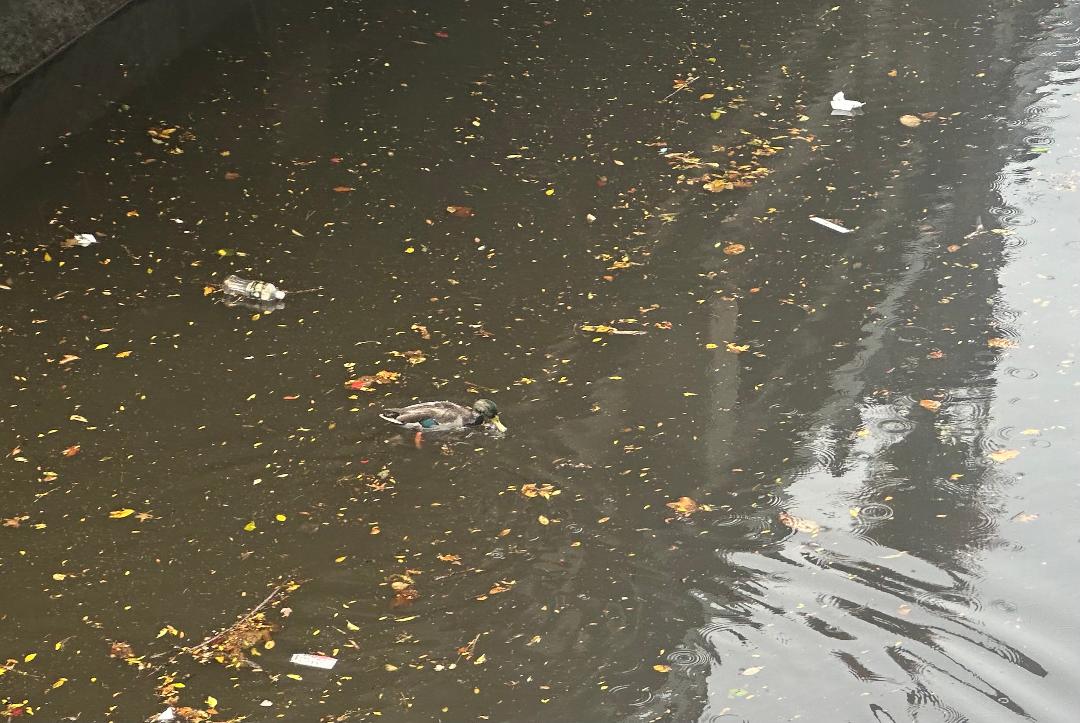
Combined sewer is a system in which both sewage and runoff are conveyed through the same pipes. It serves approximately 68% of the city and is common in other cities along the Eastern Seaboard and in the Midwest. During large rain events, combined sewer systems are often overwhelmed, leading to untreated, raw sewage discharging into local waterbodies. The majority of the city’s combined sewer overflow (CSO) discharge locations are concentrated in areas that are mostly populated by impoverished residents and POC, increasing the risk these residents face.
In addition, impervious surfaces increase the amount of water CSO systems have to manage. Hard surfaces such as asphalt, concrete, and parking lots dominate Providence, causing rain and excess runoff to enter storm drains and overwhelm the system.
A seat at the table
Nestled amongst red brick buildings and jade-green awnings, and marked by a metal fish placard, the Woonasquatucket River Watershed Council’s (WRWC) office serves as the birthplace of a variety of community initiatives, from installing green infrastructure to educational programs.
One such program is Nuevas Voces, a bilingual course providing Spanish-speaking residents with the tools to understand and navigate environmental issues such as flooding. Many Nuevas Voces participants have personally experienced their basement flooding, which has destroyed their belongings and led to health hazards like mold growth, which can compound preexisting health issues afflicting POC communities, such as asthma.
Jenny Mercado and Mariá José Gutierrez, the co-founders of Nuevas Voces, come from opposite backgrounds. Mercado grew up in Providence, but had little experience with environmental issues and climate advocacy. Conversely, Gutierrez lived in Santa Cruz, Bolivia, for most of her life and worked as a national park tour guide, coming to Providence knowing much about the environment and little about the city. With their combined strengths, they launched Nuevas Voces in 2020.
Mercado and Gutierrez say graduates of the program have gone on to become community figureheads, including Sayda Arriaza, who started at Nuevas Voces with little knowledge about environmental advocacy. Arriaza is now a WRWC staff member, fostering the next generation of students as a co-facilitator of Nuevas Voces and the Campeones del Combato Climático program (CCC). This specialized program is designed for Nuevas Voces graduates, placing them alongside city officials and engineers to create a green infrastructure project of their own design.

Before CCC began, De Soto Street in Olneyville was plagued with a variety of issues. Due to its design, water and trash accumulated in the road each time the river overflowed. However, after Gloria Morales, a De Soto resident in CCC, managed to convince the Campeones team and city officials, engineers got to work renovating her street. The result, according to Gutierrez, was a much cleaner, safer, and beautiful neighborhood.
“Nuevas Voces was created to bring more leaders to the table,” says Mercado, highlighting the De Soto project as an example of how the program has succeeded in doing so. “There wasn’t always a bridge between community voices and decision-making spaces, so Nuevas Voces was created to change that, to make sure our community not only has a seat at the table but feels empowered and speaks loud and clear.”
WRWC also engages in green infrastructure projects that allow community members to directly contribute to flood prevention measures. They host regular tree and bulb plantings, which both promote biological diversity and prevent flooding by absorbing runoff before it can enter the system.
“The community wants more trees,” says Bekah Greenwald, the WRWC’s director of grants. “But over the last decade or so, a lot of trees had been planted with no pathway to maintenance or stewardship.” While there have been numerous planting initiatives led by the city and nonprofits, without sufficient funding, many trees suffered from difficulties such as blight and inefficient watering methods.
According to Greenwald, however, the WRWC recently secured a three-year urban and community forestry grant, which will allow them to prioritize the planting and maintenance of native, pollinator, and buffer species, research effective watering methods, and implement an entirely new forestry project.
In the coming years, WRWC hopes to create a Miyawaki-style forest, a type of replanting that spreads a diverse mix of native seedlings in dense and varied patterns, supported by enriched soil and mycology that mimic natural reforestation.
A new proposition
While city officials have long been aware of Providence’s flooding infrastructure problems, a lack of funding has hindered their ability to act on them. City Council member Sue AnderBois, the representative for the Mount Hope, Hope Village, Collyer Park, and Blackstone neighborhoods, was on the mayor’s Stormwater Task Force, which informed the Sustainable Stormwater and Sewer Assessment, which was published last March. It discusses methods that could address both the inadequate city funds and the significant runoff contributions to flooding.
The report recommends the implementation of a new fee: one that charges landowners based on the amount of impervious surfaces they own. Unlike a tax, this fee would apply to tax-exempt institutions, including universities, hospitals, and government buildings that make up a significant portion of Providence’s land. Additionally, while regular tax funds are lumped into a general fund that can be put toward any cause, the funds from this fee would be put only toward flood mitigation.
While a new fee is a daunting proposition, AnderBois points out that people already pay for flooding, one way or another. “People’s homes are flooding, the roads are flooding, people are losing things, and so it’s individuals that are currently paying for it,” she says.
With this new plan, the city will uplift the community’s most vulnerable groups and address the root infrastructural causes of flooding. Projects that the fee would go toward include green infrastructure, such as rain gardens, permeable surface installations, and tree plantings, and grey infrastructure, like additional pipes, culverts, and flood protection walls.
There are many aspects of the proposed fee that are still up in the air, including whether it will be implemented and how exactly it will operate. How the fee is executed would be made with the community in mind, says AnderBois, such as making sure to accommodate folks who may not be able to afford an additional fee.
“Hearing from them how these issues are impacting them, and their thoughts on how we address it will be really vital,” she says.
Ultimately, the decision of whether to carry out the fee will come down to the Providence City Council. As AnderBois notes, the community’s input will be crucial toward getting the potential fee correct.
“If we leave out community expertise, our chances of solving problems are zero,” AnderBois says.
This story was published as part of a collaboration between ecoRI News and students in Brown University’s Science Journalism class. The stories examine the science, history, and human experiences connected to the Ocean State’s rivers — from water quality and wildlife restoration to flooding, pollution, social justice, and the communities working to protect them.