
Horticulture Industry’s Problematic Pot Addiction
Single-use plastic containers dominate plant trade
December 11, 2025
Share


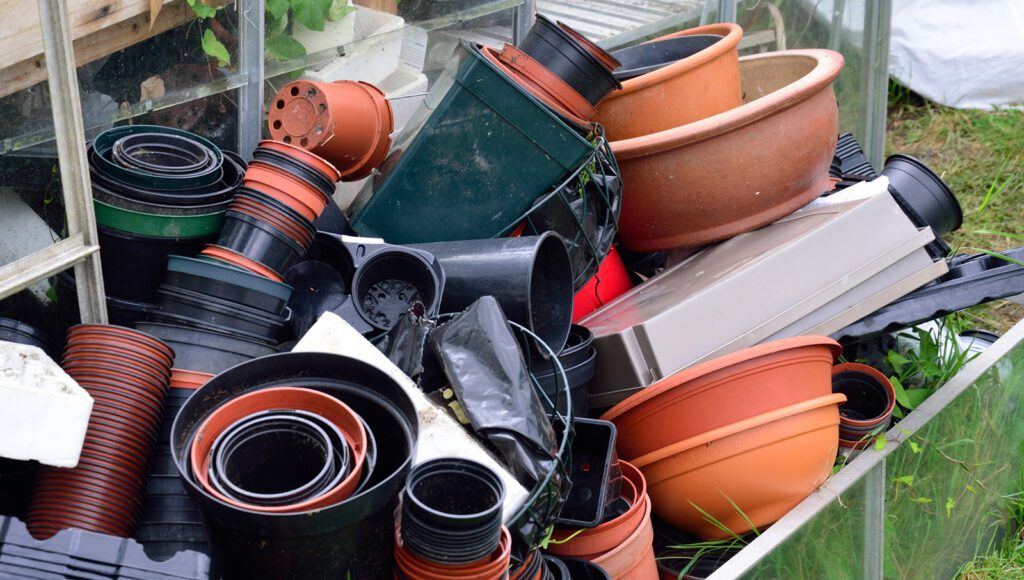
During a time when the negative impacts of plastic production and waste become ever more clear, the industry standard for U.S. growers and nurseries remains plastic pots. Perhaps up to 5% will be recycled, with the rest of the half a billion or so used every year ending up in a landfill or incinerated.
The estimated 500 million plastic plant pots, trays, and flats produced annually in the United States generate an estimated 350 million pounds (175,000 tons) of plastic waste.
The global market produces billions of plastic plant containers annually and, according to Cognitive Market Research, is projected to expand at a compound annual growth rate of 5% annually through 2031.
Until the late 1960s, clay was the most widely used material for flower pots. Those who couldn’t afford clay pots often used tin cans.
Today, the horticulture industry, like so much of the planet, has been plasticized. The vast majority of plants we buy come in plastic pots with plastic ID tags. Soil, mulch, fertilizer, and other products often come in plastic bags.
Marie Chieppo, an ecological landscape designer with EcoPlantPlans LLC, has been examining and writing about the use of plastic in the landscape/horticulture industry for the past six years. She has been working in the industry for 27.
She has noted plastics are deeply rooted in the horticultural industry, “playing a ubiquitous role in plant production with containers, glazing materials, irrigation systems, and fertilizer coatings.”
The Bourne, Mass., resident researched and authored a white paper, published in 2020, for the Association of Professional Landscape Designers (APLD) about the “true story behind the recycling of plastic plant containers.”
She and a fellow APLD member had found out about a program at the Missouri Botanical Gardens in St. Louis, where people were bringing in their plastic flower pots because they didn’t know what to do with them. The institution was awarded a grant and began collecting flower containers, which were upcycled to plastic deck planks.
The program, however, was discontinued in 2022, because “the kinds of plastic used to manufacture garden containers now have a negative value in the recycling industry.” The mix of plastic resins used to make plastic pots, trays, and flats includes some of the lowest-value types of plastic, according to Missouri Botanical Gardens. These resins are cheap to mold into containers durable enough to support commercial movement of plants, but aren’t suitable to re-manufacture.
The 19-page paper, titled “Plastic Pots and the Green Industry: Production, Use, Disposal and Environmental Impacts,” that came out of their interest in the Missouri Botanical Gardens program increased awareness about the fact most plastic plant containers end up buried or burned.
“I had no idea that it wasn’t being recycled, just like the majority of us,” Chieppo recently told ecoRI News. “It’s called ‘wishcycling.’ I’ve been in business for almost 30 years, so take 24 of those and add up thousands of pots per season that I was bringing to my recycling facility. I thought I was doing the right thing.”
Chieppo is a member of the Horticultural Research Institute’s Plastic Task Force, a group that was formed after she spoke with some of the nation’s largest growers for her 2020 paper. The accredited organic land care professional said “progress is being made on many fronts.”
Since the paper was published, APLD has created a campaign called Healthy Pots, Healthy Planet to educate professionals and consumers about the issue, Chieppo launched a website that educates and provides up-to-date information on ongoing efforts within the industry, and she began working with Weston Nurseries to keep pots out of landfills.
After speaking and working with Chieppo, the Massachusetts nursery with several locations began taking plastic flower pots and trays. All of the plastic pots and trays used in her landscape design business are now taken to Weston Nurseries. The containers are compacted, baled, and picked up by a Michigan company.
East Jordan Plastics Inc. recycles old containers to make plant trays, growing pots, and plant containers for greenhouses and nurseries. When the company’s recycled products are delivered, used containers are picked up.
“They’re limited. They have only so much space, but at least they’re doing it,” said Chieppo of Weston Nurseries’ efforts. She also noted Prides Corner Farms in Connecticut partakes in collecting used pots to be recycled by East Jordan Plastics. The Connecticut nursery also uses new containers made of 100% recycled plastic and is researching plastic pot replacements with hopes of soon having prototypes.
Three years after Chieppo’s white paper was published, the Ecological Landscape Alliance, of which Chieppo is a board member, published a follow-up report, 2023 State of the Pot. The report found plastic pots of all types dominate in the United States — 68% of nursery stock sold and 98% of herbaceous perennials sold.
“Plastic pots are single use packaging, often created from virgin petroleum and alternatives are not available in larger sizes and necessary quantities,” according to the 2023 report.
The report also noted: the United States is the world’s top generator of plastic waste at last count (2016); 75.6% of plastics in the U.S. were landfilled at last count (2018); 99% of plastic resins produced globally are made from fossil-based feedstocks; polystyrene, often the material used in packs or flats, has the highest cradle-to-grave emissions of all the plastic resins.
Chieppo said she created Sustainable Plant Pots to engage consumers, brands, garden centers, growers, recyclers, landscapers, and product engineers to seek alternatives to plastics. She noted treating plastic plant containers as single-use items has led to a mountain of horticultural waste.
“Educating people that this is the issue, that this is what’s happening, so they ask their nurseries can you do better with this plastic? Can you at least take it back?” Chieppo said. “Letting nurseries know it’s a problem, and that it is not recycled. People think it is, even nurseries think it is. It’s not, so getting the word out is huge and, with demand, things will change.”
Immediately ending the use of plastic pots isn’t possible, she said, but “we can prevent the majority of plastic pots from entering landfills if more than a just few companies recycled them. We need to create collection alliances and systems to help material get to these facilities.”
She wrote in a 2024 article published in Nursery Management that after the Second World War, “the housing market grew exponentially and with it the demand for plants. Growers and nurseries eager to fulfill orders had been limited in their offerings because bare root material covered in a clay-based slurry or plants grown in ceramic pots prone to breakage were not suitable to be transported long distances.”
She noted that once plastic plant containers became available, horticulture became one of the fastest growing industries. Plastic has long since been the default container used in growing, transporting, and selling plants.
To write the article, Chieppo visited nurseries and asked how they handle their pots once they no longer need them. The default answer she discovered was “they get recycled.” But she found that is rarely the case.
“What I learned was sobering: 95-98% of plastic plant containers are thrown into landfills,” she wrote. “Wondering how this could be, I reached out to people in recycling, producers of plastic containers, growers, people that work in our industry, environmental groups and researchers to learn if I somehow was not connecting the dots. Having used thousands of plastic pots over 26 years in business and depositing them in my recycling bin, my heart sank.”
She found that a number of factors, including China’s decision in 2017 to stop taking most foreign recycling and this country’s lack of infrastructure to handle the amount of plastic we produce, created a perfect storm of waste.
She has noted that a product with the chasing arrows stamped on it doesn’t ensure that it is recyclable. There is a large difference between what is recyclable and what actually gets recycled, according to Chieppo.
Plastic plant containers pose a particularly complicated challenge to recycling facilities, she said. Many of them are black and most recycling facilities’ optical lasers can’t detect the absence of color. Containers can also be gritty, which isn’t ideal for expensive recycling machinery, and they can spread disease and invasives, so reuse is usually frowned upon; they are cost prohibitive for companies to collect and clean; they are typically composed of weak plastics with minimal market value once pelletized; and there are only a handful of facilities across the country that will recycle them.
Thus, it’s much cheaper to manufacture new pots, even if the old ones were only used once.
In 2009, 4 billion plastic plant containers using 1.7 billion pounds of petroleum byproducts were manufactured worldwide, according to Chieppo’s story “The container challenge: A journey into the world of plastic plant containers.” She believes those numbers are higher today, but tracking has waned.
She discovered during her research that most pots are made of weak plastics that had minimal value as feedstock. At least four different types of plastic are used to produce plant pots, which complicates recycling efforts.
“Our reliance on inexpensive and easy-to-access virgin oil significantly reduced demand for recycled material,” Chieppo wrote.
She noted growers and nursery owners are hesitant to use alternative materials. The main barrier is cost. Plastic costs between 15 and 25 cents per pot, while bioplastics pots made of cellulose cost 75 cents to a dollar each. Plastic containers are also durable and easy to ship.

As for other alternatives, there are wood-pulp, fabric, keratin, and coconut-fiber pots, which, unlike plastic containers, have the potential to reduce the water, chemical, and carbon footprints of greenhouses and nurseries. There are also other “biobased” alternatives made from plants, paper, newspaper, and manure.
A Denmark-based company Ellepot offers a plastics-free planting system that incorporates degradable paper.
Chieppo said consumer pressure is the best way to reduce the industry’s dependence on plastic.
Plastic flower pots that are 5 gallons or smaller can be recycled, according to the Rhode Island Resource Recovery Corporation (RIRRC), which operates the Central Landfill in Johnston. Black plastic flower pot liners and plug trays aren’t recyclable. Plastic flower pots larger than 5 gallons can be dropped off for recycling only through a special rigid plastics program operated by some municipalities. Twenty-one of Rhode Island’s 39 cities and towns offer this service, according to RIRRC.
In Massachusetts, most plastic plant containers aren’t recyclable in curbside bins because of their dark color and mixed plastic resins. In Connecticut, black plastic planter pots and trays aren’t acceptable in the state’s mixed recycling program. Only plastic pots that are green, red, or white are acceptable.



Thank you for covering this issue, Frank! Plastic pots from nurseries drive me NUTS. There appears to be no way to return them. no way to recycle them. and I’m hard pressed to find a reuse purpose. And I’m of course only one person. I’ve gotten nowhere with my questions to date. Thanks for introducing Sustainable Plant Pots – I wrote to Marie and will keep up with their efforts, reports, and recommendations. As she points. the missing R is Redesign. Amen. Thank you!
This is a huge problem and Chieppo is to be commended for exposing the issue. In hope this article and her work encourages RI legislators to make it easier to recycle these singl use containers and the nursery industry to come to grips and develop mass produced container alternatives.
Enlightening. So many of us feel guilty about this every spring! We all suspect these many pots don’t get recycled and now we know, so thanks for this. Let’s hope this organization is the beginning of a new movement that gets results. Don’t you wonder what Sweden and Norway and the Netherlands do?
Thanks for bringing this to everyone’s attention, Frank. Like everything else, not a lot we can do about it but be aware, and try whenever possible to not get the plastic, and/or at least try to get it reused or recycled. I for one, have a bunch saved (I refuse to send them to the landfill) so if anyone needs any…
We’ve known for some time that black plastic is non-recyclable, whether it’s the flimsy black plugs or the “black plastic flower pot liners”, which I’m assuming are those flimsy black flower pots some plants are sold in that are less than 5 gallon containers. I question whether the larger than 5 gallon black containers are, indeed, recyclable, even in the rigid plastic recycling program at RIRRC. It is monumentally frustrating and disappointing. Single use plastic is a scourge. Period.