
North Woods Project Puts URI’s Little-Known Outdoor Classroom at Center Stage
November 6, 2025
Share


KINGSTON, R.I. — What do you get when you take a 300-plus-acre parcel of undeveloped woodlands with a walking trail and add high-tech flourishes such as an augmented reality walking tour and explanatory maps?
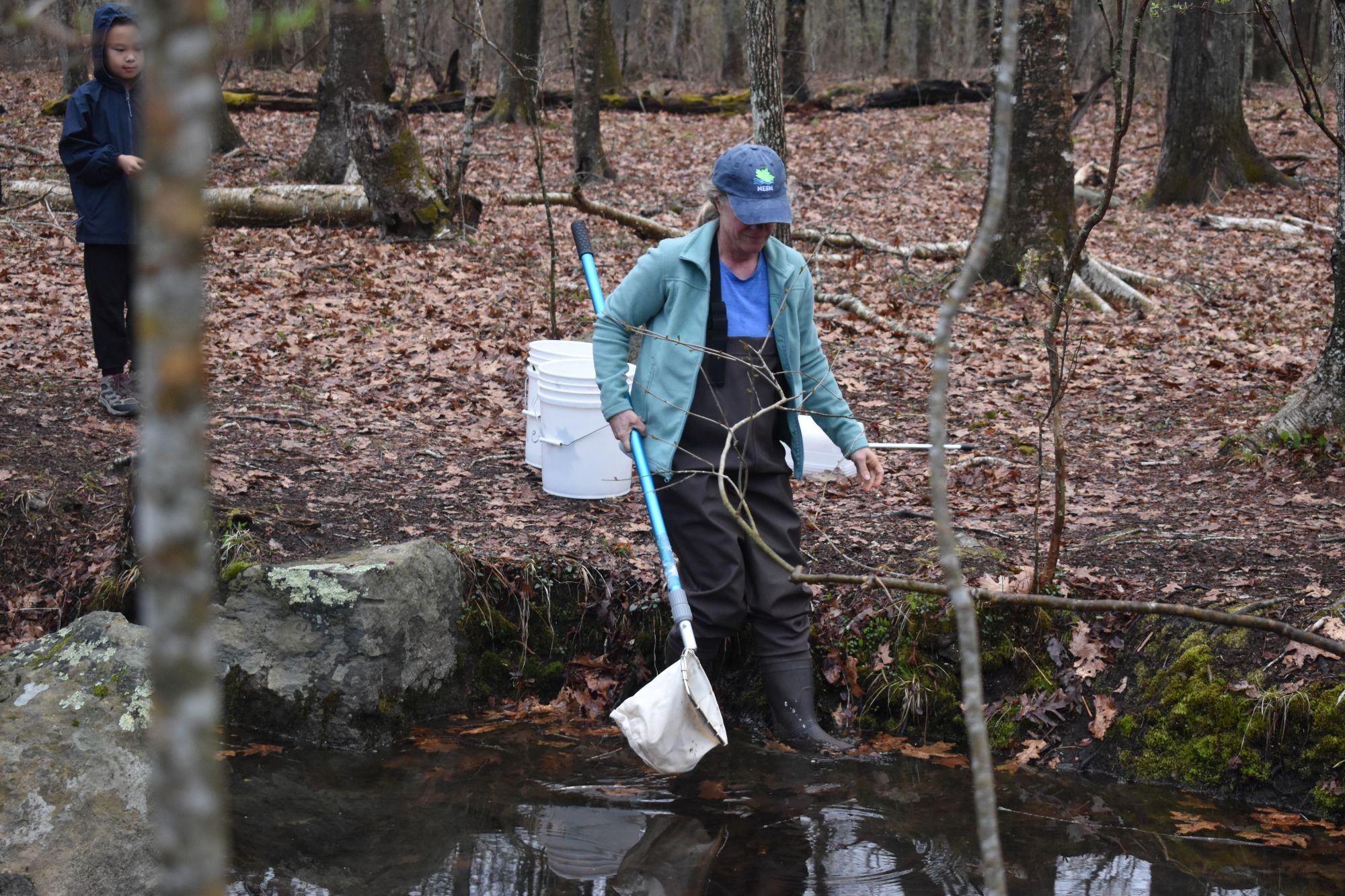
You get the North Woods at the University of Rhode Island — an outdoor classroom used to teach ornithology, herpetology, entomology, wetland ecology, environmental writing, art, and science communications.
“Really, everything is studied here,” said Madison Jones, an associate professor in URI’s departments of Professional & Public Writing and Natural Resources Science.
On a recent walk along the Blue Trail in the woods, which are in the northern part of the campus off Flagg Road and make up 25% of the university’s 1,200-acre total, Jones was almost evangelical about the educational possibilities of the North Woods.
“I give talks to different classes about North Woods frequently,” he said. “And at least, when I first started doing it, we would only have, you know, a small portion of the class, maybe one or two students who had even ever heard of it. So that’s kind of the exigency behind the work that we’re trying to do with the North Woods project, kind of the blanket portfolio under which all these different things we’re doing falls. And the idea is basically raise awareness of the North Woods, to get people to see how this is a valuable research, teaching, learning, service, [and] recreation space.”
Jones, who came to URI in 2020, is the founder and director of DWELL (Digital Writing Environments, Location, & Localization ) Lab, a joint initiative between the Professional & Public Writing and Natural Resources Science departments that focuses on innovative approaches to science communication and which is overseeing the North Woods Project, an effort to combine digital field methods, science communication, and environmental advocacy.
“Through interdisciplinary partnerships and community-focused programming, we are working to peel back the layers of place and give rise to a diversity of voices, stories, experiences in, and understandings of, the North Woods,” said Stephanie West-Puckett, an associate professor in the Department of Professional & Public Writing and the director of first-year writing in URI’s Harrington School of Communication and Media.
“So far, we have a small and growing cohort of folks who are bringing classes here,” Jones said.
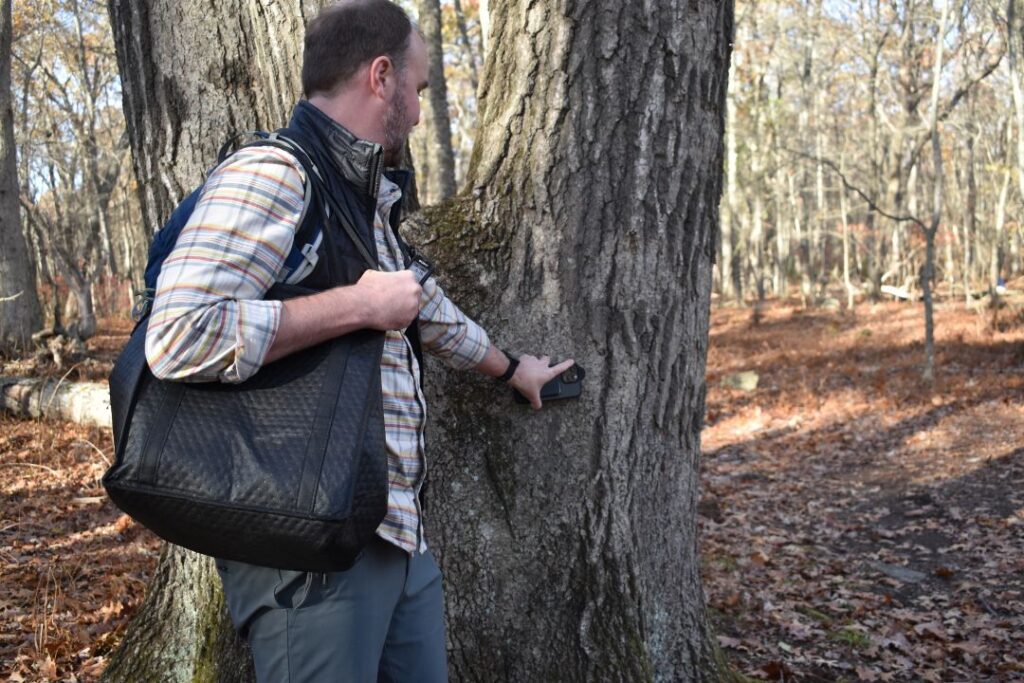
As he was talking, Jones came upon a tree with a small black plastic circle attached to the bark, which he said was a near-field communication chip (NFC). He took out his phone and held it close to the chip.
“You tap your phone to this little thing, it acts like a QR code, and it pulls up a link, and that’s the first stop on the walking tour,” he said.
It’s the beginning of a “StoryWalk,” a way of combining storytelling with outdoor exercise and exploration. As participants walk along the path, they can listen to portions of an audio story by tapping four NFC chips along the way, immersing themselves in the story’s setting. The North Wood’s StoryWalk, titled “How Birds Got Their Song,” is a traditional Indigenous tale narrated by Lynsea Montanari, Indigenous empowerment coordinator at the Tomaquag Museum.
The creator, the story goes, told native bird species to fly as high in the sky as they could, and when they returned to Earth, they would receive their songs. As each bird returned, it was granted a unique song. But the tiny hermit thrush, believing she could not fly as high as the others, jumped onto an eagle’s back with the hopes of soaring highest and receiving the prettiest song. Instead, the creator knew she was dishonorable and today the hermit thrush is only heard singing quietly in the deepest part of the woods.
The StoryWalk, Jones said, had its genesis in the classroom, and Erin Edmonds, a member of URI’s Department of Natural Resources Sciences and director of the Metcalf Institute, worked on it for a year before the DWELL Lab produced it and installed it in the woods. For those who prefer the written word, a transcript of the story can be found by clicking here.
Being immersed in the environment in such a way, said Jones, who teaches multi-departmental classes on writing and natural sciences, is invaluable for learning.
“I teach science writing classes. And typically, those kinds of classes are taught just in a classroom, right? But what an amazing opportunity for an environmental writing class to actually get to go out and, for instance, see a remediated Superfund site,” he said, referring to the former West Kingston town dump in the North Woods property, which was cleaned up and now houses a URI solar array.
“Or to, you know, to look at a transitional space like this one, where you can see this movement into this mountain laurel …” he added, before once again stopping on the trail at a point where the trees and shrubs drew back and a small grove of pine trees appeared.
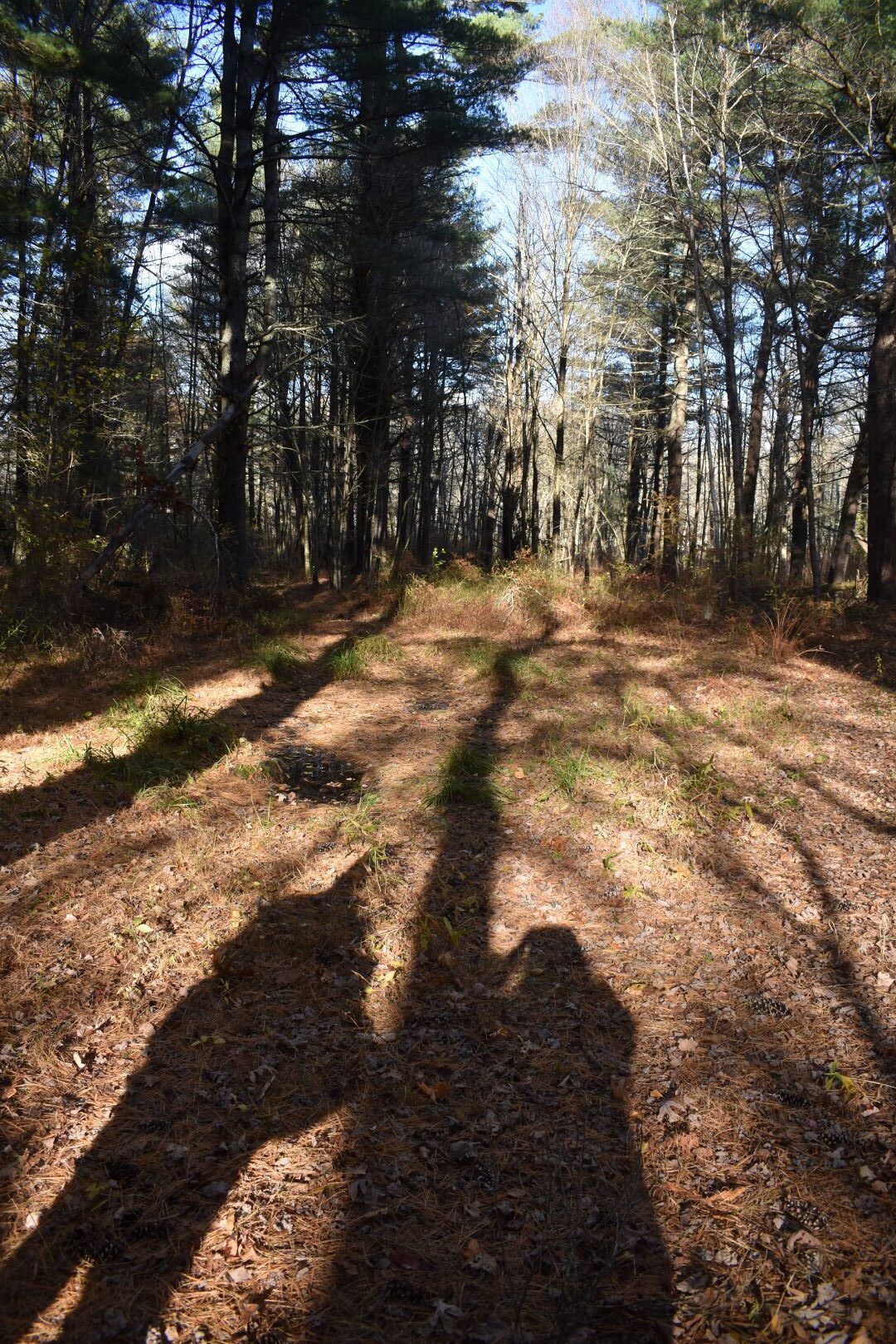
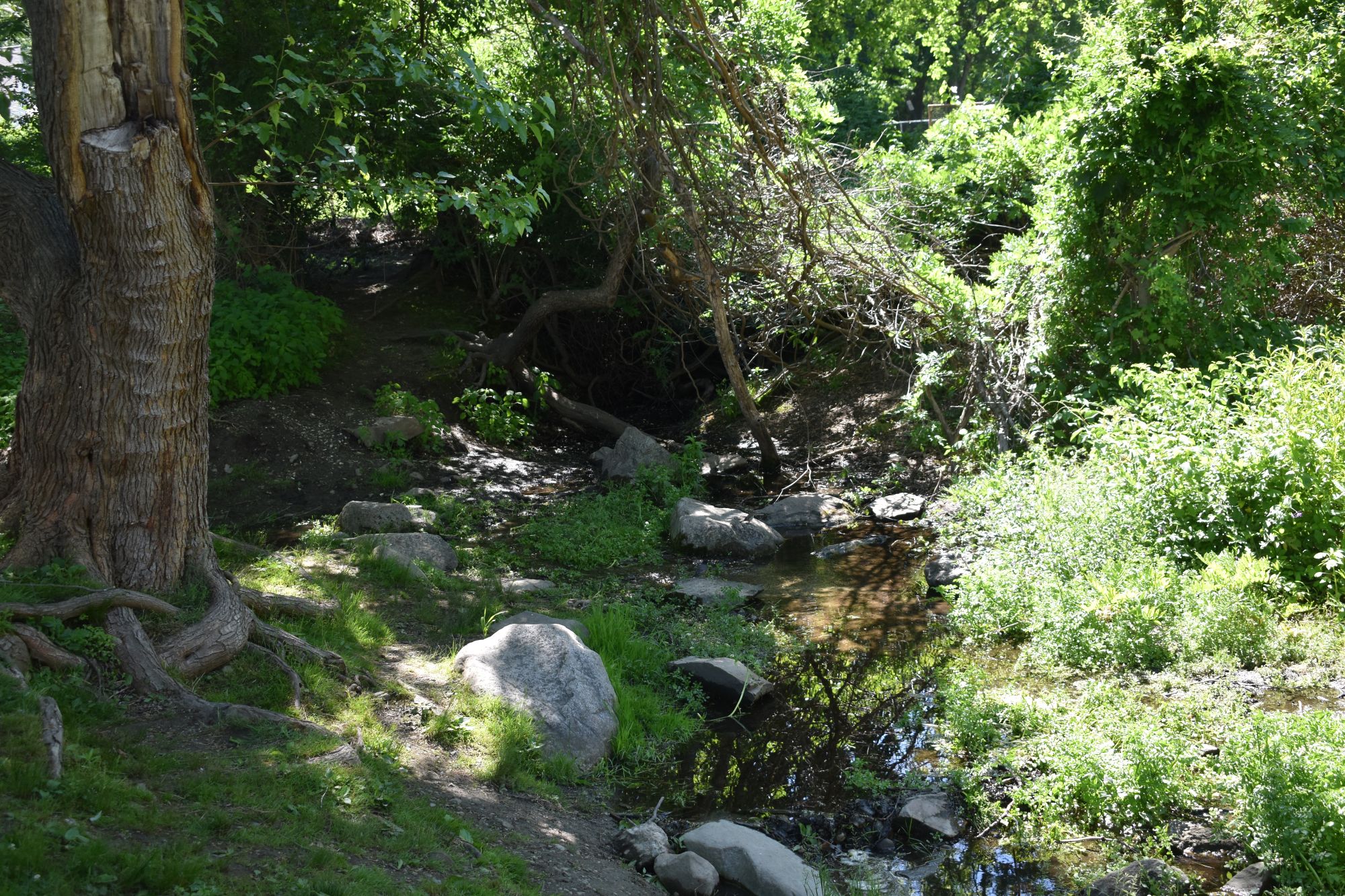
“Oh, this spot is kind of interesting,” he said. “Notice, above you, this is the only stand of pine trees. And you hear the wind sounds different here.” He pointed out the way the pine needles dampened the sound of our steps, and then, indicating what looked like a puddle amid the needles, he said, “Right here, this is really interesting spot. You know, I grew up in rural Alabama, and to me, this looks like someone went mud-riding out here, right? You’ve got tire tracks. And so what has happened here is from, you know, some kind of man-made intervention. We’ve got, sort of a vernal pool, right? And in the spring, this will flood as well. I just think it’s a really neat spot for that reason.”
Elsewhere on the trail Jones pointed out the remnants of foundations from a Colonial settlement.
“You can see there’s all kinds of just incredible history there,” he said. “This was cattle lands during the Colonial period, which is hard to imagine. And then you have the unceded territories of the Narragansett people. There’s just so much evidence of human use, you can kind of observe it everywhere around you here.”
The North Woods Project takes pains to respect the origins of the land and those who used it on its website: “The University of Rhode Island, including the area known as the North Woods, occupy unceded territory of the Narragansett Nation and the Niantic People. There has been a continual presence of the Narragansett Nation on this land for over 30,000 years, and they remain the sovereign stewards of this land. Our work includes teaching and learning more about Indigenous history and present-day communities, and the ongoing process of becoming stewards of the land we, too, inhabit.”
University President Marc Parlange said, “The North Woods remind us why our location matters. They give our students and faculty the chance to study the environment first-hand and offer everyone on campus a place to recharge. We’re fortunate to have such a resource and I’m especially thankful for the many faculty, staff, and students who dedicate their time and energy to caring for and protecting the North Woods.”
One of the goals of the North Woods Project is to create a crowd-sourced field guide to the woods, both to raise awareness of the ecological value of the area and to encourage its use by all types of people, not just URI students and faculty.
Using grant funding, West-Puckett said, “Madison and I are producing a ‘people’s field guide’ that will provide multiple entry points for learning and connection with the forest.”
She said the vision for the field guide includes different genres of writing, “including scientific, journalistic, and creative writing as well as visual art and digital media.
“To that end, we are inviting writers, journalists, storytellers, naturalists, artists, and content creators of all ages and backgrounds to represent their experiences in and knowledge about the North Woods,” she said.
West-Puckett said she sees a bright future for the North Woods.
“The North Woods is such a precious pedagogical resource — a teaching forest that everyone should know about and have access to,” she said. Speaking of a recent Write Out event held in the woods, she said, “Of the over 900 students who participated, only a handful had heard of or visited the forest. And most of those students were environmental and life sciences majors. I’d love to see more engagement with the forest from faculty in the humanities.”
Both Jones and West-Puckett said the North Woods should play a larger role in life at the University of Rhode Island.
“A trip to the North Woods should be built into campus tours for prospective students and orientation programming. We should organize group hikes during parents’ weekend,” West-Puckett said.
“I’d like the university to have better messaging, clear signs,” Jones said. “One of my students developed a website for the North Woods, the first one. I’d like to see more support for things like that.”
Adding accessible trails and infrastructure for people with disabilities to access the woods is also on their wish list.
“Accessibility is a major issue,” West-Puckett said. “Creating barrier-free access for people with limited mobility would require a massive investment. We also need more resources that support place-based learning for students, faculty, staff, and the larger community. We need waysides, better trail markers, and public-facing interpretive materials.”
The woods, which are home to 500 different species, provides a living, breathing classroom among the concrete and brick of URI. Among the professors taking advantage of it is Travess Smalley, an assistant professor in printmaking, who takes his students into the woods to collect leaves and make rubbings and other art from the forest.
“As we walked the woodland trails, discussions flowed freely, touching on topics ranging from the stillness of the forest to color theory and creating natural dyes,” Smalley wrote on a website about the North Woods project. “It was evident that the North Woods had sparked a sense of curiosity among the students.”
For a complete list of the components of the North Woods project, click here.
Full disclosure: ecoRI News is working in partnership with the DWELL Lab and URI on the North Woods field guide.
Sounds great. I’d like to go there for a hike. A map and/or directions would be helpful.
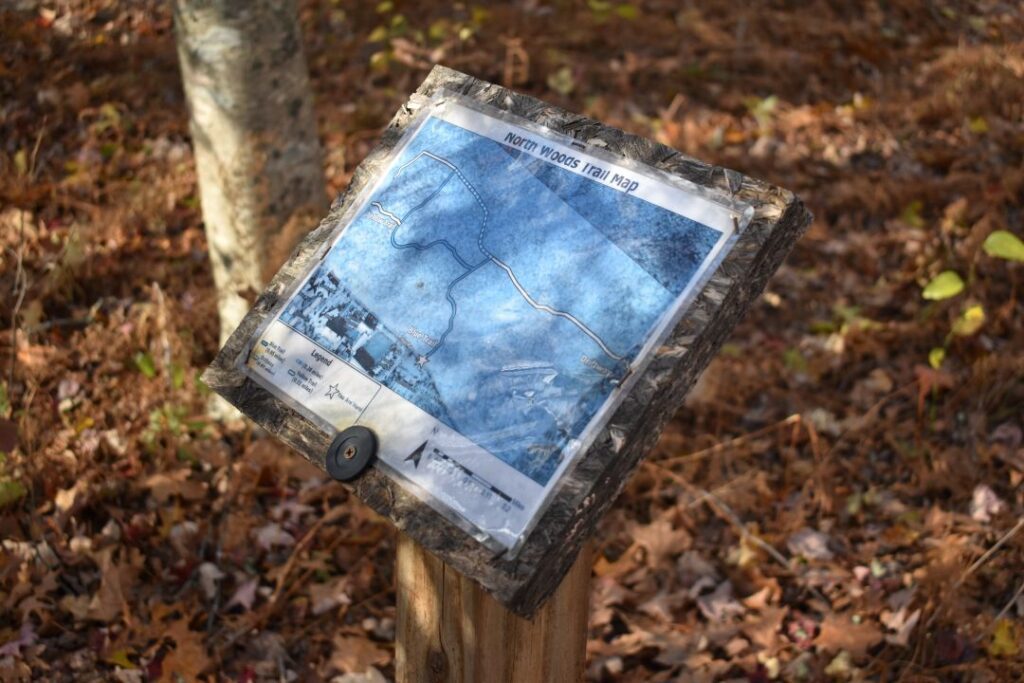
I would love to hike there. Is there a map of some sort to show the trails?
I don’t know much about North Woods but Doesn’t URI own Alton Jones Campus? I believe that’s contiguous to Arcadia Wildlife Management Area. Talk about opportunities to study ecology! Here’s a potential opportunity which URI should explore.
Pull the dam on the small pond in Alton Jones which is currently a main contributor of warm water to a ecosystem which currently has a struggling population of wild brook trout and have students study the effect on the wild brook trout as well as document and study the ecological response in the new fluvial habitat and surrounding environment which would result from dam removal. Real science and opportunities for engineers, biologists, ecologists, and restoration scientists.