
Blithewold’s Big Bamboo Birds Meant to Send Message of Conservation
October 6, 2025
Share


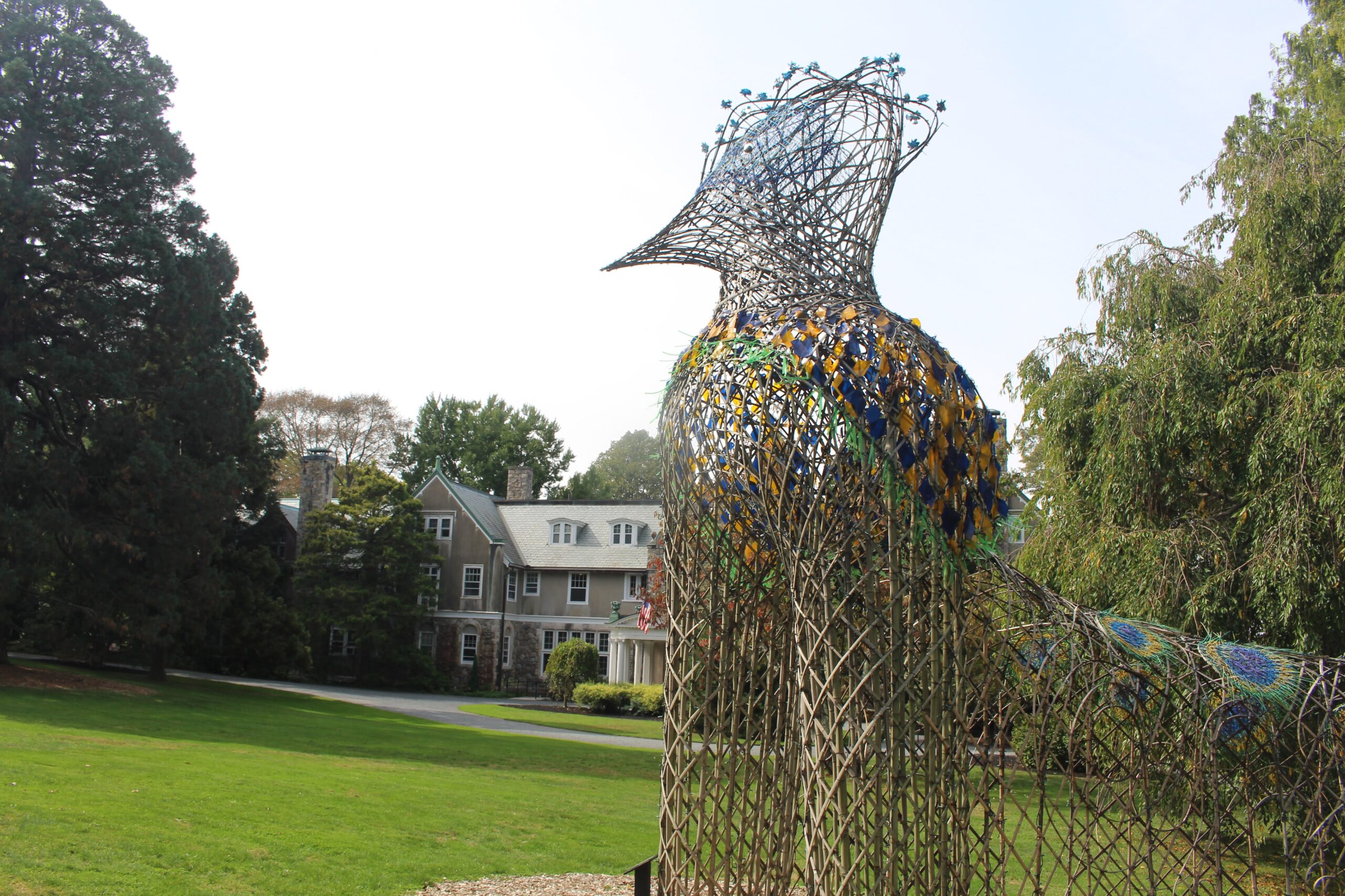
BRISTOL, R.I. — It used to be possible to see an eastern bluebird or a sandhill crane around the gardens at Blithewold Manor on an average day, but now there are two gigantic examples of the two species perched on the grounds all the time.
The big bamboo birds are a part of an installation of sculptures dotted around the 100-plus-year-old property created by artists Andy Moerlein and Donna Dodson, aka The Myth Makers.
The married couple have collaborated for 15 years, creating large-scale outdoor art. Based in Maynard, Mass., Dodson and Moerlein have built sculptures around the world together, combining their distinct styles.
“We sort of morphed into this idea of doing kind of a mashup of Andy’s signature sapling technique and my vocabulary with the animal heads,” Dodson said, “and then it kind of took on a life of its own.”
While the bamboo birds are on display at Blithewold indefinitely, they aren’t meant to be permanent creations. Depending on the conditions around a sculpture, the artists said a bamboo bird has an average lifespan of two to five years.
Before they took on bamboo birding, their earlier collaborations slid even further on the ephemeral scale. In the past, they made snow sculptures out west and fire art for Providence’s WaterFire.
“For 15 to 25 minutes, you see this line drawing just, like, explode into flames,” Moerlein said of the fire art, “and then it all falls apart and disappears.”
The pair moved toward slightly more permanent art after doing a residency together in 2017 to learn how to work with bamboo.
Light, hardy, and pest resistant, Dodson said it’s an almost ideal medium to work with.
Dodson and Moerlein source a lot of their bamboo from sustainable farms in the southern United States and either build the birds directly at the site or construct them at their warehouse, then truck them to the location (like they did for the Blithewold birds).
But the construction of the birds is only one part of the artistic process, which starts months if not years earlier for the Myth Makers.
“We do a lot of local research, we do site visits, we do a lot of our own internet searching, as well as collaborating with our partners,” Dodson said. “We try and gather stories.”
The Van Wickle family bought the property where Blithewold sits in 1894. Augustus Van Wickle had wanted a place to moor his yacht, while his wife, Bessie, wanted a vast property to explore her love of horticulture.
Members of the Van Wickle family occupied the home and grounds until the 1970s, when the youngest daughter of the Van Wickles’ died at the age of 78, leaving the property to be turned into a museum.
Much of the family’s furniture, decor, and even china is still on display within the Queen Anne-style mansion. Curators rotate Bessie’s beautiful gowns through displays on the museum’s second floor.
When Dodson and Moerlein first visited the property, they saw a peacock cloak in one of the cases.
“We just thought, ‘Oh, wow, this so represents the regal beauty of this young couple that moved into this house and lived on this estate.’ And so we knew we wanted to have a peacock there,” said Moerlein, adding “although we make all our work rather gender-free or feminine. So, that’s a peahen, even though she has all the floral delicacy of a true woman.”
The other birds in the collection are a nod to the natural history of the area.
The sandhill crane is a native species long decimated but now making a comeback in New England. Moerlein said they instantly thought of the bird when they saw the property’s huge grassy lawn, an ideal location in which to see a flock of the cranes.
The sculpture of the crane, with its red crown, looks out over the ocean, towering over the green lawn and almost as tall as the trees behind it.
Across the grass, a great horned owl with more muted colors blends into the scenery.
Other native species, including a bluebird, bittern, and a queenfisher (the name for a female kingfisher) are scattered throughout the grounds.
Moerlein cautioned that the birds aren’t exactly anatomically accurate — and they aren’t supposed to be.
“Well, we’re not ornithologists, and we’re not making birds for people to say how they identify things,” he said. “We’re really aiming for birds that have a delightful demeanor about them, but we also attach them to the real-life story of birds.”
And that story can sometimes be worrisome. Although they don’t claim to be experts, Dodson and Moerlein have spent so much time in birding hot spots through their work, as well as tagging along on birdwatching trips with Moerlein’s birder father, that they can both identify a hundred or so types of birds.
“We’re very concerned, as amateur birders, about the state of birds in our world today,” he said. “There’s a lot of really strong, frightening statistics coming at us every day.”
Perhaps the story of the birds makes those who see the sculptures a little more interested or a little more connected to the fragile but beautiful environment around them.
“We really think it’s important when you put art in public, especially at the scale that we do, that there’s a story,” Dodson said. “There’s a purpose, there’s a message.”
I’ll take these any day over trolls.