
Removal of Morley Field Will Reduce Green Space in Pawtucket Neighborhood That’s Already a ‘Park Desert’
August 21, 2025
Share


PAWTUCKET, R.I. — It’s barely 11 o’clock in the morning and with nothing but sunshine coming from the sky, temperatures in the city have already reached 85 degrees on this August day and are still rising.
It’s the third day in a row that temperatures in Pawtucket will exceed 90 degrees, making it officially the third heat wave in the city this year. At the end of Moshassuck Street, sandwiched between the eponymous river and a demolition site, William H. Morley Field, the neighborhood’s only significant piece of green space, remains locked to the public.
Moshassuck Street is as noisy as it is hot. Somewhere past the end of the street, across the river, you can hear the six lanes of motor vehicle traffic from Interstate 95. At the other end of Morley Field is a demolition site, with a handful of excavators and other heavy construction equipment busy demolishing what is left of the old Microfibres factory to build a controversial, massive distribution center.
A man and a woman sit just outside the gates, unable to access the 5.3-acre park on a hot day, instead finding relief from the heat in the shade cast by the overgrown vegetation that has overtaken the chain-link fence surrounding the field.
The steel bleachers, where parents once watched their children’s soccer games, remain partly visible through the thick vegetation. Nearby, at the top of a wheelchair ramp, is another locked gate, with a sign posted on the fence partially obscured by overgrowth and graffiti.
“NO TRESPASSING,” the sign reads. “AREA UNDER DEVELOPMENT.”
Pawtucket’s park desert
For residents of the city’s Woodlawn neighborhood, there’s a hole where Morley Field used to be. Prior to its closing by city officials in 2022, it was the only significant piece of green space within a 10-minute walk for most residents in the neighborhood.
On paper, Morley Field is actually two parcels. The park was created when the city acquired two separate parcels in the 1970s. One part was gifted to the city by the park’s namesake, William H. Morley, an executive with the Anaconda Wire & Cable Co. The remaining 3 acres was purchased with a National Park Service grant.

Despite its location between a factory and an interstate highway, Morley Field was an oasis for local residents.
“Most Woodlawn residents don’t have a backyard to play in; the kids play in the streets, even on hot days like today,” said City Council member Clovis Gregor, who represents the Fifth Ward, which includes the neighborhood. “It’s what we used to do as well. There’s hardly any parks.”
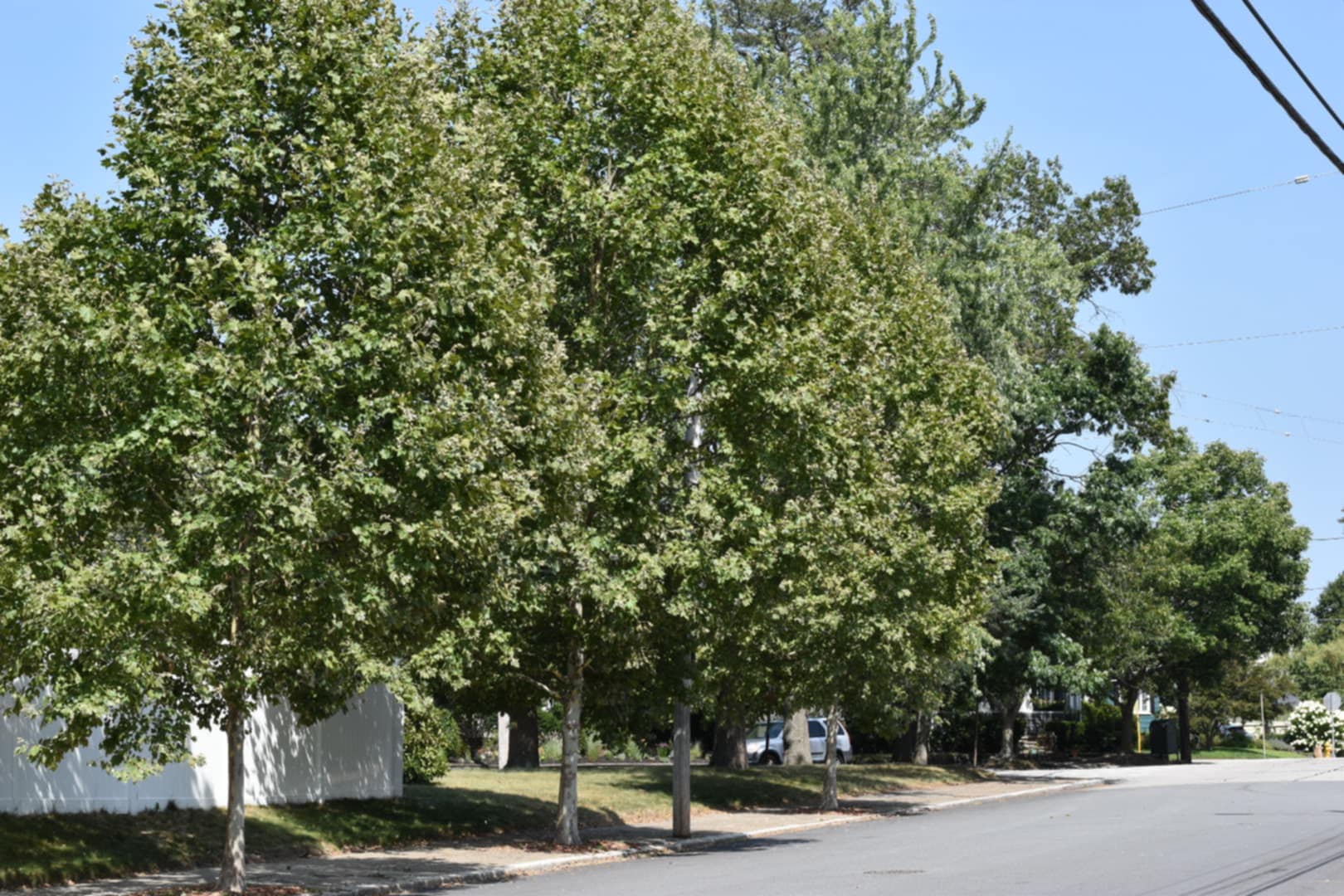
Forget parks, there’s barely any greenery at all in Woodlawn. Tree canopy cover throughout the neighborhood, which can be a literal lifesaver in the summertime, is virtually nonexistent. A count by the nonprofit Tree Equity Score, which studies and maps environmental justice issues in the United States, shows little tree cover for the Census tracts surrounding Morley Field.
The area of Woodlawn between Main Street and the Moshassuck River only has 16% tree cover. Most other tracts in the neighborhood range from 14% to 19% tree coverage, with two tracts bordering Oak Hill, a neighborhood with significantly more street trees and greenery than Woodlawn, exceeding 20% tree canopy coverage.
“There’s a marked difference environmentally, canvassing in Woodlawn versus Oak Hill,” said Rep. Jennifer Stewart, D-Pawtucket, who has represented the neighborhoods in the General Assembly since 2022. “There’s so much tree canopy in Oak Hill, even when you’re canvassing a block that doesn’t have much shade. You know it’s going to be like crossing the street or going down a few yards before you hit the shade, which feels so good.
“The streets around here, basically any street west of Pawtucket Avenue, just don’t have” tree canopy.
That means that during the summer, the urban heat island effect can raise the overall temperature of the neighborhood much higher than that of other areas of Pawtucket with more tree coverage.
According to the Tree Equity Score report for the area around Morley Field, the heat disparity in the Census tract is up to 21 degrees hotter than average. Even the tracts bordering the Oak Hill neighborhood have average heat disparities exceeding 19 degrees Fahrenheit.
That means Woodlawn, with its lack of green space and tree cover, is literally hotter than other parts of the city during the summer, and residents in the neighborhood have nowhere nearby to go to beat the heat.
If Woodlawn was a whiter or wealthier neighborhood, it’s unlikely that a project like the distribution center would be sited at all, let alone partially in a public park.
Woodlawn is a neighborhood heavily populated by people of color. Demographic estimates from the Environmental Protection Agency’s EJ Screen, an environmental justice mapping tool that was shut down by the Trump administration, show that people of color make up between 72% and 80% of the neighborhood population.
“A lot of people are low-income, most of them live in multifamily homes,” Gregor said. “There are some single-family homes, but not that many. For the most part it’s two or three families to a home, many are people of color, Cape Verdeans are probably the highest.”
Just under 60% of Woodlawn residents live below the poverty line, and many do not speak English as a first language.
Without Morley Field, the neighborhood’s nearest park is Payne Park on Jefferson Avenue. Residents living in northern Woodlawn are a 10-minute walk away from Payne Park, but for most residents of the neighborhood, it’s actually much longer. It’s a 24-minute walk from Morley Field to Payne Park.
“Woodlawn as a whole basically has no green space now,” Stewart said. “There’s Payne Park, but it’s much smaller than Morley Field, and there’s a basketball space, and a concrete wall for other kings of ball-related games, but it’s a very small green space. It’s not a playing field like Morley Field was.”
Payne Park is mostly a playground, with two basketball courts in one corner. It’s pretty limited in its uses. While Morley Field was mainly an athletic field, when it wasn’t used for sports it could be used for exercise, dog-walking, or just as a spot to get away from Woodlawn’s built-up asphalt environment.
Residents seeking a similar environment to Morley Field will have to walk outside Woodlawn to the next nearest athletic field, Max Read Field. It sits on the banks of the Seekonk River with Riverside Cemetery and the Tidewater Landing Stadium as its neighbors on Pleasant Street.
Max Read is far longer than a 10-minute walk for Woodlawn’s residents. It’s a 31-minute walk alone from Morley Field, and requires pedestrians to cross busy thoroughfares with little safety infrastructure for anyone not driving a motor vehicle.
Sure, alternative parks are only a mile away. But you’ve got to go up hills, and residents shouldn’t have to do that. They should have a really accessible spot, and that’s what they had before the city abandoned it.”
— Clovis Gregor, Pawtucket City Council
It’s far from a pleasant trek in the summertime heat, as this ecoRI News reporter learned in an attempt to walk to Max Read Field. Parking at a strip mall on East Avenue during a heat wave, I walked down Ridge Street, traversing its steep hill. By the time I reached the turnoff for Pleasant Street, I had to give up and turn back.
It was early afternoon and the temperature had already exceeded 90 degrees that day. I gave up just a few blocks from completing the hike, fearing serious heat exhaustion. For Woodlawn residents without a car on the hottest days of the summer, park access is difficult.
Paving paradise for a parking lot
Morley Field was originally closed in spring 2022. The city fenced off the field as a precautionary measure after soil tests at the time, commissioned by the Blackstone Distribution Center LLC, the holding company redeveloping the parcel next to the park, found lead and polycyclic aromatic hydrocarbons concentrated above acceptable levels.
ecoRI News reported in 2022 that city officials were floating a plan to sell Morley Field to JK Equities LLC, a New York-based firm that wanted to demolish the old Microfibres factory, which went bankrupt in 2016, and build a 165,000-square-foot distribution center.
Preliminary plans for the site at the time were supported by the mayor, City Council, Zoning Board of Appeals, and City Planning Commission, with the council approving a 20-year tax stabilization agreement for the project, which would save the developer $6.6 million.
JK Equities’ project promises to raise the property value of the abandoned factory and provide up to 350 jobs to local residents. The factory, which was operational for 90 years, made flocked fabrics for upholstery, furniture, and specialty projects. There were several underground storage tanks that held fuel oil and solvents.
As a result, the site was contaminated with petroleum hydrocarbons, arsenic, and chrysene detected at concentrations above safe standards, according to a site investigation report commissioned in 2021 by JK Equities.
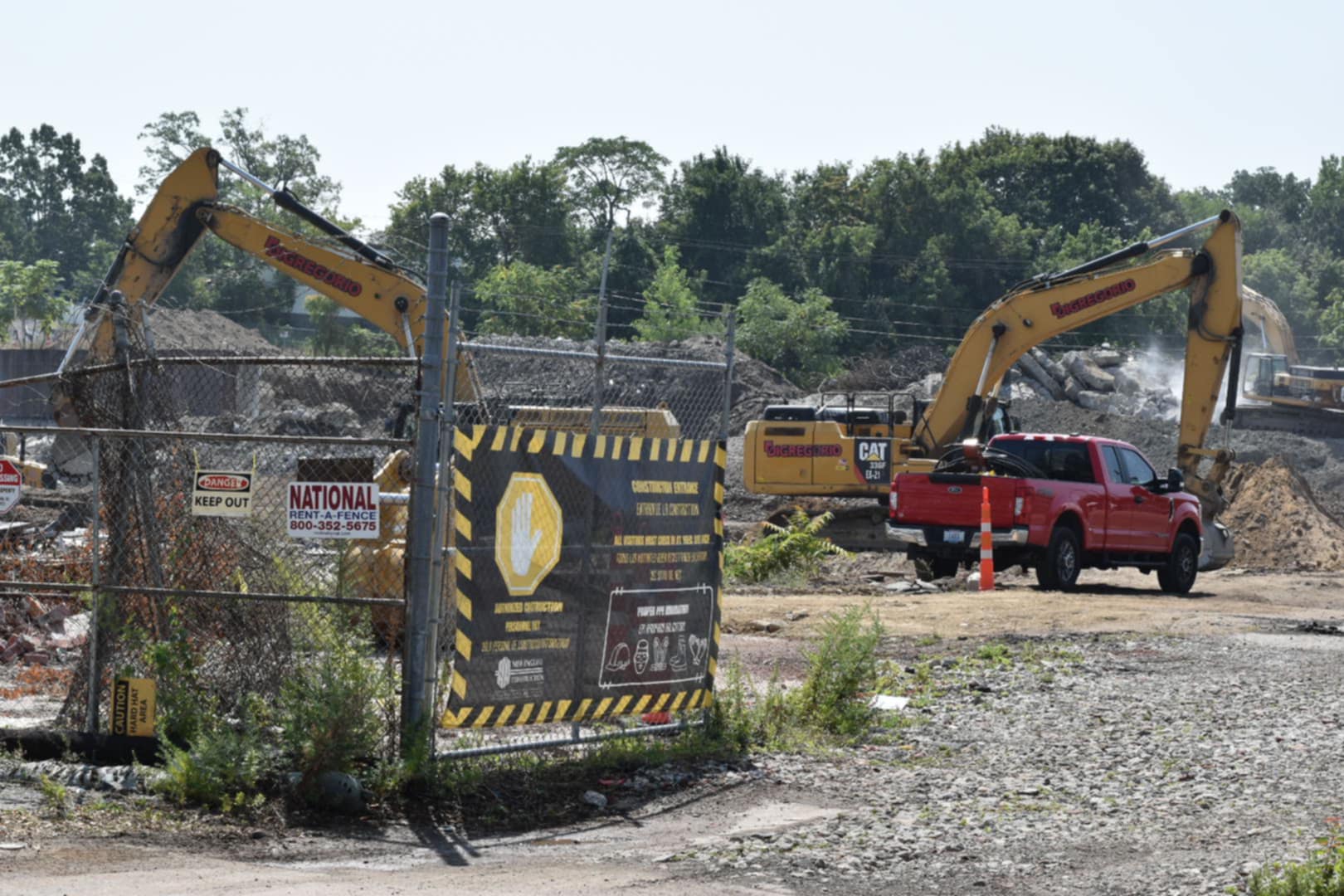
The original plan was to bury 1,400 tons of contaminated dirt and debris from the factory site in Morley Field. The park would be capped, paved over, and made into a parking lot for the company to use at its new distribution facility. Pushback to the project has limited the scope of the project to 3 acres on the site, with the remaining 2 acres of Morley Field to be used for “passive recreation.”
The plans have raised accusations of environmental injustice, and repeatedly attracted the ire of Woodlawn residents, environmental groups, and other advocates who want to see the park restored.
“We need you to open Morley Field, period,” said Mary Healey, a member of the city’s Parks Commission, at an Aug. 9 City Council meeting. “If you don’t open the field, I’m sorry, but you’re complacent.”
Healey wasn’t alone in scolding the council at that meeting. In total, 15 members of the public testified, asking council members to abandon the deal it made to develop Morley Field and save the park. They also supported efforts by Gregor to rescind the tax stabilization agreement, which some residents view as subsidizing JK Equities to close the park.
Supporters gathered before the City Council that night amid rumors the board might rescind the agreement, since the developer has missed some of its construction deadlines outlined in the original tax treaty.
JK Equities secured its final financing for the project in June, breaking ground on the distribution facility project June 25. Construction is expected to last 14 months.
Attorney Kelley Morris Salvatore, who along with JK Equities principal Jerry Karlik spoke to the City Council prior to the public testimony, refuted the notion that the council could cancel the tax agreement.
“To be clear the developer is not in default of any of its obligations and continues to act in full conformance with the tax stabilization agreement [TSA],” Morris Salvatore said. “The city recently issued an estoppel certificate, stating that the developer is in compliance with the TSA and specifically exists no state of facts that would constitute a default on the part of the developer under the TSA.”
Although the project is under construction, lingering doubts remain on whether it can include Morley Field. The original park was built in part thanks to the National Park Service’s Land and Water Conservation Fund, a federal program that protects natural areas and helps states and municipalities build or buy new parklands for their residents.
Part of the bargain states and cities agree to when they take LWCF federal dollars is that the land purchased remains in public hands — in perpetuity. Converting the land to anything but park or natural lands requires approval of the National Park Service, and is part of a rigorous process managed by federal and state authorities. Part of the process is ensuring the park owner, in this case the city, finds a suitable replacement park.
City officials bought 9.5 acres of undeveloped land on Pawtucket’s south side on the banks of the Seekonk River. The land is sandwiched between Riverside Cemetery and Max Read Field, nowhere near Morley Field or the Woodlawn neighborhood, and a good 20- to 30-minute walk away for the residents that would have used the original park.
Both the National Park Service and the Rhode Island Department of Environmental Management would have to agree the new park location on Pleasant Street is a suitable replacement for Morley Field.
The city handed in its application to convert the LWCF portion of Morley Field in February 2024, and the National Park Service has yet to respond. The agency did not answer inquiries from ecoRI News on when the public, or the city, could expect an answer.
Approval may not be a sure thing. In June 2024, DEM officials requested more guidance from the National Park Service on evaluating equity concerns.
“At this time, the state is not prepared to recommend approval of the conversion at South Woodlawn since questions remain regarding environmental justice impacts,” DEM wrote in a letter to the federal government.
On Aug. 18, the Rhode Island Environmental Education Association sent a letter to the City Council and the mayor demanding that the park be reopened and rehabilitated.
“We must not underestimate the tremendous value of what might seem like a relatively small park. Time spent outdoors offers opportunities for physical activity, critical and creative thinking, and meaningful interaction with community members,” said Jeanine Silversmith, RIEEA executive director, in the letter, which was also sent to the DEM.
The city of Pawtucket is a criminal conspiracy built on environmental racism. The park is no more contaminated than any other park in the city but the city lies about it
Good summary, thanks! The desire for ever more (free) parking is a contributor to runoff that is so expensive to treat, adds to the heat island effect making climate change worse, undermines the beauty of all places, and adds a lot to the cost of housing. Its been reported 24% of downtown Providence is for parking but even that is never enough.
But motorists don’t seem to care about all the negative impacts. Apparently motorists, the poor dears, cannot be expected to walk a little or use the bus such as the frequent R line nearby Morley Field. So poor people, many of whom can’t even afford a car, lose a park because even in Pawtucket, government sees parking as more important. Its the tyranny of the majority that do drive!
grebien has been mayor of pawtucket for 15 years!! i truly hope someone else runs (clovis gregor, maybe?) so that this city can be returned to the people who live in it. we deserve better schools (currently we’re “among the lowest-performing on the state’s 2024 accountability results” https://shorturl.at/oAbzU) & green space that doesn’t constantly need to be defended, justified. vote. him. out.
Check out Bing or Google map, satellite view, of Morley Field and see how important it is to the Moshassuck River corridor, and even as small as it is, a place for local kids to see a bit of Nature. Even in The Bucket.
Adam Greenman is running in the primary for Pawtucket mayor (https://www.adamgreenman.com/).
Documentation shows that the City of Pawtucket not only broke the law but lied in attempting to destroy Morley Field. (For example, they claimed that the RI Audubon Society said there would be no negative impact on avian life if Morley Field were paved, a claim the Audubon Society denies they made, and documented at length the damage to avian and other wildlife if the field were paved (https://steveahlquist.substack.com/p/audubon-society-of-ri-corrects-the?utm_source=publication-search).
JK Equities has asked the Pawtucket Planning Commission for a hearing to extend their “approval” for the conversion of Morley Field for a year. The Commission hearing is on September 16. No public comment will be allowed, but the public should certainly attend and express their opposition with signs.
How did this project get approved in the first place? This is not a rhetorical question. I suppose desperation to redevelop this decrepit abandoned site. I passed it many times walking to the winter farmers market in the mill. Always the trashiest property on the street.
Questions:
Why didn’t the City force the owner to keep this blighted property clean in the interim years?
Who in the City failed to see that the use of national park funds for acquisition of a part of Morley Field precluded redevelopment without park service approval?
Who failed to see that there is a value in the watercourse bordering the property? And take steps to protect it?
Who didn’t care about the traffic burden and consequent air quality deterioration from this use?
Why didn’t the City know if the property could be developed as proposed without using all of Morley Field?
If Pawtucket is to ever become a better place its review protocols must improve. I tried to get info on this project about a year ago. Every planning staffer seemed to have disappeared.
Also:
The study of Morley Field submitted by the developer shows exceedance of the Direct Exposure Criteria, standards established by EPA for evaluating airborne dust from the ground.
“Direct Exposure Criteria are established to protect human health from exposure to contaminants in soil. With some exceptions, these criteria apply to soil located within fifteen feet of the ground surface. Polluted soil must be remediated to a concentration that is consistent with the Residential Direct Exposure Criteria, unless the site is used exclusively for industrial or commercial purposes.”
It is irrelevant that other city parks may be equally contaminated. It is unsafe to play sports on this field unless it is remediated. I would not want my kids or yours to play there.
The acquisition of property a mile away for playing fields is a huge win. Morley Field was used for playing sports, not as a go to city park for parents and their kids. People drove there. This is not an area for a pleasant stroll. It is dirty and unattractive ( being polite). I asked the City more than once to clean up the staggering trash along Grenville Street bordering the property. Nothing happened.
FYI. Placing contaminated soil under an on site cap is a standard and epa accepted method for remediating a contaminated site. It may surprise you to know that there are few places to dispose of contaminated soil, and there is a whole lot of contaminated soil in the northeast. On site solutions are not inherently wrong.
We have to try harder and do better.