
These Small Mammals Can Feature Venomous Saliva
July 7, 2025
Share


Series note: The region’s collection of native species is under threat on several fronts, most notably from humanity’s shortsightedness. Humans aren’t giving the natural world the space it needs and deserves. We’re crowding out nonhuman life, which, in turn, makes nature less productive and us less healthy. Wild New England examines the animals and insects most at risk.
Originating 30 million years ago, shrews have diversified into about 300 species worldwide. These small insectivores display a range of adaptations, with some species having developed distinctive traits such as echolocation, underwater diving, and toxic saliva.
Several shrew species, including the northern short-tailed shrew, the southern short-tailed shrew, the Eurasian water shrew, and the Mediterranean water shrew, are venomous.
The northern short-tailed shrew, which can be found in southern New England, and the southern short-tailed shrew are the only venomous mammals in the United States. The southern version, which also can be found in the region, is smaller and its venom milder. They use their venom to paralyze or kill prey such as insects, worms, and small mammals.
In the 1959 horror movie The Killer Shrews, giant shrews from an experiment gone wrong attack people stranded on an island during a hurricane. The giant shrews terrorize the castaways with sharp teeth, long claws, and poisonous saliva. It brought a toxic characteristic of shrews to the big screen.
The northern short-tailed shrew is only about 4 inches long and weighs in at around an ounce.
Besides the northern short-tailed shrew, southern New England is home to the least shrew, the masked shrew, the pygmy shrew, the rock shrew, the smoky shrew, and the water shrew. Four are state listed.
The following is the first of three looks at mammals in southern New England listed as a species of concern, threatened or endangered:

Least shrew: Listed as endangered in Connecticut. It was the first mammal listed as endangered under the state’s Endangered Species Act. The greatest threat facing Connecticut’s least shrews is the development of coastal habitats, which results in the isolation of breeding populations. The chances for any individuals from these populations to move to other areas of suitable habitat may be limited or non-existent under these circumstances. Other threats include pesticides and pollutants that contaminate food and habitat.
This shrew occurs from coastal and southwestern Connecticut to central New York, west along the southern Great Lakes to South Dakota, and south to Florida, the Gulf of Mexico, central Texas, Mexico, and Central America.

Rock shrew: Listed as a species of concern in Massachusetts. In the Bay State, this shrew has only been cited in Berkshire County. Only nine specimens have been documented in four of the state’s 351 municipalities, but this shrew is probably much more common and secure in its limited habitat than these few records would suggest.
This shrew prefers cold, deep, damp forests, particularly old-growth forests with hemlock or spruce. It is primarily a shrew of wooded rockslides, just beneath low, shaded cliffs, and at the edges of nearby mountain streams.
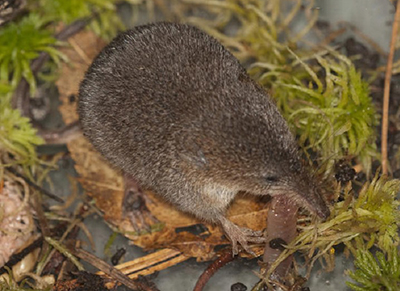
Smoky shrew: Listed as a species of concern in Rhode Island. This shrew prefers shady, damp woods, but little is actually known about this cryptic species in Rhode Island. The most recent record was collected in the Big River Management Area in West Greenwich.
They are native to the eastern United States, with a range running along the Appalachian Mountains and extending as far north as southern Canada. They are often found in higher elevations, typically above 2,200 feet, in or around deciduous montane forests. At the southern edge of their geographic range, it’s been reported that they exists at elevations as low as 900 feet. They occur in a variety of forest types, on talus slopes, and occasionally some wetter areas such as bogs, swamps, and bankside of rivers.

Water shrew: Listed as a species of concern in both Rhode Island and Massachusetts. It has rarely been observed in the Bay State, but few deliberate searches for it have been conducted. Its reclusive habits make it difficult to encounter by chance; therefore, little is known about its actual distribution and abundance in the state. It has been documented in 15 of Massachusetts’ 351 municipalities.
This shrew is seldom found more than a few yards from the nearest water, most commonly the banks of a swift, rocky stream usually near a conifer or mixed forest. It prefers heavily wooded areas and is rarely found in marshes that are devoid of bushes and trees. It can be found in beaver lodges and muskrat houses in the winter.
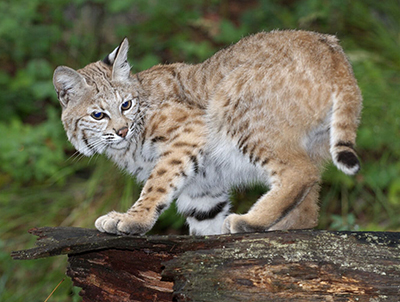
Bobcat: Listed as threatened in Rhode Island. While native to the Ocean State, it has never been considered to be common or widespread in the state. Recent indicators, such as sightings, reports, and road kills, suggest the population is on the rise, both locally and regionally. They are very adaptable and, given adequate food resources and habitat, can tolerate human-altered environments and activity.
They are the most numerous and widely distributed wild felines in North America. This species has adapted to live in a variety of habitats including swamps, deserts, grassland, shrubland, forest, mountains, and agricultural land.
Bobcats prey on a variety of small mammals, such as mice, voles, woodchucks, chipmunks, squirrels, and rabbits. They are capable of killing white-tailed deer, especially fawns, but are not significant predators of deer. They grow to be 2.5 to 3 feet long. Females weigh 13-20 pounds and males 25-30.
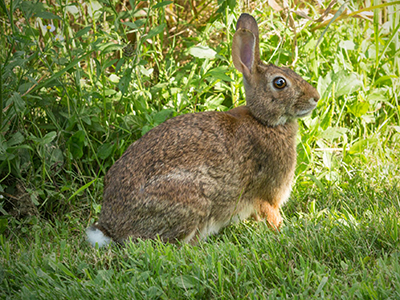
New England cottontail: Listed as a species of concern in Rhode Island, and not to be confused with the introduced eastern cottontail, which now outnumbers the native species. The New England version, the only native rabbit in the region, thrives in dense young forests and shrublands. However, this habitat is disappearing across Massachusetts, Maine, New Hampshire, Rhode Island, Connecticut, and eastern New York, putting the species at risk.
They can grow to be 15-17 inches long and weigh up to 2 pounds.
Though native to the six-state region — and west to New York’s Hudson River — New England cottontails are rarely seen. They are vastly outnumbered by eastern cottontails, which were introduced in the early 20th century as a game species and look almost identical, according to the U.S. Fish & Wildlife Service (USFWS).
In the mid-2000s, the USFWS considered listing the New England cottontail under the federal Endangered Species Act, due to population declines and loss of habitat. These rabbits prefer young forest — dense, brushy, thicket habitat. A coordinated response by state and federal biologists, private landowners, tribes, foresters, hunters, and conservation organizations kept it off the list.
Since 2009, the USFWS has provided $3.6 million for New England cottontail research to state wildlife agencies in Rhode Island, Massachusetts, Connecticut, Maine, New Hampshire, and New York through Wildlife Restoration and Competitive State Wildlife grants.
A key part of recovery is increasing the size of the wild population through breeding and release into suitable habitat. The New England cottontail breeding program began at Roger Williams Park Zoo in Providence in 2011 and expanded to the Queens Zoo in New York City in 2015.
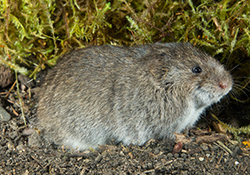
Southern bog lemming: Listed as a species of concern in both Rhode Island and Massachusetts. This small, chunky rodent with small eyes and ears is a grassland animal. This species is active year-round and both during the day and at night. If frightened, they can move fast and swim well.
They create complex systems of short, crisscrossed tunnels or burrows with side chambers that are used for feeding, resting, and storing food. These tunnels measure about 1–2 inches wide and are 6-12 inches below the surface.
Note: Some of the species listed in each state overlap, and how often the lists are updated varies — the Rhode Island list was last updated in March 2006, Massachusetts last August, and Connecticut in January 2023. For species listed as state historical — essentially extirpated — in Rhode Island, they were included in the endangered category.
Frank,
I’m all signed up for this environmental Master Class!
Nice change of pace, too, thank you.
Oh, and plenty of rabbits where I live, but I haven’t a clue which kind.