
Flock Forestry: How Forest Management Can Help Birds
June 30, 2025
Share


RICHMOND, R.I. — When Antonia and Tom Bryson bought their 160-acre-or-so property decades ago, their main objective was to preserve land.
“We didn’t know anything about forest management, and we didn’t live here full time either, so we just let it sit,” she said. “And we thought we were doing a great thing.”
At some point, through the Natural Resources Conservation Service (NRCS), the couple found out that just owning the land wasn’t necessarily enough.
“Frankly, at some point we learned that, in fact, it’s better for your forest if you actually manage your forest,” Bryson said. “This is a key concept.”
Through a grant program funded by NRCS and its parent organization, the U.S. Department of Agriculture, the Brysons received funding to plan and manage their land specifically for interior forest bird conservation.
The effort was part of a program called Forestry for Rhode Island Birds, which did similar projects on other properties throughout the state.
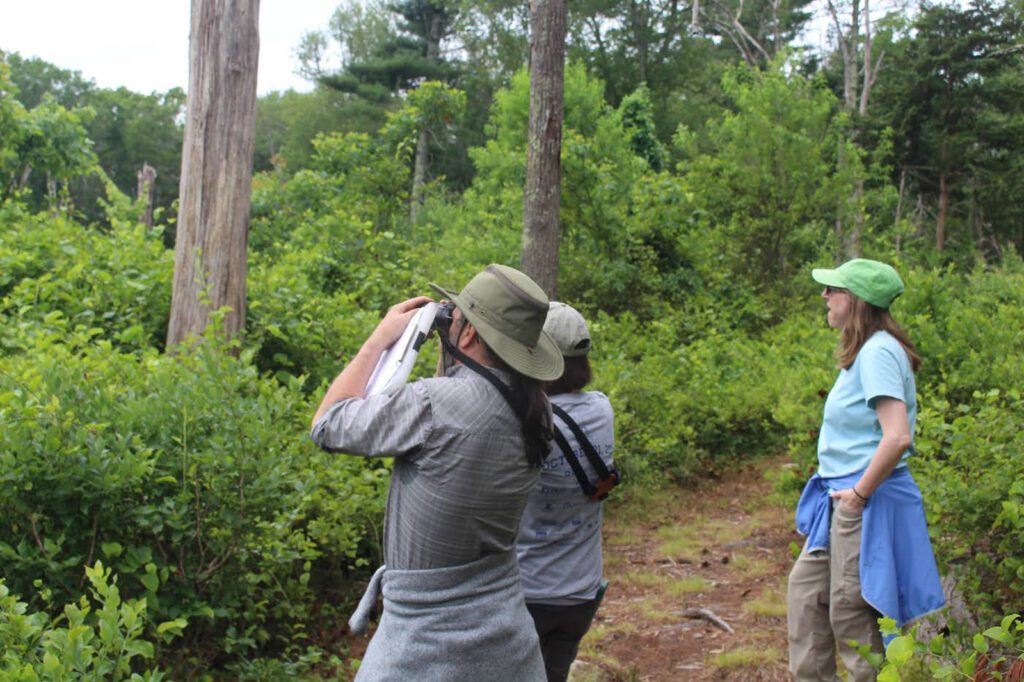
Antonia and Tom invited members of the Rhode Island Woodland Partnership, which had been a part of the earlier project, to walk through their land last week, giving them the opportunity to hear about the process they went through and maintain today.
Kate Sayles, executive director of the Rhode Island Land Trust Council and co-coordinator of the Rhode Island Woodland Partnership, started off the walk by explaining a little bit about the Forestry for the Birds program’s aims and goals.
When the project started several years ago, there had been a heavy focus on birds in early successional habitats, the type of environments they develop right after an area has been disturbed, either by natural or human-made processes.
So, the NRCS-USDA funded program wanted to take a look at birds that lived in the interior of forests with populations that had declined globally. Ultimately, they choose to focus on 12 species, known as the “Rhode Island Birder’s Dozen”: pine warbler; black-throated green warbler; black-and-white warbler; northern waterthrush; wood thrush; pileated woodpecker; rose-breasted grosbeak; scarlet tanager; ovenbird; red-eyed vireo; eastern wood-pewee; barred owl.
“We chose birds that utilize different parts of the forest, and then we worked with both the ornithology and forestry community to find different prescriptions that would benefit those birds in the forest,” Sayles said. “They love a mosaic of habitat types. They might use something, some sort of habitat type, for breeding and use another habitat type for feeding.”
From there came the planning.
Holding up a map of the Bryson property to the group, land management consultant and member of the Rhode Island Forest Conservation Commission Mark Tremblay explained how he would split up the 160 acres into different areas, where different management techniques would be applied.
“Is it a thinning? Is it a clear-cut? Is it a patch-cut? Is it, leave it alone? Let it grow forever? I mean, there are a variety of things that can be done to end up with meeting your goals and objectives,” he said.
Tremblay and the Brysons, with guidance and requirements from NRCS, choose several areas to thin, leaving some hardwood trees and deciding to keep or sell logs off the land.
In 2019, after the work was completed, the Audubon Society of Rhode Island performed a birds survey in several areas. Five years later, the Ocean State Bird Club repeated the survey to see how the bird count and habitat had changed.
“We had varied results,” Ocean State Bird Club board member Paul Miller said. “A lot of the birds we saw that they saw, then some we missed that they had then, and we actually had a few that they didn’t have then on this more recent survey.”
The weather, which was great when Audubon completed its survey, had been cold and windy for the follow-up survey last June.
Tom Bryson shepherded the group to an area that had been cleared of most of its trees but where they had decided to leave the logs in place after clearing.
“This is amazing,” said Scott Ruhren, Audubon’s director of conservation.
Leaving the logs had prevented deer, which several people on the walk said are a huge environmental challenge, from eating up the area, and hardwoods had started to come back.
Those conditions help cultivate plant diversity, which is good for the birds and pollinators Ruhren said.
“A messy forest also allows for regeneration, because the deer don’t like to go where it’s inconvenient,” he said, pointing to some log litter. “Some of the forest fire people get nervous about that. Think we’re going to have this big conflagration, but actually, the wood sitting on the ground doesn’t burn as well. It’s moist.”
It also attracts insects, salamanders, and other critters to the ecosystem.
“Clear-cut sounds scary,” Sayles acknowledged, while explaining the management process to the group. But the process this project undertook is different. “This is not a permanent conversion of land use from a forest to not forest.”
In another area that had been cut but logs had been sold off, fewer hard woods had come in and there was less diversity.
“This is an example of what happens when you take the logs out and the deer come in,” Tom Bryson said.
Although the area was lush with vegetation, Tremblay explained the color of the area alone wasn’t a good indicator of ecological health.
“There’s an expression I heard recently called the ‘Green Lie.’” Tremblay said. “You go down the road, it’s green, everything must be OK. But that’s not necessarily the case.”
He noted that vegetation could be invasive or lack diversity, which doesn’t make for the best types of habitat.
Through the walk, the group could hear the sounds of the pileated woodpecker, beating against trees, a few red-eyed vireos flitted through branches, and around one corner of the trail, far off into the forest, a broad-winged hawk perched on a tall limb.
Although the last bird wasn’t on the “birder’s dozen” list, Miller called it “another good forest interior bird.”
After finishing up back at the Bryson home, everyone sat for cookies, lemonade, and coffee.
“The main focus of Forestry for the Birds,” Sayles said, “is to connect people, who wouldn’t normally think of their forest as more than woods in their backyard, with thinking about their forest as part of a larger, more connected system.”
I am reading an interesting book called Wilding by Isabell Tree about returning an agricultural estate in England back to nature including introducing specific heritage type breeds of donkeys, deer and pigs that provide new habitats as well as scrub like hawthorn protecting young trees such as oaks planted by jays. They had various hurdles to overcome but an astonishing array of wildlife-birds, butterflies, moths, amphibians and various other insects and wildlife came in. I have not finished the book but thought this couple and the agencies might be interested. The hawthorn protected the new growth from browsers like deer. They also state that conservation folks do not look back far enough as to what was there. Anyway it is very interesting.