Human Pressures On Sea Turtles Have Relented But Still Pose Significant Threats
June 23, 2025
Share


Series note: The region’s collection of native species is under threat on several fronts, most notably from humanity’s shortsightedness. Humans aren’t giving the natural world the space it needs and deserves. We’re crowding out nonhuman life, which, in turn, makes nature less productive and us less healthy. Wild New England examines the animals and insects most at risk.
Robert Kenney’s nearly 47 years of marine research — it will reach that mark in September — has focused on the ecology and conservation biology of marine vertebrates, including sea turtles. These popular marine reptiles, as a group, are doing much better now than when Kenney arrived in 1978 as a “rookie” graduate student at the University of Rhode Island.
It was just five years after the Endangered Species Act went into effect.
“There’s a lot more protection. Things are better,” Kenney said. “There’s hawksbills still harvested for their shells to make ornaments, but that trade is mostly in Japan and it’s dying out. The other ones were mainly harvested to eat. Turtle is really good. Archie Carr, who is the father of turtle biology, said he made the ultimate sacrifice when he stopped eating green turtle meat.”
Even after the Endangered Species Act was passed, Kenney said “you could still go into little shops in Georgia and buy turtle eggs, because people in Georgia swore by using turtle eggs for baking cakes, because it makes really smooth cake batter. You can’t hard boil a turtle egg. They never get hard.”
The Michigan-born, Buffalo-raised 76-year-old never left URI to work elsewhere or Rhode Island to live elsewhere, although he soon plans to move to Vermont to be closer to his daughter. For now, the emeritus marine research scientist still sits at the same desk in the same office where he worked full-time from the late ’70s until June 2012. He now works as a part-time marine researcher on various projects. He said habit loss is now the biggest threat to sea turtles.
“Nesting beaches are places we like to build things like condominiums and resorts,” Kenney said. “The nesting beaches that were not protected are gone.”
Kemp’s ridley turtles, for instance, all nest on one beach in Mexico, which made it easy to grab them and their eggs. Kenney said in the mid-1960s at a meeting of the American Society of Ichthyologists and Herpetologists an old black-and-white home movie taken at the beach was shown. Those in attendance estimated “there were tens of thousands of Kemp’s ridleys on this beach nesting at the same time.”
“At its lowest point, it was down to handfuls. They would harvest the eggs with bulldozers and dump trucks and sell them,” Kenney said. “You could go into a bar in Mexico City and get a shot of tequila with a turtle egg in it — puts lead in your pencil. They don’t do that anymore.”
He said the beach is now protected, and “they’ve also tried to establish nesting beaches in Texas, right where Elon is launching his spaceships.”
Green turtles were overexploited for their cartilage, which was used to make turtle soup.
Many of the other threats to sea turtles also come from humans: nighttime light pollution, which can misguide hatchlings on their migration to the sea; entanglement with commercial fishing gear; boat strikes; collisions with boat propellers; and discarded plastic bags and wrappers, helium balloons, and monofilament fishing line. This debris, when floating in water, can resemble jellyfish and other prey.
The climate crisis could also create a potentially devastating impact, Kenney explained.
“One of the things that’s strange about sea turtles is that their sex is not determined by chromosomes, like it is in mammals,” he said. “It’s determined by the incubation temperature. So eggs that are incubated at above the critical temperature become females and below become males. If it gets warmer and they don’t adjust by putting nests in shadier spots, we could have populations dominated by females. No one has seen that actually happen yet, but it’s something that people worry about.”
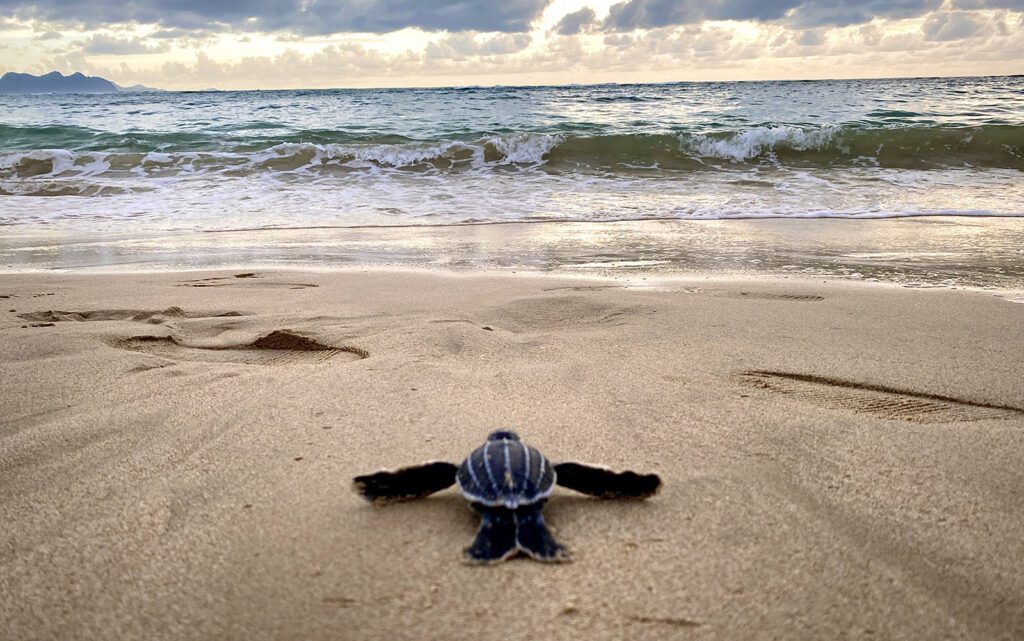
Kenney also noted sea turtle hatchlings, juveniles, and adults “have completely different habitat use patterns.”
Sea turtles are cold-blooded reptiles, but unlike terrestrial turtles, they can’t pull their heads and flippers inside to protect themselves. They have existed on Earth since the days of the dinosaurs.
Seven species of sea turtles inhabit the world’s oceans, except for the Arctic: flatback, green, hawksbill, Kemp’s ridley, leatherback, loggerhead, and olive ridley. They are highly migratory, traveling hundreds or even thousands of miles between foraging and nesting grounds.
Five of the seven are state listed in southern New England. Kenney said the listing of the hawksbill is a “bit bogus.”
“Hawksbill turtles don’t belong on any of those lists,” he said. “They live on coral reefs. I looked at the distribution map of all the records that I found and there’s nothing close in southern New England. I know there was one that was caught in a long line off of Cape Hatteras [N.C.] once.”
Kenney noted leatherbacks and loggerheads are the most common species in southern New England.
The following is a look at the sea turtles in southern New England listed as a species of concern, threatened or endangered:
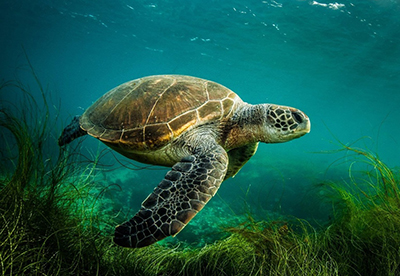
Green: Listed as threatened in both Massachusetts and Connecticut. These sea turtles occur along the northwest Atlantic Coast from Massachusetts south to Florida and throughout the Gulf of Mexico and Caribbean Sea. They generally inhabit shallow waters, including lagoons, inlets, bays, and estuaries, where they have access to seagrass beds.
Sexual maturity isn’t reached until at least 20 years, and some individuals may not become sexually mature until they are 50 years old. Breeding takes place on a two- to four-year cycle. Their shells are about 35 inches in length at maturity.
It has been estimated that green turtles migrate with precise navigation up to 1,400 miles between nesting beaches and feeding areas. They seem to make use of a sun/compass orientation similar to that of bees.
In Massachusetts, juveniles can be found on the southern and eastern beaches of Cape Cod Bay in December and January as water temperatures drop. These juveniles are usually about 12-16 inches long.
In response to cold-stunning in Cape Cod Bay, staff and volunteers of Mass Audubon’s Wellfleet Bay Wildlife Sanctuary mount an annual effort to search the beaches after every high tide during the late fall and early winter. All of the recovered turtles are brought to the facility for evaluation and emergency care. Live turtles are then taken to the New England Aquarium where they are given more rigorous medical evaluations and treatment.
In Connecticut, an Atlantic green turtle has never been found on the shoreline. However, the species may occasionally migrate through Connecticut waters during the warmer months.
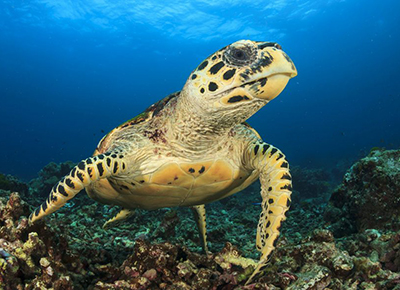
Hawksbill: Listed as endangered in Massachusetts. This is the most tropical of all the Atlantic sea turtles and seldom wanders north of Florida. It is a turtle of tropical and subtropical reefs, eating sponges, algae, and other invertebrates. Only three dead individuals have been reported from Massachusetts, all from Cape Cod in 1909, 1968, and 1989.
The lifespan of the hawksbill is unknown, but exceeds 50 years. Adult females return to the beach where they were born every two to three years to lay eggs at intervals of every 14-16 days during the nesting season. Females generally lay three to five nests per season, each with around 130 eggs.
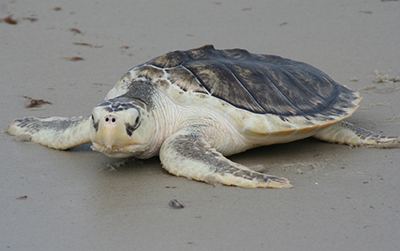
Kemp’s ridley: Listed as endangered in Massachusetts. This is the smallest of all the sea turtle species of the world. Adults are only about 2 feet long and 100 pounds. Their diet consists mainly of spider crabs, shrimps, snails, sea stars, and occasionally jellyfish and sea plants.
This is the rarest and most endangered of the North Atlantic sea turtles. These turtles are almost never seen in the summer in Cape Cod Bay when they are healthy and active.
Nearly all of these sea turtles seen in Massachusetts are small, 2- and 3-year-old juveniles who have washed ashore on a 50-mile stretch of coast along the south and east shores of Cape Cod Bay, from Barnstable to Provincetown, during November and December when the water temperatures drop. Small ones begin to show up cold-stunned when the water temperatures dip below 65 degrees Fahrenheit and all of the turtles are affected once the temperatures go below 50. Below 40, turtles that wash ashore are already dead. Since loggerhead and green sea turtles are larger, they are more cold-tolerant and are cold-stunned at temperatures lower than those that affect the smaller Kemp’s ridley.
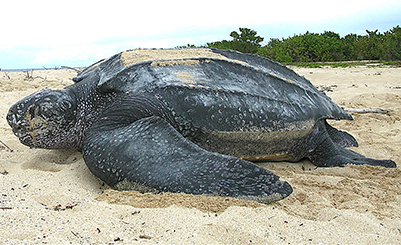
Leatherback: Listed as endangered in both Massachusetts and Connecticut. This species is found in all of the seas of the world. It’s the most pelagic, wide-ranging, and cold-hardy of all the sea turtles. Their flipper span is enormous, about 9 feet on a 7-foot turtle. They are the most ancient species of living sea turtle, as well as the largest and heaviest turtle in the world. Their proportions and streamlined shape are advantageous for long-distance swimming.
Most, if not all, of the leatherbacks found off the Massachusetts coast breed on the sandy beaches of the Caribbean islands, the northeastern coast of South America, and Florida during the winter.
Although these sea turtles are primarily known as an open-ocean animal, they also come into shallow coastal waters during the summer to feed on concentrations of jellyfish. Twenty or so are reported annually along the Massachusetts coast, mostly in southern Cape Cod Bay near the Cape Cod Canal, and in waters south of the Cape.
In Connecticut, these turtles are frequently observed off Stonington and in Block Island Sound during the summer.
“Leatherbacks are a little bit warm-blooded, and they can occur all the way to Iceland, but in the warmest part of the year,” Kenney said. “They’re huge, so once they warm up, they can stay warm for a long time just by their size. They don’t have the plates on their shell. They are smooth, so they can sit at the surface on a sunny day, no matter what the water temperature is, and warm up by soaking up the sun.”
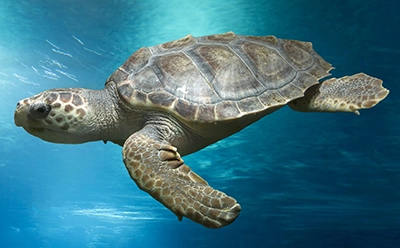
Loggerhead: Listed as threatened in both Massachusetts and Connecticut. Their large heads support powerful jaws that enable them to feed on hard-shelled prey, including moon snails, channeled and knobbed whelks, and a variety of crab species. Adults are about 3 feet long and weight 250 pounds, making this is the second-largest of the hard-shelled sea turtles.
They are the most common sea turtle along the East Coast. They make extensive migrations from their nesting beaches to foraging areas on the continental shelf, and move northward during the summer as water temperatures increase to 68-73 degrees Fahrenheit. These temperatures allow a few adults to occasionally move as far north as Long Island Sound, the waters south of Cape Cod, and rarely around the Cape.
In Connecticut, this sea turtle has rarely been seen or documented. However, cold-stunned turtles have been reported on the north shore of Long Island, N.Y.
Note: Some of the species listed in each state overlap, and how often the lists are updated varies — the Rhode Island list was last updated in March 2006, Massachusetts last August, and Connecticut in January 2023. For species listed as state historical — essentially extirpated — in Rhode Island, they were included in the endangered category.