
Mr. Gauthier Goes to Smith Hill to Support Public Transit
June 19, 2025
Share


PROVIDENCE — Zach Gauthier and his friend Myles Brawn-Husband sat in an empty Statehouse hallway late last month trying to speak over the buzzing of another lobbying day.
Gauthier, 37, of Johnston, visited the Statehouse frequently during the 2025 General Assembly session to advocate for a series of issues that matter to him.
“I feel like it’s my purpose,” he told ecoRI News. “I feel like in another life I must have done this.”
On that particular afternoon on Smith Hill, Gauthier and Brawn-Husband were there to speak in support of a wealth tax that advocates say would generate millions of dollars for state services, including the Rhode Island Public Transit Authority.
Gauthier has cerebral palsy and uses a wheelchair. He can’t drive, so he depends on RIPTA’s paratransit service for people with disabilities, called RIde.
“If there wasn’t RIPTA, I wouldn’t be the person who I am today,” he said. Gauthier uses public transit to visit friends and testify at the Statehouse, among other adventures and errands.
RIPTA led Gautheir to advocacy in the first place. It was only after meeting transit advocate Heidi Showstead on the bus that he started to get more involved and realized he’s pretty good at it.
Over the past few years, Gauthier has become a staunch advocate for the rights and needs of people with disabilities, particularly their need for adequate public transit.
Gauthier is the Policy Committee chair for the Rhode Island Developmental Disabilities Council, and he sits on the Governor’s Commission on Disabilities with Brawn-Husband. Someday, he said, he would like to become a professional lobbyist, to get paid for the advocacy work that he does.
A big part of the work is tearing down stereotypes and emphasizing that people are more than their disabilities.
“I’m not Zach the person with CP,” he said. “I’m Zach the advocate, I’m Zach the friend. I’m Zach the brother. I’m Zach the son.”
He noted the RIde Anywhere pilot program, an effort that expanded paratransit to the entire state, beyond the fixed-route corridors where it is usually restricted, allows people to act and enjoy their lives as they want to.
The program helps more people get to things such as appointments and jobs, but it also enables the fun parts of life, too.
“We want to go out and get drunk and party,” Gauthier said. “We have our challenges of course, but we’re just people.”
The image and stigma around people with disabilities has improved a lot over Gauthier’s lifetime, he said, “but it’s not perfect.”
The sound in the Statehouse rotunda began to grow louder as more and more wealth tax supporters poured into the stone building, forming a marching line through the hallways.

Gauthier and Brawn-Husband, who also has cerebral palsy and uses a wheelchair, merged into the crowd, chanting and holding signs that read “Tax the rich,” “Share the wealth,” and “Save RIPTA.”
Like how Showstead brought him into the fold, Gauthier convinced Brawn-Husband to start taking his concerns and his voice to Smith Hill a few months ago.
Brawn-Husband said he had worked in advocacy before, helping organizations such as Camp Jabberwocky in Massachusetts, a camp for people with disabilities that he also attended. But his work in Rhode Island is new, and he’s just getting the hang of it.
“He’s a pro,” Brawn-Husband said of Gauthier, adding that his friend is photogenic and talkative, sometimes a little too much, he laughed, but in a good way that suits an effective advocate.
(Gauthier comes by it honestly, he said, joking that his mom is a “Chatty Cathy,” “but I’m worse.”)
After the marching line broke up, advocates filed into the House and Senate chambers to talk to their representatives about the bill. Gauthier made his way to the center of the House floor and started to look through the crowd to see who he could chat with.
“I just want to thank you guys from the bottom of my heart,” Gauthier told Rep. David Morales, D-Providence, noting he appreciated all the support the lawmaker has shown to RIPTA this session.
The key to good advocacy, in Gauthier’s opinion, is genuineness and honesty.
“They want real people,” he said. “They want to hear your story.”
Speaking about his experience helps officials lift their heads up for a minute, to take their eyes off the studies, the politics, and the paperwork, and really think about how their policies impact people.
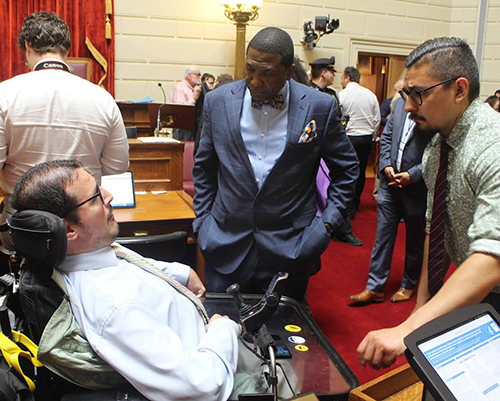
While Gauthier explained his mantra outside the House chamber, Rep. Grace Diaz, D-Providence, gave him a tap on his wheelchair as she walked by.
“I told ya, I’m good friends with a lot of people,” he said.
Even though advocating takes a lot of effort, Gauthier said speaking up for the first time was like feeling he finally could breathe. “I feel like I’m finally making a difference.”
Although the process of becoming an advocate has felt mostly natural to Gauthier, it was scary at first, he said.
“I get nervous like everyone else,” he said. Gautheir spends the night before a hearing practicing his testimony. When he was younger, he had a speech impediment, something he’s worked on for years to improve and overcome.
He also can’t physically write, another challenge, he said.
But he has a strong mind, like a “sponge,” he said, and a great memory. Both have become an important asset in front of lawmakers.
After a bell started to ring, letting everyone know the lawmakers needed to get to their seats and the members of the public had to leave the chambers’ floors, Gauthier spoke with Nicole O’Laughlin, the Save RIPTA campaign manager, about the bill up for consideration.
The Save RIPTA campaign has supported several bills this session that would create new funding sources for public transit, including the wealth tax, which would add an additional 3% tax on residents making more than $625,000 annually and generate an estimated $190 million in new revenues for the state. Riders and advocates saw that funding could help boost RIPTA.
They discussed some of those points before O’Laughlin offered to sign Gauthier up to speak so he wouldn’t have to try to squeeze into the cramped Senate Finance Committee hearing room.
Gautheir was the first member of the public to speak on the bill.
In his testimony, he talked about how Rhode Islanders are struggling — the cost of living is on the rise, housing is in short supply, and public transit is at risk.
“The state I love is slowly dying,” he said, but revenue from the proposed wealth tax could make a difference.
“Bring Rhode Island back to life,” he pleaded to lawmakers.
When he came out of the packed committee room, he asked how he did.
“I know it’s scary to use [your] voice, but once you do, it’s life changing,” he said. “If I don’t do it, who will?”
hurrah for Zack and Miles, I hope the Assembly leaders will pay attention to their efforts, we’ll know more by tomorrow (Saturday when session is over)