
Let Them Grow: Roadside Areas Don’t Need to be Assaulted by Power Equipment
June 26, 2025
Share


The Rhode Island Department of Transportation and the state’s 39 departments of public works mercilessly mow areas, some with little economic value, such as highway medians, rather than allow pollinator habitat to bloom.
Providence even goes so far as to mow down meadows carefully cultivated by others, in partnership with the city. Last fall an award-winning meadow at the downtown train station was vandalized by the DPW because of a single complaint about “overgrowth.”
In 2020, a $15,000 meadow on the banks of the Providence River was destroyed. A spokesperson for the city said the mowing wasn’t done by the municipality. City officials said they believed it was an act of vandalism. Right. Someone or someones lugged a mower to the Providence waterfront to run down coreopsis and sunflowers.
We’re obsessed with mowing, especially state and municipal departments with access to gasoline-powered weapons of mass destruction. We whack, cut, trim, mow, and blow with little to no thought. This addiction wastes taxpayer money to buy fossil fuels to keep the natural world down and greenhouse gas emissions up.
It’s mindless behavior ingrained over generations.
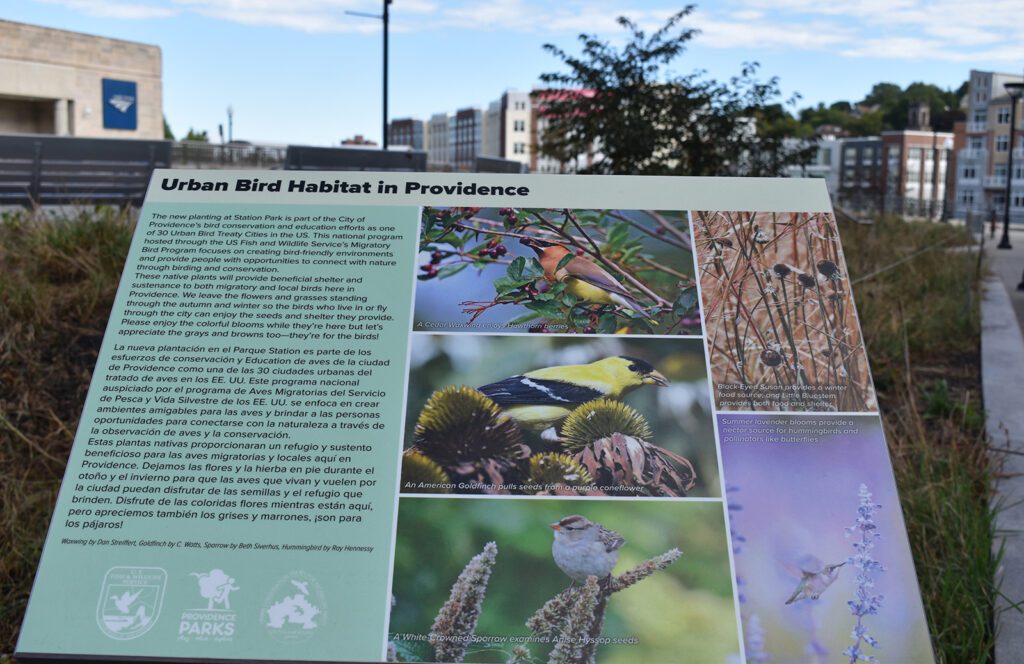
A meadow is much more than a lawn in need of a cut. These green spaces are diverse, dynamic habitats dominated by native grasses and wildflowers. A single meadow can contain some 200 plant species. Meadows provide habitat for pollinators, and shelter, food, and nesting sites for birds and other wildlife. They support biodiversity.
They also absorb stormwater runoff, which helps prevent flooding and erosion. They are cooler than lawns. And they’re good for our health.
We would be wise to let medians and other roadside areas grow. Mow a boundary around them and then let them do their thing. There’s no downside to letting nature be in these areas, and the benefits are many: money saved by cash-strapped municipalities; reduced climate emissions; recovered pollinator habitat; biodiversity protection; free ecological services; overwintering wildlife habitat; improved scenery.
With RIDOT and DPW employees freed from unnecessary mowing, staff could work on other projects, such as tearing down the roadside invasives that are strangling trees, building rain gardens, and helping bring the natural world back to life, rather than assaulting it.
RIDOT mowing operations begin in mid- to late April and last until late October or early November. The agency divides the state into seven mowing areas — Belleville, East Providence, Glocester, Hope Valley, MidState, Portsmouth, and Smithfield.
Some spots must be mowed for safety reasons, but those areas should be the exception not the rule.
Frank Carini can be reached at [email protected]. His opinions don’t reflect those of ecoRI News.


Great article! Roadsides are great spaces for native meadow plants and it IS a terrible waste of time, fuel, and money to mow them down. The same is true of lawns but that is a topic for another day….
I totally agree! Cut out most of the mowing!
I entirely support the idea of NOT mowing median strips along highways and most roads. The caveat being as long as sight lines around corners and at intersections are maintained to the greatest extent possible and branches aren’t allowed to protrude into roadways. Barring that, prohibit mowing during bird breeding and migration seasons. We could even encourage the planting of native pollinating plants to encourage and support bird and insect populations. To be sure, we’d lose quite a few to traffic but many more would survive and be of benefit. And just think of all the gas, equipment wear and tear, and manhours saved doing the unnecessary
mowing.
Hi Frank,
Thanks for summarizing so well the senseless obsession of mowing, whacking, and blowing by state and municipal agencies. Old habits die hard, but it’s imperative that state DOT/DEM and municipal DPWs change their ways. You’ve outlined practical steps these agencies can take “today” that will make a huge positive impact on all living things (including the agency workers). RI residents should speak up more on this topic and contact their respective town/city council/DPW, and DOT/DEM agency leadership. Demand they change their ways and transition over to less mowing/whacking/blowing, and to more cultivation of natural habitats and meadows.
The examples of habitat destruction from over aggressive or ignorant state and municipal agencies/workers abound. Last year a beautiful grove of native trees and pollinators was clearcut at Colt State Park in Bristol by workers who maintain that park. As is typical, a lame excuse of “oh sorry we didn’t know” and “we will try and replant something in its place” was given. Meanwhile, the raised area remains bare; now overrun with invasives. This scenario plays out daily around our state.
I just returned from a couple of weeks in Europe. I did not see or hear any mowing/whacking or blowing anywhere. Not a single instant and I traversed several countries in urban and rural areas. Sure, they cut grass over there, but the default is to let nature prevail. Gas-powered whacking and leaf blowing is rare and very isolated, and many countries don’t use them at all.
When State and Municipal governments do mow/whack and blow, they should be using battery powered equipment and not the horrifically loud and polluting gas-powered ones. Changing the way RI State and Municipal governments maintain “our” public spaces will take time, but there are hundreds of cities and towns across the country that are or have transitioned to more sustainable practices. Let’s keep the pressure on these agencies to accelerate the transition. It will benefit all living things.
We do need a narrow – 4 feet? – mowed strip beside the roads so wildlife don’t wind up cavorting into traffic. However it can be sown with a low plant such as a smaller clover that only needs infrequent mowing mainly to get rid of taller weeds. Aside from that, meadow on!
A couple weeks ago miles of coltsfoot flowers and others were mowed down on rt.1 from Wakefield to westerly.for no reason at all. The grass wasn’t long, just millions of beautiful foot tall yellow flowers. It was beautiful. Now just a dusty waste land. Stop the madness.
Kudos! Additionally, train DPW and RIDOT in regenerative AG practices and we can cultivate said areas in forage and hay for backyard chickens and rabbits :).
My advocacy now and in the past has been:
Cumberland Highway Dept. : I have long ago mentioned that the staff seize the opportunity to take a Tree Stewardship course with the RI Tree Council https://ritree.org/what-we-do/#treestewardscourse! Also, it would also help birds and other wildlife in decline if they adhere to the Meadow Management Plan, I had the Town Council approve for the Monastery.
Natural Resources Conservation Service
Natural Resources Conservation Service
U.S. DEPARTMENT OF AGRICULTURE, mentioned………
“Hay fields should be mowed from the center outward to allow the animals to escape,” which I also see as applicable to mowing ………the Monastery meadows too.
Also, I spoke of https://extension.sdstate.edu/haying-wildlife-mind, which reiterates “Leaving unharvested strips can offer several benefits by providing escape cover and undisturbed habitat through the nesting season.”
It is rather sad that 🧑🌾Franklin Farm 🚜does not practice this!!! Do farmer elsewhere do this?
https://www.3billionbirds.org/
https://asri.org/stateofourbirds/2023.html
I also, have previously forward those in my net…
https://drive.google.com/file/d/1wxjVPMyUUG691mnV_pm2vVANjv_dQ0VO/view
Awhile back RI Land Trust Council’s wrote a letter for “House Bill 5551- The RI Land Trust Council SUPPORTS empowering the State Department of Transportation to plant pollinator-friendly species on state roads.”
* Didn’t check to se if it passed!
Below is some research I did following my finding of https://nativeplantsocietyofus.org/native-plant-laws/native-plants/ that notes other State laws PROMOTE incorporating native plants in State Roadway landscaping.
Meanwhile I might add that I have attended a Rhode Island Wild Plant Society webinar https://www.dropbox.com/s/vxiisg0qkmxqsob/Pdf%20of%20Dr.%20Barton%20Lessons%20From%20the%20Roadside%2011%3A21%3A2020.pdf?dl=0 on top of attending an Ecological Landscape Alliance https://www.ecolandscaping.org/ called “Tenacious Plants for Roadsides”. I know I have a link to salt tolerant grasses in a research paper I did on the proposed Blackstone River Hydroelectric dam project too. Please review my vision: RI highways naturally beautiful with wildlife crossings. “Discover Beautiful Rhode Island” needs to be a journey and vision of native flowers, shrubs and trees with less unsightly litter and burnt grass.
https://e360.yale.edu/features/green_highways_new_strategies_to_manage_roadsides_as_habitat
https://nenativeplants.psla.uconn.edu/wp-content/uploads/sites/3415/2022/08/netcr97_09-2.pdf
https://cipwg.uconn.edu/wp-content/uploads/sites/244/2016/10/Poster-PDF-John-Campanelli.pdf
https://nenativeplants.psla.uconn.edu/roadside-revegetation/
Webinar https://riwps.org/event/enhancing-delaware-highways-lessons-from-the-roadside-virtual-lecture/ .
Years ago, I remember reading RIDOT’s 2035 plan included roadside flowers. Anyway, I thought to pass all these along in the event people might create pollinator pathways https://www.pollinator-pathway.org/ of their own or advocate for it in their municipality. START small!