Southern New England’s Rarest Amphibian Often Called a Toad But Really a Frog
May 23, 2025
Share


Series note: The region’s collection of native species is under threat on several fronts, most notably from humanity’s shortsightedness. Humans aren’t giving the natural world the space it needs and deserves. We’re crowding out nonhuman life, which, in turn, makes nature less productive and us less healthy. Wild New England examines the animals and insects most at risk.
The last recorded sighting of the golden toad was 36 years ago. It was officially listed as extinct in 2004.
The species — named because of the vibrant golden-orange skin of the males, unusual among amphibians — was once abundant in a 1.5-square-mile patch of the Monteverde Cloud Forest Reserve in Costa Rica. Their ecosystem, nearly a mile above sea level, was characterized by high humidity, constant mist, and a canopy of foliage.
Those living conditions can’t be found in southern New England, obviously, but the disappearance of the golden toad signified the dawn of the climate crisis. Herpetologists and biologists have deemed it the first extinction victim of climate change.
Closer to home, the eastern spadefoot is among the rarest amphibians in the Northeast. It is state listed in southern New England — endangered in both Rhode Island and Connecticut and threatened in Massachusetts.
The region’s rarest frog is round and short-legged with bulging eyes and a spade-shaped protrusion on its hind feet that enable them to corkscrew themselves into the ground, where they stay moist and cool and avoid predators.
They are often referred to as a toad, but the eastern spadefoot is actually a primitive frog.
In 2019, Scott Buchanan, a herpetologist with the Rhode Island Department of Environmental Management, told ecoRI News spadefoots are “the best example of a species that, as far as we know, is on the verge of disappearing from Rhode Island.”
Buchanan and University of Rhode Island herpetologist Nancy Karraker believe there is just one population of eastern spadefoots left in Rhode Island, in Richmond.
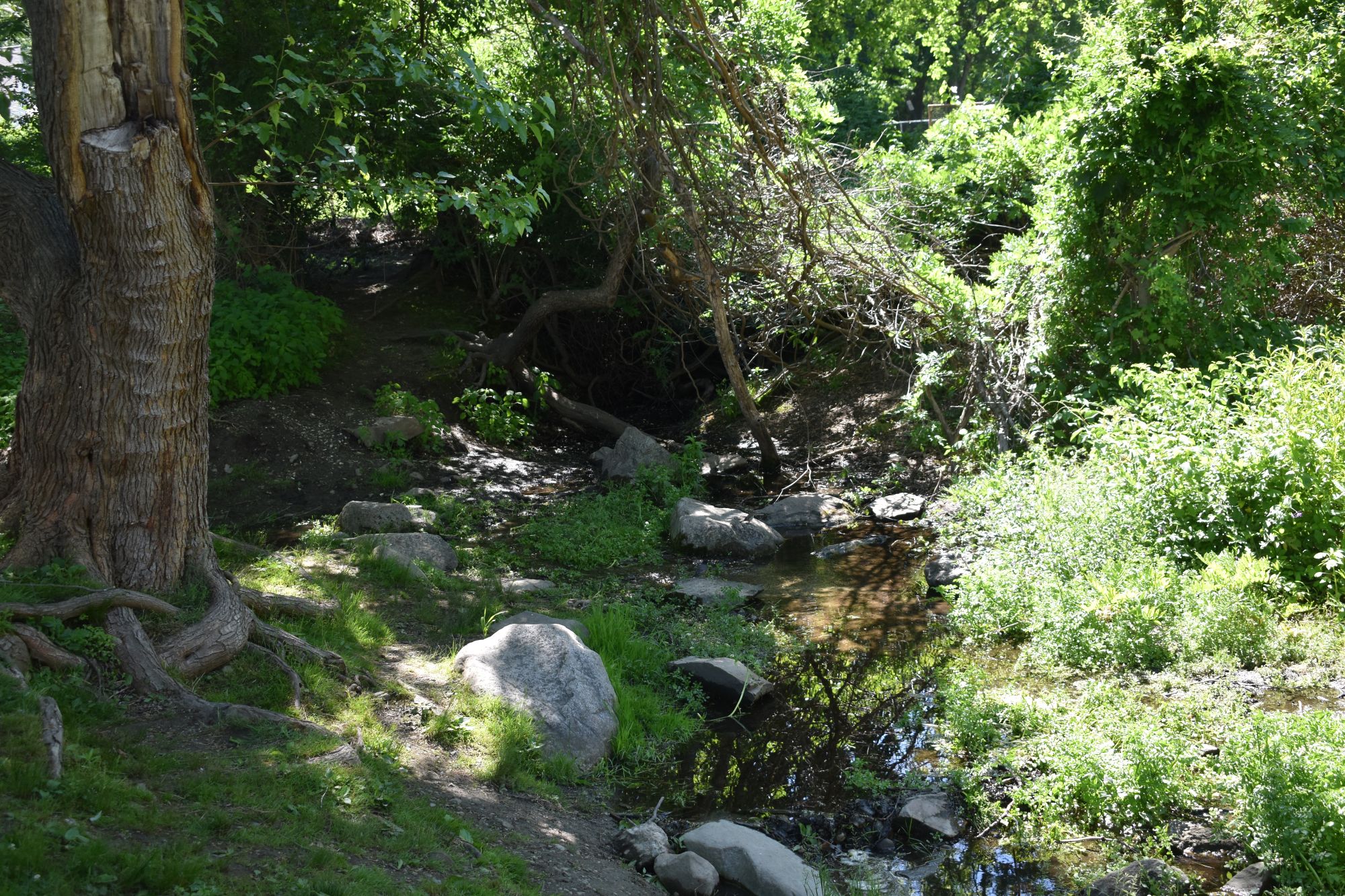
They breed in the most ephemeral of vernal pools, according to Karraker. “They use what most would call a puddle in the middle of an agricultural field, with no forest canopy cover, and they’re filled by torrential storms that occur in May and June,” she said. “Those big storms that produce thunder and lightning and an inch or more of rain in 24 hours brings the toads up to breed.”
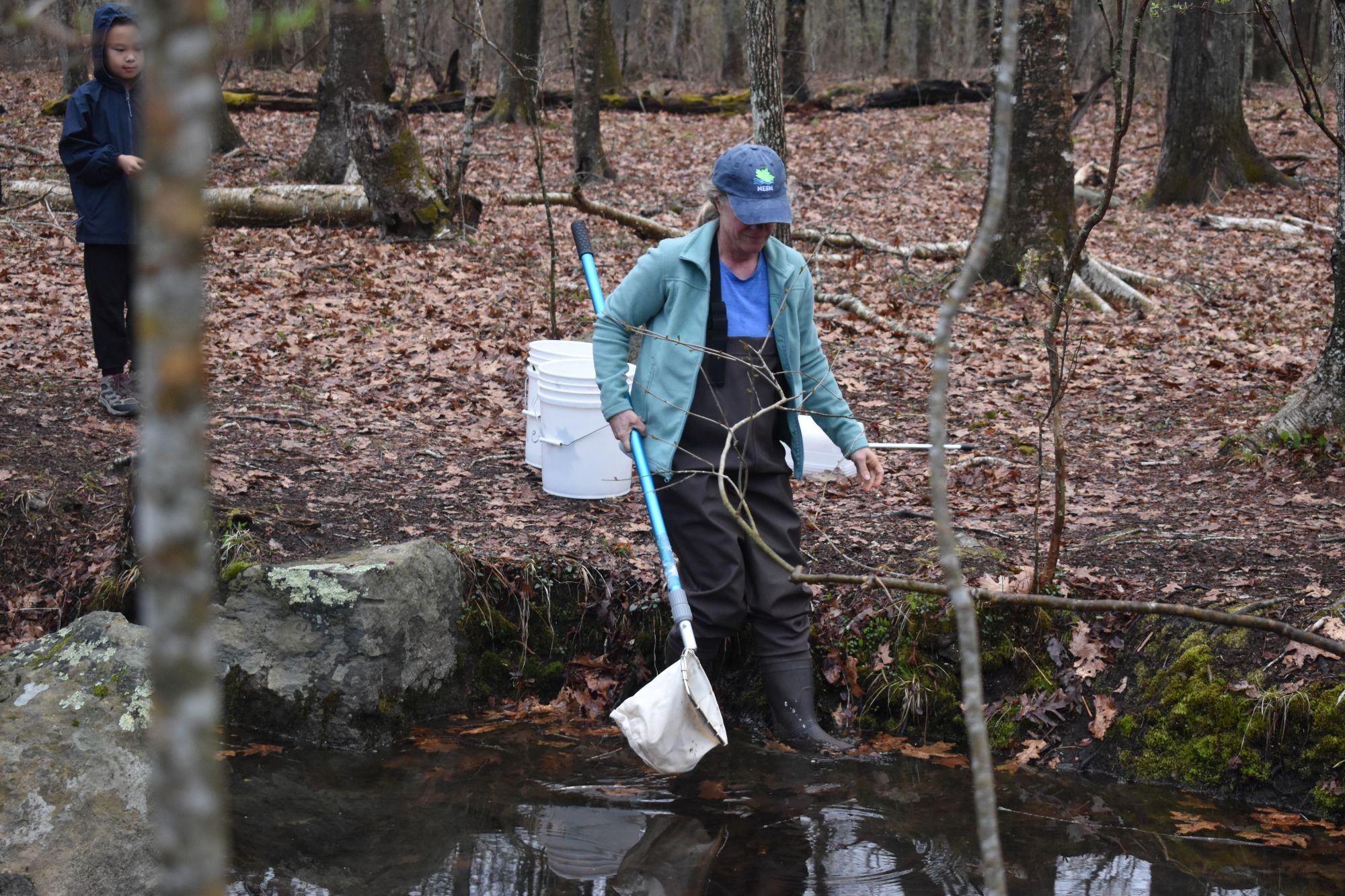
Rhode Island scientists, researchers, and volunteers have built spadefoot breeding pools on property owned by the Richmond Rural Preservation Land Trust and the South Kingstown Land Trust.
Spadefoots typically dig their burrows several inches below ground, but they have been known to dig as deep as 8 feet. When heavy rains do fall, they emerge from their burrows in large numbers and explosively breed. They also can remain dormant for months in a state of torpor.
In Connecticut, their numbers appear to be in decline, according to the Connecticut Department of Energy & Environmental Protection. Many localized populations have been extirpated, presumably due to development impacting their breeding pools.
“Urbanization of early successional habitats and alteration of breeding pools, which are often not afforded wetland protection status due to their highly short-lived nature, are the greatest causes of decline,” according to Connecticut environmental officials.
In Massachusetts, only 32 populations have been verified since 1982.
Most amphibians are highly sensitive to habitat disturbance.
Primary threats to amphibians in southern New England include: habitat loss, degradation, and fragmentation; road mortality; emerging infectious disease; and chemical applications of pesticides, deicing salts, and fertilizers that pollute breeding wetlands.
A 2023 study, compiled by some 100 scientists from all over the world, found about 40% of 8,011 amphibian species could die out in the coming decades. This is the highest of any major animal group on the International Union for Conservation of Nature’s Red List of Threatened Species.
The study highlighted climate change as a particular threat to amphibians.
The following is a look at the amphibians in southern New England listed as a species of concern, threatened or endangered:
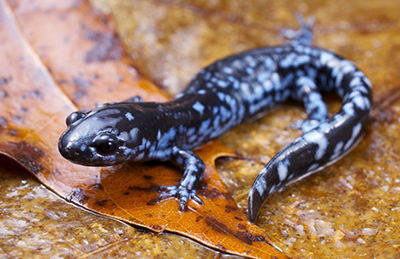
Blue-spotted salamander: Listed as a species of concern in Massachusetts and endangered in Connecticut. In Connecticut, it occurs in isolated areas where individuals don’t have the chance to mate with the Jefferson salamander — a similar-looking member of the mole salamander family.
In Massachusetts, populations in Bristol and Plymouth counties are listed as threatened, whereas populations everywhere else in the state are listed as special concern. As of January 2020, about 160 local populations have been documented in 86 municipalities.
This species occurs in the Canadian Maritime provinces to northern New Jersey and from southeastern Quebec to northern Illinois and Indiana. Disjunct populations have been found on Long Island, N.Y.
Typical habitat consists of red maple swamps with nearby woodlands. The soil types hosting these amphibians vary from water-saturated loam to damp sand. Breeding areas include swamps and marshes with weak water flow that are often connected to other waterbodies. Vernal pools and floodplains with plentiful organic debris also comprise the breeding grounds.
This salamander feeds on insects, slugs, worms, and other small invertebrates.
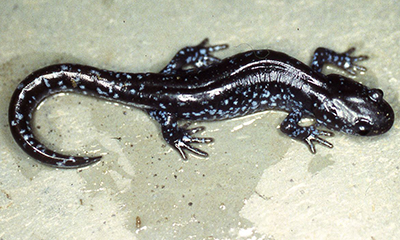
Blue-spotted salamander complex: Listed as a species of concern in Massachusetts. In the Bay State, the complex consists of two bisexual species, blue-spotted salamander and Jefferson salamander, and a group of unisexual Ambystoma of a hybrid lineage. Unisexual Ambystoma in this complex have variable nuclear genomes consisting of complements of both blue-spotted salamander, Jefferson salamander, and a mitochondrial genome derived from the streamside salamander, a species occurring in Kentucky, Ohio, Indiana, Tennessee, and West Virginia.
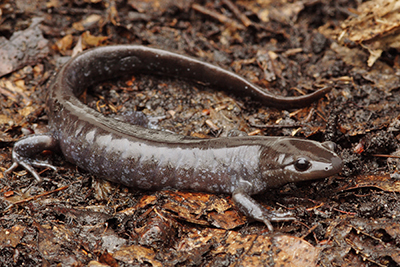
Jefferson salamander: Listed as a species of special concern in Connecticut. It spends most of its life underground, but congregates during breeding cycles.
This species ranges from eastern Illinois through Kentucky and Virginia and up to southwestern New England. Populations mostly occur in far western Connecticut in northern Fairfield and Litchfield counties, although some exist along the trap rock ridge system of Central Connecticut. All occur west of the Connecticut River.
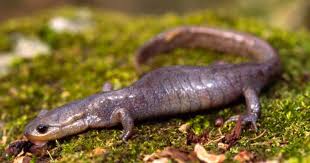
Jefferson salamander complex: Listed as a species of concern in Massachusetts. This species is in the family of mole salamanders, and so it has distinctively long toes and a stockier build relative to other groups of salamanders in the region. Males tend to be smaller than females and have conspicuously swollen vents during breeding season.
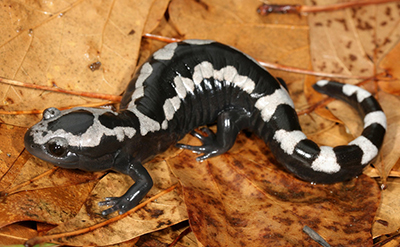
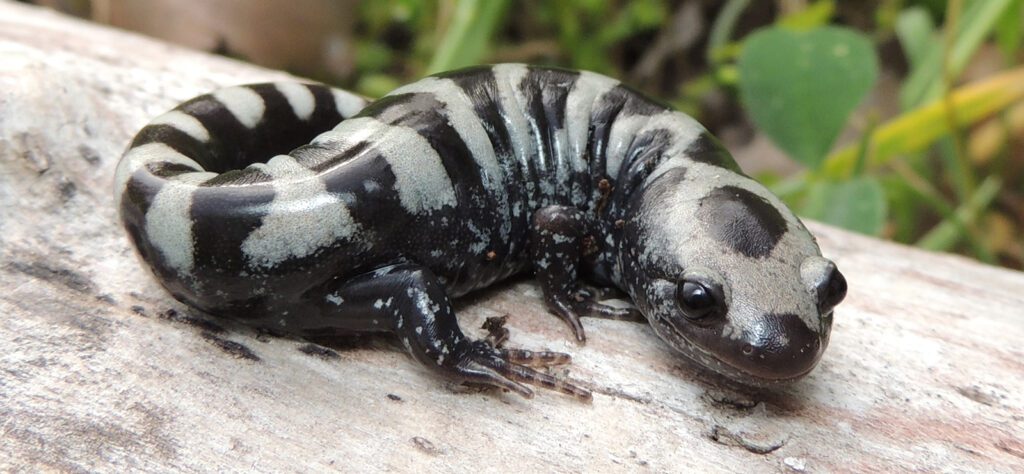
Marbled salamander: Listed as threatened in Massachusetts. As of January 2015, about 85 local populations had been documented in 61 municipalities. This species ranges from southern New England south to northern Florida and west to eastern Texas and Oklahoma.
Within Massachusetts, this salamander is distributed primarily among parts of Bristol, Franklin, Hampden, Hampshire, Norfolk, and Worcester counties. Only several populations are known from Middlesex and Plymouth counties, and a disjunct population occurs in Berkshire County.
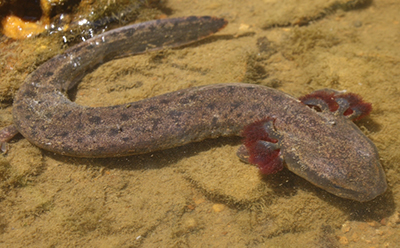
Mudpuppy: Listed as a species of concern in Connecticut. The distribution of mudpuppy populations is poorly understood in Connecticut and throughout most of New England. The earliest confirmed record of a mudpuppy in Connecticut was in Middletown in 1875. In Connecticut, mudpuppies are found in the Connecticut and Housatonic rivers, associated tributary streams, and riparian zones south from the Massachusetts border.
This species is the largest and only fully aquatic salamander found in Connecticut. It measures between 8 and 17 inches in length and resembles a large larval salamander at maturity, as it never loses its external gills.
The mudpuppy gets its name from a grunting sound it can make, which resembles the bark of a dog. Though it has lungs, this salamander breathes primarily through its gills and uses its lungs to adjust its buoyancy.
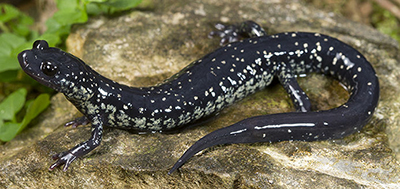
Northern slimy salamander: Listed as threatened in Connecticut. There are at least 16 subspecies of slimy salamanders, which look the same but are genetically variable. Overall, this species ranges from Texas to Florida, north into Missouri and Illinois and northeast into New York and Connecticut.
The subspecies is at its northernmost range in Connecticut, with only a few populations in western Fairfield and Litchfield counties. This nocturnal salamander emerges from its burrow at dusk and retreats at dawn. It’s occasionally active on rainy days.
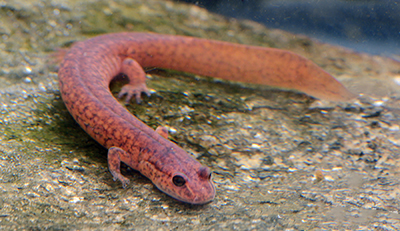
Northern spring salamander: Listed as a species of concern in Rhode Island and threatened in Connecticut. This species is a brightly colored member of the lungless salamander family (Plethodontidae). Since it requires very clean, cool, and well-oxygenated water to survive, its presence in springs and streams is an excellent indicator of a healthy water source.
Some spring salamanders can be cannibalistic, eating the young of their own species. Predators include northern watersnakes and gartersnakes.
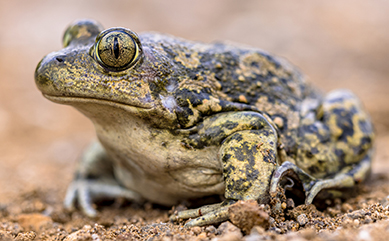
Eastern spadefoot: Listed as endangered in both Rhode Island and Connecticut and threatened in Massachusetts. It belongs to the genus Scaphiopus, which differs from true toads in having vertical pupils, relatively smooth skin, and a distinct spade-like projection on the hind limbs from which its common name is derived. This spade-like projection is used in the excavation of burrows.
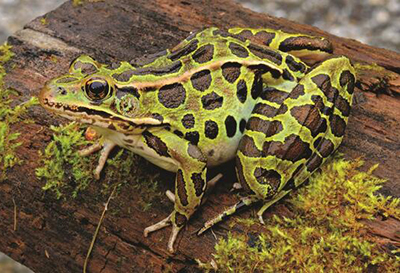
Northern leopard frog: Listed as a species of concern in Rhode Island. The pickerel frog is commonly confused with this species. It occurs across most of northern North America, ranging from southern Quebec west to southern Alberta and eastern portions of Washington, Oregon, and California. The range extends across New England, New York, the Great Lakes states and the Upper Midwest, south to Arizona and New Mexico.
Within Massachusetts, populations of the frog are scattered among portions of at least eight counties: Berkshire, Essex, Hampden, Hampshire, Middlesex, Norfolk, Plymouth, and Worcester. Recent data suggest the species is distributed sparsely, but it is abundant locally.
Note: Some of the species listed in each state overlap, and how often the lists are updated varies — the Rhode Island list was last updated in March 2006, Massachusetts last August, and Connecticut in January 2023. For species listed as state historical — essentially extirpated — in Rhode Island, they were included in the endangered category.