
Warbler Migration Fueled by Shade-Grown Coffee
May 19, 2025
Share


Series note: The region’s collection of native species is under threat on several fronts, most notably from humanity’s shortsightedness. Humans aren’t giving the natural world the space it needs and deserves. We’re crowding out nonhuman life, which, in turn, makes nature less productive and us less healthy. Wild New England examines the animals and insects most at risk.
Your morning cup of joe could be impacting the health and future of colorful songbirds who pass through southern New England in May and back again in late summer and early fall on their southern return.
About 25 warbler species make this round trip through Rhode Island, Massachusetts, and Connecticut every year. Habitat loss and degradation of both their breeding and wintering grounds, however, pose a significant threat to their existence.
That’s where your cup of coffee enters the equation. The primary threats to their wintering grounds are deforestation and the conversion of shade-grown coffee plantations to monotypic sun-grown coffee.
For warblers, and many other songbirds, shade-grown coffee plantations provide vital wintering grounds. The tall trees that shade the coffee plants provide a winter home for migrating birds such as warblers, orioles, and tanagers. These plantations, with their canopy of trees, offer nesting sites, food, and protection.
For some 5 million years, a kaleidoscope of Neotropical migrant birds has been embarking on epic migrations from breeding grounds in North America to Central and South America.
But these coffee forests and other forestland are being bulldozed to make room for agricultural (mostly soy and cattle), development, and sun-grown coffee. In 2016, the Cornell Lab of Ornithology reported that in Colombia from the 1970s to the ’90s, about 60% of Colombian coffee lands were cleared of forest.
During those two decades, the populations of many migrant species plummeted — a drop linked to the deforestation of the songbirds’ wintering areas.
Coffee, like solar energy, doesn’t require clear-cutting forestland. Shade-grown coffee is the traditional approach. For instance, when the Dutch introduced coffee to the New World in the 1700s, it was a forest-floor crop grown under a tree canopy.
Beginning in the 1970s, however, the idea of growing coffee in full sun was introduced to farmers with the intent to increase production. Sun-grown coffee does produce higher yields, but it has an adverse impact on the natural world and public health.
Sun-grown coffee, which removes natural barriers to pests, requires more pesticides, fertilizer, and water. It degrades ecosystems, as it is grown as a lifeless monocrop.
With shade-grown coffee, chemical fertilizers aren’t as necessary, because decaying leaf litter recycles nutrients to feed the coffee plants, according to the Cornell Lab of Ornithology. Pesticides aren’t needed, because more birds are around to eat insect pests.
In all of Central America, sun-grown coffee has reportedly led to the loss of 2.5 million acres of forest.
At least 42 species of North American migrant songbirds spend winters in coffee plantations, and 22 of those species have declining population trends, according to the Cornell Lab of Ornithology.
The American Ornithological Society has reported that “due to the extensive loss of native forests, shade-grown coffee plantations are one of the few remaining habitats with forest-like vegetation in many mid- to high-elevation mountain ranges in Latin America.”
The Chicago-based nonprofit has noted conservation efforts for overwintering migratory species have “focused on these agroecosystems to address the widespread loss of natural habitats.”
Studies have revealed a high diversity and abundance of Neotropical migrants in shade-grown coffee plantations and have shown individuals using this habitat typically survive the winter and return the following year, according to the American Ornithological Society.
Buying bird-friendly coffee can help ensure the protection of wildlife habitat.
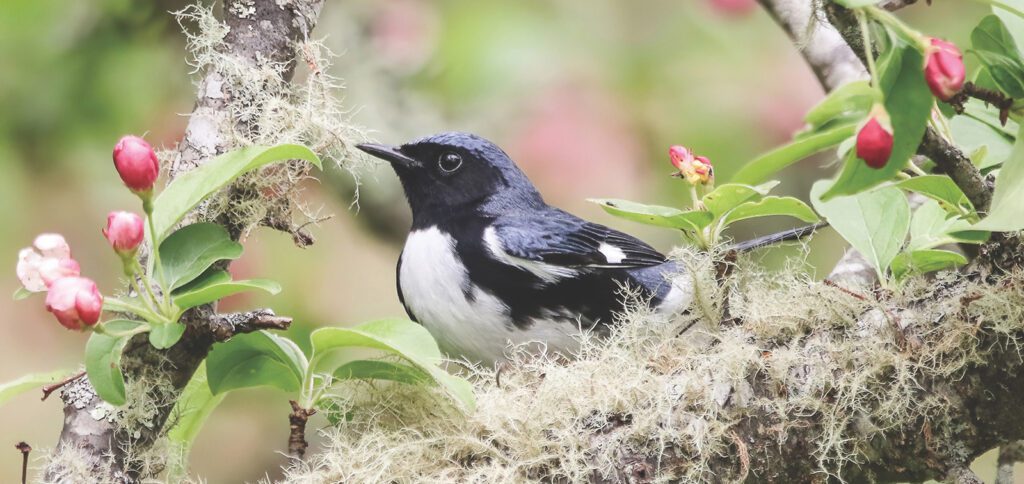
The following is a look at warblers in southern New England listed as a species of concern, threatened or endangered:
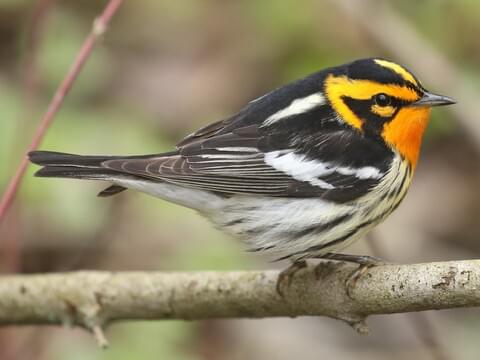
Blackburnian warbler: Listed as threatened in Rhode Island. These forest-canopy specialists are seldom seen at eye level except during migration, when they may be found among dozens of other warbler species at sites that concentrate migrants in spring and fall. They spend winters in South America.
In the spring, rival males perform territorial conflicts that recall an aerial ballet. They chase one another through and around the treetops, flying in loops, plummeting downward through the branches in a whirling pattern, gliding with tail raised and spread, or slowly flapping in exaggerated “moth flight.” Once territories are established, the aerobatics lessen.
These tiny birds are strong fliers that travel between North and South America twice annually, so it isn’t surprising that they are occasionally found far off course, in Greenland, Iceland, Scotland, and the Azores.
No other North American warbler has an orange throat.
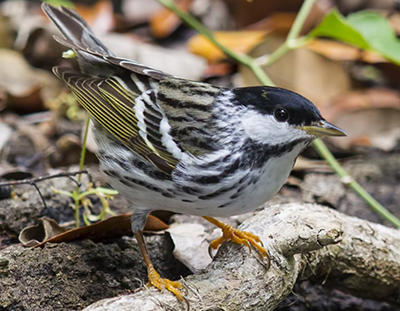
Blackpoll warbler: Listed as a species of concern in Massachusetts. This warbler is limited in Massachusetts by the lack of its preferred habitat, stunted spruce-fir forest. Near the summit of Mt. Greylock, in northern Berkshire County, breeding blackpoll warblers are found in patches of stunted balsam fir.
The main migration wave of these warblers to the region arrives in late May. They travel a distance of not less than 2,500 miles, and the extremes of the range — Alaska and Brazil — are twice that distance.
The song of this bird is one of the highest pitched of any North American passerine. It’s an insect-like trill, a high, thin “tree-tree-tree-tree-tree-tree” given on one pitch of equal length, beginning softly, gradually increasing in the middle, then falling softer at the end.
Their diet consists of aphids, scale insects, cankerworms, sawflies, and other insects that infest trees, spiders and their eggs, wasps, ants, and termites.
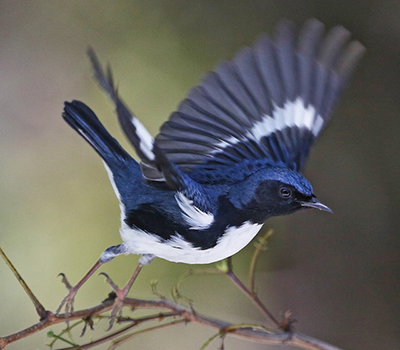
Black-throated blue warbler: Listed as threatened in Rhode Island. This warbler doesn’t spend much time in the treetops. Look for them in the shrubby understory and lower canopy in larger tracts of forest during breeding season. This warbler breeds in eastern North America and spends the winter in the Caribbean.
Males and females look so different that they were originally described as two different species. Males have a midnight blue back, sharp white belly, and black throat. Females are olive-brown and have a unique white square on the wing that readily separates them from other females.
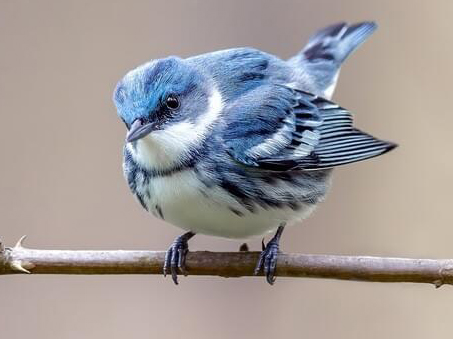
Cerulean warbler: Listed as endangered in Rhode Island. This warbler is a small Neotropical migrant songbird that breeds in eastern North America and winters in the foothills of the Andes Mountains in northern South America. This species was once one of the most common birds in the Ohio and Mississippi River valleys, but since at least the mid-1900s it has undergone one of the fastest declines of any North America bird.
They nest in large patches of mature, deciduous forests that are characterized by large trees and an uneven canopy structure. This type of habitat was historically provided within old-growth forests and is found today in forest gaps, riparian bottomlands, and ridge-top forests.
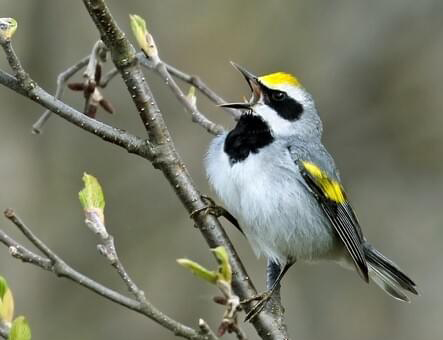
Golden-winged warbler: Listed as state historical in Rhode Island — last seen there in 1960 — and endangered in Massachusetts. There is no longer a viable population anywhere in Massachusetts. They prefer woodland edges bordering early successional clearings, such as abandoned farmland and power line areas, heavily overgrown with patches of grass, weeds, bushes, shrubs, briars, and small trees. Common species of vegetation found in these habitats are grapevine, goldenrod, and birch.
They usually arrive in New England in early May, with the females arriving a day or two later than the males.
The blue-winged warbler is a close relative of the golden-winged warbler, but the latter’s body is predominantly yellow instead of gray and white. These two species often mate and produce hybrids — Brewster’s warbler and Lawrence’s warbler.
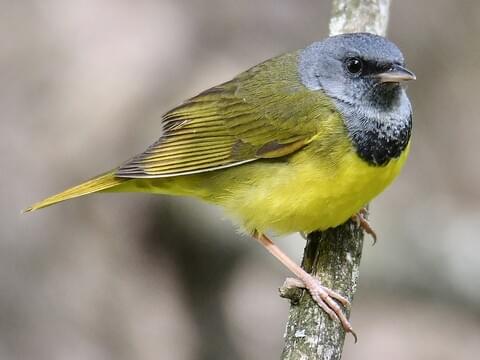
Mourning warbler: Listed as a species of concern in Massachusetts. A rather secretive species, this bird is often difficult to observe, except when the male is singing from a perch. In the Bay State, this species has been consistently rare and restricted in its distribution since at least 1975.
They breed from British Columbia to Labrador, into the Great Lakes region and east to northern New England, and south along the Appalachian Mountains into West Virginia. In Massachusetts, they have been observed in Berkshire, Franklin, Hampshire, and Hampden counties, with most observations occurring in northern Berkshire County.
They prefer to breed in clearings associated with disturbed woodlands and second-growth forests. In Massachusetts, most breeding individuals are observed in regenerating clear-cuts or other forest openings less than 10 years old.
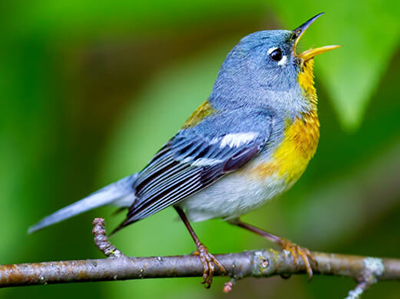
Northern parula: Listed as threatened in both Rhode Island and Massachusetts. This species is one of the smallest and most distinctly marked of the North American wood warblers. They are 4.25-4.75 inches in length with a wing spread of 7-7.75 inches.
The males are bright blue-gray above; white below; an olive patch on the upper back; and two bold white wing bars. They have a white eye ring broken by a black eye line, and a bright yellow throat with a dusky, red-brown chest band. Females and juveniles are similar but paler, and have little or no throat band.
They are characteristically found in wet woodlands, such as red maple or Atlantic white cedar swamps, river margins, and pond shores. They usually nest in association with moss-like lichen. In the Northeast, they begin nesting in late May or early June. The nest is generally in a hollowed-out bunch of hanging Usnea lichen in either a deciduous or conifer tree.
Since 1978, nine breeding locations have been recorded in Massachusetts.
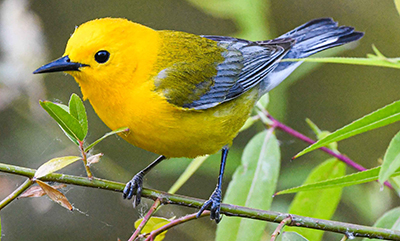
Prothonotary warbler: Listed as a species of concern in Rhode Island. This warbler bounces along branches like a golden flashlight in the dim understory of swampy woodlands. Often called a “swamp warbler” in the Southeast, it also can be found as far north as southern New England, usually along rivers. The species’ population is declining, due to loss of forested wetlands in the United States and mangroves on its wintering grounds.
Most warblers nest on the ground, in shrubs or in trees, but this species and the Lucy’s warbler build their nests in holes in standing dead trees. They tend to stay low in the forest and often forage above water and along shorelines.
The species got its name from the bright yellow robes worn by papal clerks, known as prothonotaries, in the Catholic Church.
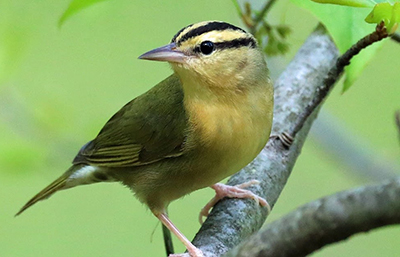
Worm-eating warbler: Listed as a species of concern in Rhode Island. They use their large, sharp bills to hunt for insects and spiders in foliage and clusters of dead leaves. Young typically leave the nest 8-10 days after hatching. Chicks as young as 5 days old may leave the nest and survive, although they can’t fly at that age.
The oldest recorded worm-eating warbler was a male and at least 8 years and 1 month old when he was recaptured and released during banding operations in Connecticut.
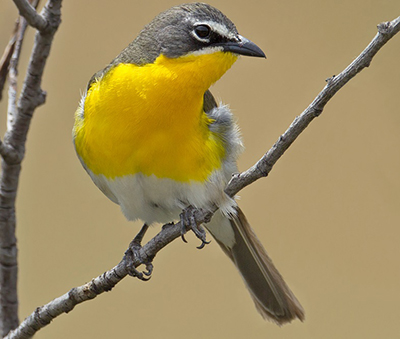
Yellow-breasted chat: Listed as endangered in both Rhode Island and Connecticut. They can be found in woodland edges, dense thickets, especially of briers and brambles, shrubby old fields, stream thickets, and swamp margins. They primarily eat insects, including bees, wasps, ants, grasshoppers, and beetles, berries, and wild grapes.
This bird was considered a common summer resident in Connecticut from the late 1800s through the early 1920s. It declined in northern Connecticut through the 1930s and ’40s and was considered a rare nester in all but the southern regions of the state. Their population numbers have dropped drastically throughout much of the species’ eastern range.
Note: Some of the species listed in each state overlap, and how often the lists are updated varies — the Rhode Island list was last updated in March 2006, Massachusetts last August, and Connecticut in January 2023. For species listed as state historical — essentially extirpated — in Rhode Island, they were included in the endangered category.
What coffee is bird friendly? (i.e, coffee grown with shade trees?).
Sorry, I just found the link in the article. Thanks.
Great job with these articles. Every one of them makes me stop and think. Thank you for that.
Thank you and let’s all do our part – buy forest friendly coffee. After all we all do a part in the destruction.
Excellent story. I’ll now insist on bird friendly coffee. Small price to pay to protect habitat