
Raptors Back in Humankind’s Poisonous Crosshairs
April 28, 2025
Share


Series note: The region’s collection of native species is under threat on several fronts, most notably from humanity’s shortsightedness. Humans aren’t giving the natural world the space it needs and deserves. We’re crowding out nonhuman life, which, in turn, makes nature less productive and us less healthy. Wild New England examines the animals and insects most at risk.
Humans are again threatening the future of raptors, by poisoning everything in our ruthless quest to kill the species we have labeled pests.
In 2008, the U.S. Fish & Wildlife Service and its partners, Island Conservation and The Nature Conservancy, dumped, by helicopter, second-generation anticoagulant rodenticides (SGARs) to treat a number of rat-infested islands in Alaska. The purpose of the poisonous project was to “restore vital breeding habitat for many wide-ranging and globally significant seabird populations by removing invasive rats.”
In the absence of those rodents, which were no doubt introduced to the islands directly or indirectly by humans, several bird species, including Aleutian cackling geese, peregrine falcons, and black oystercatchers, are again nesting there.
The Rat Island Restoration Project, however, also resulted in the death of at least 46 bald eagles, a peregrine falcon, and hundreds of other birds representing 24 species. Those birds were found dead among the rat carcasses. Other poisoned birds likely died out of sight of humans.
In May 2008, five months before the Rat Island massacre, the Environmental Protection Agency declared SGARs pose an “unreasonable risk” to children, pets, and wildlife.
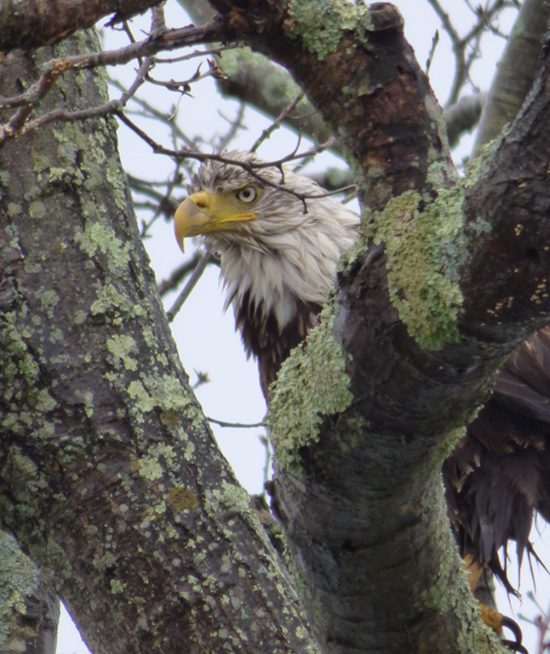
Raptors, including eagles, hawks, falcons, owls, and vultures, are a group of carnivorous birds with hook-tipped beaks and sharp talons. They feed primarily on meat, and we are currently marinating some of their favorite foods in poison.
As my colleague Rob Smith noted last month during his reporting on bills introduced to ban SGARs in Rhode Island, “Rats are a species of animal close to the bottom of the ecosystem’s food chain. Their smaller size makes them a great meal for bigger, faster predators such as hawks, owls, and other raptors, and their habit of living amid human development to scrounge for food makes them an unwanted neighbor.”
This is the intersection where humans and raptors collide.
Rodenticides, commonly referred to as rat poison, kill rodents, but it takes varying times for them to die, which slows them down and makes them easy targets for birds of prey. The region’s raptors eat thousands of rodents annually, and it only takes one or two poisoned rats or mice to harm the birds, or kill them.
Safer alternatives exist for both wildlife and people, such as rat sterilization bait. The Audubon Society of Rhode Island uses this method on its properties. The organization has spoken out against the use of SGARs in Rhode Island.
“We have raptors — hawks, eagles, and owls — that are all declining rapidly because of our use of anticoagulant rodenticides,” Charles Clarkson, the Audubon Society of Rhode Island’s director of avian research, recently told ecoRI News. “All of these rat poisons that we use, they make their way into the environment, and these birds are consuming these rodent species.”
Most pest control companies use the class of lethal rodenticides that were dumped on Rat Island. SGARs were first developed in the 1970s, in response to rodents becoming resistant to the first generation of anticoagulant rodenticides. They work by interfering with blood clotting, causing death from excessive bleeding.
They can kill rodents after only a single night of feeding, but they pose a long-term problem to wildlife because they stay in animal tissue far longer than the first generation of rodenticides.
Sheida Soleimani, the founder and executive director of Congress of the Birds, told lawmakers at a Statehouse hearing in March that she sees birds in her care die daily because they had rodenticides in their bodies and blood.
She noted that Providence animal control brought her a bald eagle, found in Roger Williams Park near the black bait boxes used to trap and kill rodents. The bird died in her arms.
“After necropsy it tested extremely high for second-generation anticoagulant poisons in its blood,” Soleimani said.
Last year Congress of the Birds admitted 148 raptors into its care. All of them tested positive for anticoagulants. A total of 86 died or had to be euthanized because they had been poisoned.
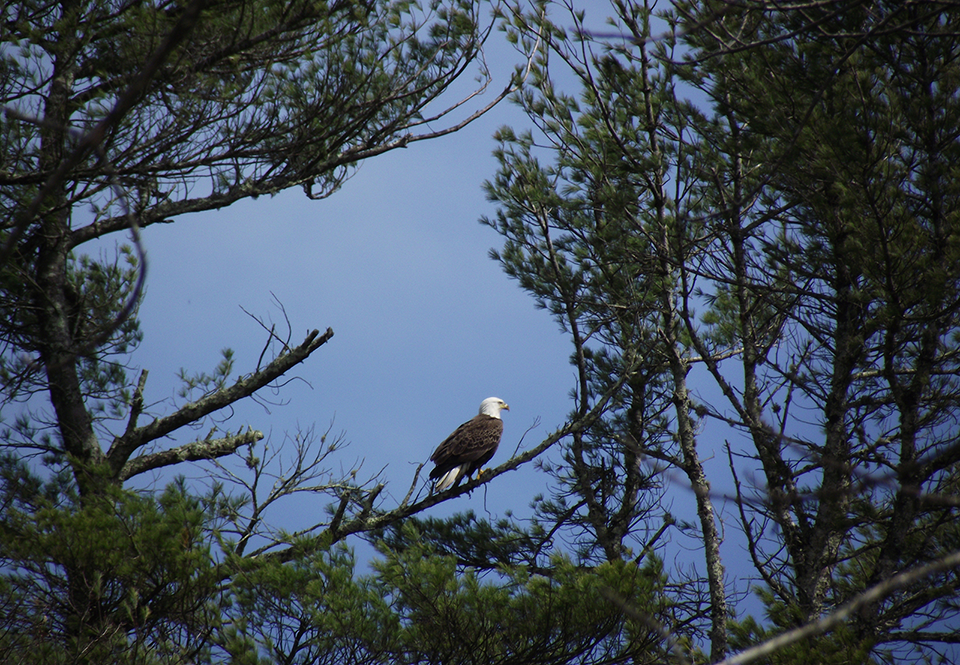
A major difference between SGARs and other rodenticides is the half-life — the amount of time it remains lethal — of the toxins. While a single feeding of SGAR bait is fatal to a rodent, it may take up to five days to actually die and the poisons can remain in animal tissue for some 100 days as they are passed around the food web.
Between 2014 and 2018, a study of 303 deceased bald and golden eagles found the two most common rodenticides in their bodies to be SGARs. In May 2021, Massachusetts wildlife officials confirmed the first bald eagle known to have died in the state from SGAR poisoning. The bird’s liver contained three of the four SGARs registered by the EPA.
SGARs can be bought online by anyone. Federal regulation allows SGARs to be legally used and applied by “commercial pest control and [bought/sold in] structural pest control markets.”
In Rhode Island, the House Municipal Government and Housing Committee, before which Soleimani testified, considered a bill (H5704) that would restrict the sale of SGARs and ban their use by state and municipal governments, medical waste facilities, warehouses, and agricultural sites. The bill would also direct municipalities to participate in a voluntary pilot program to use rodent contraceptives to curb populations. Similar legislation (S0651) in the Senate also received a committee hearing.
Both bills were held for further study.
Southern New England’s birds of prey already made a dramatic comeback after facing near extinction due to the effects of a toxin dumped in great quantities across the country for three decades.
Dichloro-diphenyl-trichloroethane (DDT) is a highly toxic chemical that was once widely used as an insecticide. In the 1940s, it became the first of the modern synthetic insecticides to be unleashed. It was initially used to combat malaria, typhus, and the other insect-borne diseases. It also was effective for insect control in crop and livestock production. It was also sprayed at institutions, businesses, and homes.
Basically, humans sprayed it all over the space, from backyards to battlefields.
DDT’s effectiveness as a pesticide and overuse in the United States led to resistance by many insect pest species. It also decimated raptor populations.
The poison caused egg shells to become so thin they broke when the birds of prey tried to incubate them. It led to almost complete reproductive failure in much of the country for most raptor species.
Rhode Island, for instance, historically supported a substantial population of osprey, but in 1967 the population bottomed out at just two nests in the state as a result of DDT and related pesticide use. The region’s pollution of sharp-shinned hawks also declined around this time.
DDT was banned in 1972, thanks in large part to the publication of Rachel Carson’s groundbreaking book “Silent Spring” in 1962. The book stimulated widespread public concern about the dangers of pesticide use.
After a long absence, these raptors returned here and across the country in significant numbers.
Decades later, however, raptors are again being poisoned by humans.
“These birds are not insulated against declines just because we no longer use DDT,” Clarkson said. “It doesn’t take much to reduce these populations, because they’re relatively small to begin with, not to mention the vast majority of raptors are long-lived birds, so they are slow to become sexually mature. As a result, recovery takes a very long time. We are just starting to see the benefit of the recovery that the populations are experiencing since DDT was banned, but it’s taken decades.”

The following is a look at non-owl raptors in southern New England listed as a species of concern, threatened or endangered:
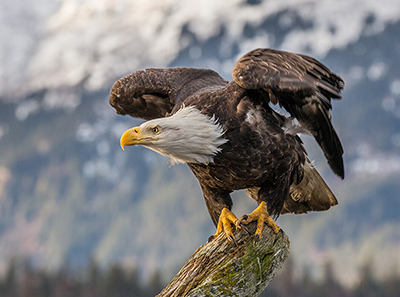
Bald eagle: Listed as a species of concern in Massachusetts and threatened in Connecticut. They occur from Alaska and Canada south throughout the United States to Florida and Baja California. In the lower 48 states, they occur sporadically over a wide area with notable seasonal concentrations in Florida, the Chesapeake Bay area, the Mississippi Valley, and the Pacific Northwest.
The breeding season for these birds in southern New England begins with courtship during late fall or early winter. After courtship, the mated pair builds a nest during December-February. The female lays one to three eggs several days apart, usually during a period between early March and early April. The eggs are incubated, mostly by the female, for about 35 days until hatching.
The flight speed of a bald eagle ranges between 36 and 44 mph. At night, wintering bald eagles often congregate at communal roost trees; in some cases, they travel 12 or more miles from a feeding area to a roost site. Roosts are often used for several years.
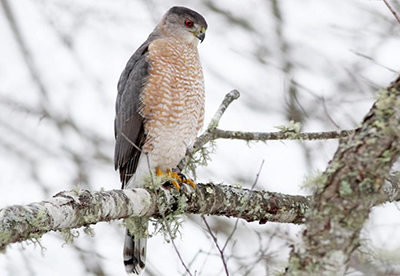
Cooper’s hawk: Listed as a species of concern in Rhode Island. The crow-sized raptor of the woodlands has short, rounded wings and a long tail, excellent adaptations for pursuing smaller birds through thick understory. They capture prey using the element of surprise, perching quietly, then bursting from cover on foot or zipping through dense vegetation on the wing in pursuit. They prey almost exclusively on small to mid-sized birds, such as American robins, northern flickers, and mourning doves.
This wide-ranging bird breeds throughout much of the United States, southern Canada, and northern Mexico. Birds from most of the Canadian and northern U.S. populations migrate south for the winter, with some ranging as far south as Panama.
Cooper’s hawks from western North America are substantially smaller, weighing around one-fifth less, than birds in the East.
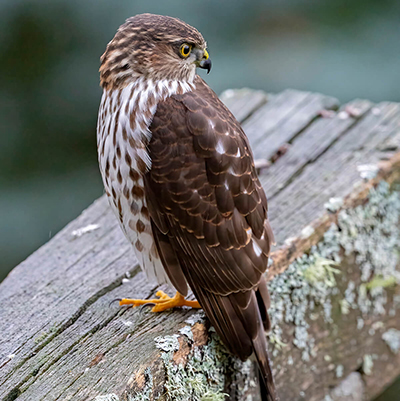
Sharp-shinned hawk: Listed as state historical in Rhode Island — last seen there in 1939 — and endangered in Connecticut, due to its small breeding population in the state. This species occur throughout most of North America, from Alaska and Canada south to the Gulf states. In the fall, large numbers of this hawk pass through southern New England as they migrate to the southeastern United States and Central America for the winter.
Collisions with plate glass doors and picture windows are responsible for the deaths of many of these hawks annually. The glass reflects the surrounding woods and can’t be readily distinguished by a hawk chasing prey or seeking cover.
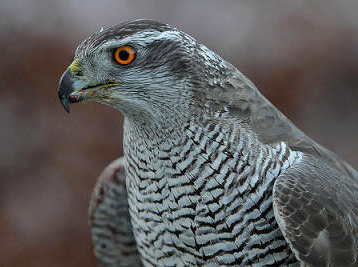
Northern goshawk: Listed as a species of concern in Rhode Island. Females are larger than males. Plumage of an adult male is typically brown and slate gray with a black cap on the head. Under parts are light gray with fine black vertical streaks. The tail is dark gray with a white fluffy underside. The female plumage is similar to the male plumage, but browner in color. Juvenile plumage is dark brown to black with buff, white and light brown streaking.
The feet and legs of this hawk species are yellow and the eyes are red. The legs and feet of juveniles are greenish gray.
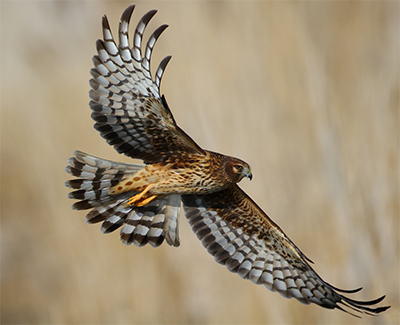
Northern harrier (also know as a marsh hawk): Listed as endangered in both Rhode Island and Connecticut and threatened in Massachusetts. This species has a remarkable sense of hearing. Like owls, it has a curved, sound-reflecting facial ruff which, when combined with characteristic low flight, enables the bird to locate prey by sound.
They establish nesting and feeding territories in wet meadows, grasslands, abandoned fields, and coastal and inland marshes, mostly along the coast. Females will repeatedly attack other hawks that soar over the nesting territory; they will even drive away crows and eagles. Humans that approach too close to a nest are often dived at by the protective female.
The most significant factor in the species’ decline has been destruction of suitable habitat by reforestation of agricultural land and destruction of coastal and freshwater wetlands. In coastal areas, human disturbance may cause some to abandon their nests.
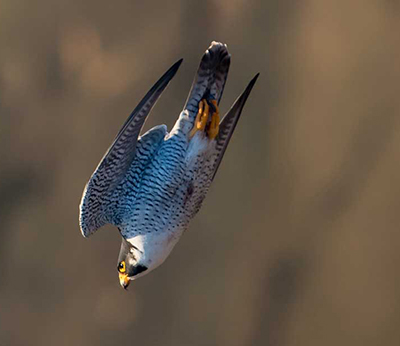
Peregrine falcon: Listed as endangered in Rhode Island, a species of concern in Massachusetts, and threatened in Connecticut. This species is the fastest bird in the world, capable of diving from great heights at speeds of up to 242 mph. Normal flight speed ranges between 28 and 60 mph. They are one of the most widely distributed birds in the world, inhabiting every continent except Antarctica.
In the 1930s and ’40s, there were probably about 375 nesting pairs east of the Mississippi River. Fourteen pairs nested on cliffs in Massachusetts. By 2015, this number of Bay State nesting pairs had doubled. They now nest most frequently on human-made structures such as buildings and bridges.
As part of their reintroduction effort, The Peregrine Fund released more than 4,000 captive-reared peregrines in 28 states over a 25-year period.
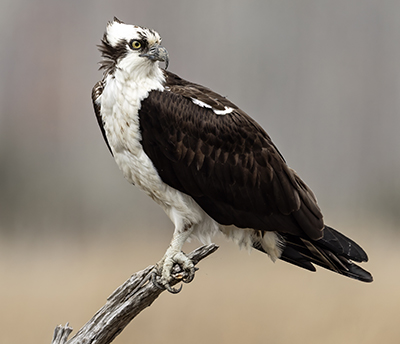
Osprey: Listed as a species of concern in Rhode Island. Ospreys found nesting in Rhode Island are migratory, spending their winters in Central and South America. During the summer, they will breed along the eastern and western coasts of the United States and Canada, as well as much of inland Canada.
They prey almost exclusively on fish, both salt water and fresh water, hovering above water at heights up to 150 feet before diving feet first to grab their prey. They also have been observed catching snakes, eels, and frogs.
Note: Some of the species listed in each state overlap, and how often the lists are updated varies — the Rhode Island list was last updated in March 2006, Massachusetts last August, and Connecticut in January 2023. For species listed as state historical — essentially extirpated — in Rhode Island, they were included in the endangered category.
Thanks for the pictures and descriptions frank
It is so disappointing that the bills to seriously limit the use of rodenticides have been tabled. We know for a fact that these poisons are harming our most majestic birds, yet we are not willing to commit to removing them from our everyday lives.