
Factory Site Slated for Olneyville Flower Farm Expansion Eyed for Apartments, Parking Garage
April 10, 2025
Share


PROVIDENCE — In 2023, a nonprofit flower farm had big plans to transform the site of an abandoned Olneyville factory into healthy soil where it could triple flower production and build a new facility for training florists.
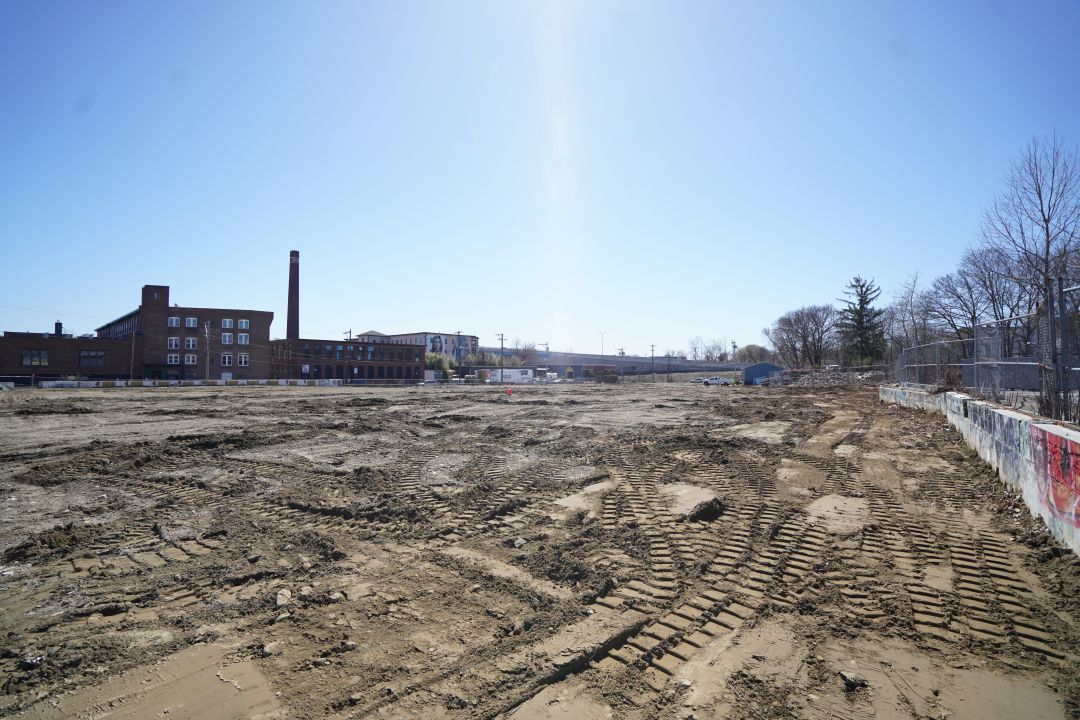
Instead, in October 2024, the farm agreed to sell the site to a local developer for $1.4 million. The 2.7-acre plot once slated for urban farmland is now primed to become a mixed-use apartment building and parking garage.
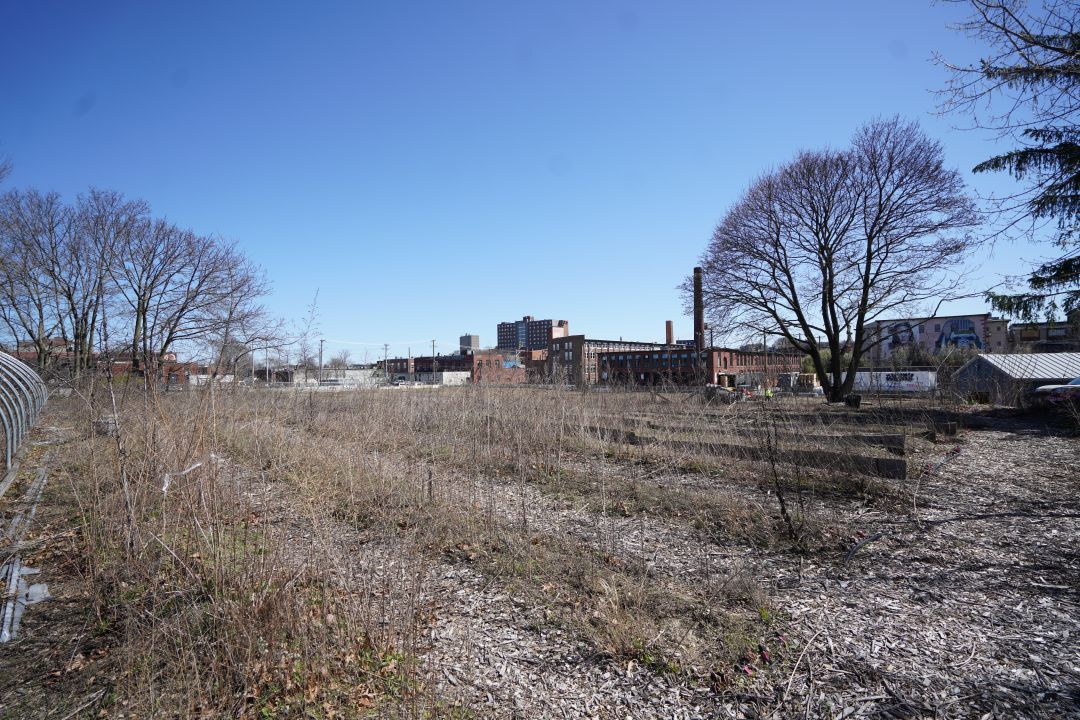
The Flower District, formerly known as What Cheer Flower Farm, donates flowers to organizations across the state. In 2018, it began to grow its flowers just a stone’s throw from nine crumbling factory buildings on the corner of Dike and Agnes streets. Where the ghosts of industry stood, the team envisioned vast fields of flowers covering a city block and a florist training facility, complete with solar panels and an event terrace.
“We had these models that looked incredible, and everyone was really excited,” said Cindy Miranda, president of the Olneyville Neighborhood Association. Groups like ONA offered feedback on the plans, representing a community that faces myriad environmental justice issues, including crumbling infrastructure, flooding, and a lack of green space. “A lot of the homeowners here are worried about their homes with flooding,” Miranda said. “It’s getting worse every single year.”
In 2019, Providence’s Climate Justice Plan named Olneyville a “frontline community,” a term referring to “communities of color most impacted by the crises of ecology, economy and democracy.”
“In the past, a lot of manufacturers came out of Olneyville,” City Council member Oscar Vargas said. “With this help of the community, we’ve been doing a lot of these cleanups, little by little.”
By 2023, the farm was using funds from the state Department of Environmental Management and the Environmental Protection Agency to demolish the old factory structures and remediate industrial pollution. At a press conference in May 2023, EPA New England regional administrator David Cash said the site would be “providing flowers, greenspace, and training to those who need it most.”
But those plans have changed.
“When I came on, we were left with a lot of debt by a past leader,” said Shannon Brawley, the nonprofit’s executive director, who joined The Flower District in 2023. The organization’s staff and board of directors searched for ways to reduce the financial burdens but ultimately decided to sell two-thirds of the property. “It was a hard decision, but we also wanted to stay alive, right?”
“We had started as an organization to grow flowers and give them away, but … growing flowers on the urban land is very expensive: water, sewer, property taxes,” said Erin Achenbach, The Flower District’s director of programming and land management.
The team realized there may be a more cost-effective and environmentally friendly way to fulfill their mission of spreading flowers. They decided to create a service retrieving and redistributing decorative blossoms being thrown away by the event industry, such as lavish floral arrangements for weddings.
“We really turned as an organization to focus on that circular mission of recycling flowers and composting and supporting communities,” Achenbach said. “We no longer had need as an organization for 2.7 acres of open growing space.”
According to public records, the flower farm agreed to sell all but a fraction of the property at 28 Agnes St. to local entrepreneur and developer Idrees Lanre Ajakaiye, once site remediation is complete. Ajakaiye’s group, Green District PVD, which owns two other properties in the area, has released renderings for 28 Agnes St. advertising a 200-unit apartment building with 7,500 square feet of retail space and a three-story parking garage.
“In that area, where people go there mostly for wieners and for Fête, that would create a whole new neighborhood in Providence. That would bring 400 to 700 people in that area,” Ajakaiye said. “I’m probably working on one of the most important projects, if it comes to fruition, for Providence and for transforming that corridor in Olneyville.”
Ajakaiye said he is planning to reserve 35% of the units for affordable housing, but he admitted those plans are uncertain.
“I can’t say I know what the outcome of what I’m doing is going to be,” said Ajakaiye, who said his plans are contingent on city and state incentives for developers. He pointed to the $120 million in housing bonds recently approved by Rhode Island voters as an example of a policy that could enable more affordable housing, if it were directed toward his properties. “The real stories are: when tax incentives and tax credits and the different loan programs come out, are they going to be positioned toward the community needs?”
ONA expressed concern that the new plans might invite higher-income tenants to the area and displace current residents.
“It’s just the pattern of gentrification,” said ONA executive director Eloi Rodas, who suggested the site could host public housing rather than a private development. “It should be a project that is extremely affordable, extremely feasible, and will improve the life of everybody.”
“People here have deep roots in the community,” said Miranda, who believes it’s “unfair” to say the neighborhood, featuring dozens of businesses, artist spaces, and lots of activity, only offers wieners and a music venue. “We don’t want a mini-Boston in our backyards that we can’t access or afford. They’re missing the greater things.”
Local political leaders are welcoming new development in the area but also want to address rising costs of city rents and taxes.
“We know that we have a crisis in housing,” Vargas said. “If we need to help [Ajakaiye], he will have to come to the City Council or city finance with a proposal, and that’s where we go on to make a decision.”
“Any development of housing is great, but I’m always pushing for affordable housing, low-income housing,” said Rep. Enrique Sanchez, a Democrat who represents District 9, which includes Olneyville. “I don’t want to see that property turn into some luxury development or housing that doesn’t meet people’s income levels.”
Ajakaiye said he is not looking to build luxury residences and will be looking for community input moving forward.
“I’m not like the private developer that doesn’t listen to all the people around them,” he said. “My intention is building a mixed-use development that empowers a community … if I’m allowed to.”
Though it appears there will be significantly less green space on the block than originally planned, The Flower District is proud to have mitigated pollution on this neighborhood brownfield. They estimate the site remediation will be complete by May, and the farm’s remaining acre will continue to be an ecological haven for the community.
“Now that we kind of see the remediation on the horizon, we are looking at what is the best use of this green space,” Achenbach said. The group is going to conduct more outreach, asking their Olneyville neighbors how the farm’s property, which maintains high tunnels for growing and a little blue barn, could be used as a public space for workshops, weddings and relaxation. “The community piece … will be working to actually define what that green space is within our one acre, as well as our little environmental hub.”

As can be seen in publicly available 990 tax filings via Propublica, the organization did not have financial problems or debt beyond its means when the current Executive Director began in February 2023. In fact it was doing exceptionally well. I left the Board in May 2023, so cannot speak to the current situation. However, assigning blame to anyone in the past is unsubstantiated at best, and besmirches the record of those who did the heavy lifting of launching the organization in 2018 and seeing it safely through the pandemic. I am particularly proud of the past executive directors, staff and volunteers who worked extremely hard to establish what was a thriving nonprofit when I departed.
a 3 story parking garage?? How much does this add to the cost of the housing to be built?
The Projo did an interesting front-page story recently on whether it’s time for local governments (state, city, town) to take over the building of affordable housing. The problem is that it costs a lot and takes a lot of (expensive) time to cobble together all the different financing required to build a complex that’s entirely affordable. A lot of people are looking favorably on this idea. This might have been an opportunity missed for the state to acquire this land.
This is a story where I want to support the goals of flowers and more housing. Some quick observations:
Regarding What Cheer’s (WC) financial problems…i.e., complaints about “water, sewer, and property tax bills…and debt”.
1. Sewer Fee. Granted WC probably had a hefty water bill given the area that was being irrigated to grow flowers. But they should have had a monthly sewer bill of less than $10-20. The Narragansett Bay Commission (NBC) bases its sewer fee on the amount of water used and that is billed by Providence Water to land owners So, if you have, for example, a $300/month water bill bill during the hot months of May-October from Providence Water, NBC was probably billing you something like 105% of the water use bill or about $315 plus a small fixed price for administrative fees.
BUT, you don’t have to pay a penny to NBC for water that does not end up sanitary sewers. NBC will allow you to install a small meter at your water service that measures water going strictly to water lines used for irrigation. Every year you read that meter, put the numbers on a form they give you, email the reading to NBC. BINGO. No charge for any water used for irrigation! Over the course of several years, that’s a lot of money that literally went down the drain.
2. Property Taxes. Yikes. If WC is a nonprofit, as in s 501(3) C, it should be paying no property taxes to the City of Providence! Zilch, Nada. 501(3)C organizations are tax exempt from Providence property taxes, like the RI Food Bank, the Woonasquatucket River Watershed Council, cemeteries, schools, churches, and PPAC, to name a few. Surely, WC didn’t pay Providence property taxes. Say it ain’t so.
3. WC Debt. As pointed out by another commentator on this article, it’s hard to believe that water and sewer bills and property taxes, if all were indeed paid, could cumulatively add up, over the course of 6-7 years, to serious debt warranting the need to sell land and receive $1.4 million. I think, if the current WC leadership, is casting stones at the previous XC and board members, it should be transparent about this debt.
4. Flowers vs Housing. In Providence’s list of needs and critical issues, it is easy, looking at the big picture, to give a knee jerk reaction that deduces, yeah, more housing (especially affordable housing) is way more important than growing flowers for the community. But geez, couldn’t a compromise deal have been negotiated by WC to sell only half the site and still make several hundred thousand $ and still have enough land to grow flowers?
Kudos to WC for remediating 2.7 acres of land!!! But a social contract was also promised in WC’s original mission statement to Olneyville and the people of Providence that seems to be fading away now in the rear view mirror.
Hey Bob,
As someone who’s volunteered at the flower farm, I found the article interesting too… but your assumptions are unfounded and honestly, a few extra minutes of research might have spared you the trouble of posting a public “gotcha” that doesn’t really land.
1) You’re speculating on their sewer fees without any data. NBC’s billing structure can reduce costs if you install a separate irrigation meter and handle the reporting — but whether that was in place, we simply don’t know. To assert that their bill had to be minimal is a stretch, especially for a multi-acre urban farming operation.
2) Regarding property taxes — a quick search on the Providence Tax Collector’s website shows three paid tax bills for the property in 2024 totaling $13,295.96. So, yes, they were paying taxes. If the nonprofit was eligible for an exemption but never filed the paperwork, that seems like a management oversight… from before the current director took over. Just a thought.
3) Obviously water and sewer aren’t the only expenses a nonprofit deals with. There are building costs, utilities, internet, insurance, security, staff payroll, programming expenses, and the real cost of putting on community events (like the ones I helped with). These things don’t just materialize out of thin air.
4) They’re retaining about an acre of land — hardly a total sellout. If shifting to a model that’s less land-intensive helps them achieve their mission more effectively, why wouldn’t they adapt? Flexibility is a virtue, not a failure.
Anne pointed to the 2023 990s to say everything was fine, which sure, $1.4 million in donations is impressive. But that spike is also way above their norm. We don’t know how much of that came from a one-time burst of generosity (possibly from Anne and her friends), and what financial commitments were riding on that budget. Without that context, it’s hard to draw any real conclusions — and frankly, I don’t see any reason to assume bad faith from the current team.