
A Yankee in Yellowstone
February 6, 2025
Share


YELLOWSTONE NATIONAL PARK, Wyo. — In the warmer months, a visit to the nation’s first national park often means sitting in “bear jams” and traffic backups, with crowds and lines at popular sites such as Old Faithful and the Grand Canyon of the Yellowstone.
Between June and August, the park averages 2.5 million visitors, according to the National Park Service (NPS).
But go to Yellowstone in winter, and it’s almost as if you have the park to yourself. Most of the park’s roads are closed to vehicular traffic, with only guided snowcoach and snowmobile tours allowed. The number of visitors between December and February drops to around 88,000, according to the NPS.
I had a chance to visit the park on the last Friday in January, and it was, in a word, magical.
A 12-person snowcoach from Yellowstone Expeditions picked us up on an overcast, relatively warm — 27 degrees Fahrenheit; it can get down to -20 in the park — day in the parking lot of the visitor’s center in the town of West Yellowstone, which is the staging place for most winter park activities. An equal number of snowmobiles and four-wheel-drive trucks shared the snow-covered streets.
We breezed through the park’s west entrance, past a long line of snowmobiles waiting to get in. In addition to the snowcoaches and commercially guided snowmobile tours, the NPS holds a lottery each year from Aug. 1-31 for permits allowing non-commercial snowmobile guides to take small groups into the park. Permits are granted in mid-September, and the winners must take a certification course before being allowed to operate a snowmobile in the park.
Madison Junction
The roads in Yellowstone in the winter aren’t plowed, they’re groomed, like a ski slope. Our coach had huge, knobby tires to help it grip the packed snow.
As we headed to Madison Junction, our guide, Alice Owsley, pointed out some lodgepole pines that had burned in the massive fires in the park in 1988, which burned 793,880 acres of the 2.2-million-acre park. Seven separate fires burned from June 14 until Sept. 11, 1988, when rain and snow helped douse them. At one point, Mammoth Hot Springs, which houses park staff and guests, was evacuated; Vice President George H.W. Bush, visiting the park on a fishing trip on July 14, was forced to evacuate when the fire got too close to his camp.
At total of 300 of the park’s large mammals, including bison, deer, elk, and moose, were killed by the fires, according to the NPS, and $120 million was spent fighting the fires.
But the fires also helped both scientists and the public understand the importance of fire in natural ecosystems. Studying the fires and their aftermath offered an unparalleled scientific opportunity, and observations began while the fires were still burning, according to the NPS.
As Owsley explained, the fires killed many lodgepole pines and other trees but did not kill most other plants, instead burning only the tops, leaving roots to regenerate. Temperatures high enough to kill deep roots occurred in less than 0.1% of the park, according to the NPS. Where water was available, new plant growth began within a few days. In dry soils, the bulbs, seeds, and other plant reproduction systems had to wait until the spring, when soil moisture was replenished.
The fires of 1988 created a mosaic of burned, partially burned, and unburned areas. This mix of conditions provides natural firebreaks and helps sustain a greater variety of plant and animal species, resulting in vegetation that is less likely to sustain another major fire for decades, according to the NPS.
Our first glimpse of wildlife was a bald eagle sitting in a lodgepole pine overlooking the Madison River. When Owsley stopped our coach so we could take pictures, the eagle promptly let loose a stream of waste in our direction.
Traveling parallel to the river, we made our way past Mount Haynes, an 8,000-foot peak named for Frank Jay Haynes, Yellowstone’s first official photographer. Haynes photographed the park for 30 years, taking some of Yellowstone’s most iconic photographs, including of geysers and the Lower Falls in the Grand Canyon of the Yellowstone.
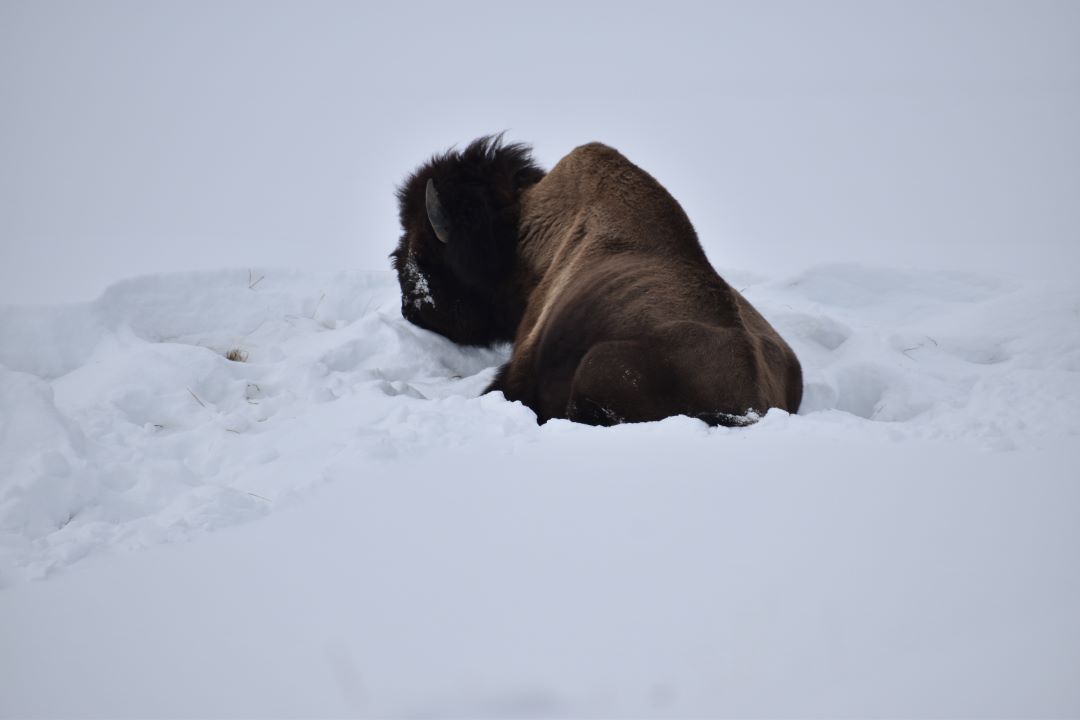
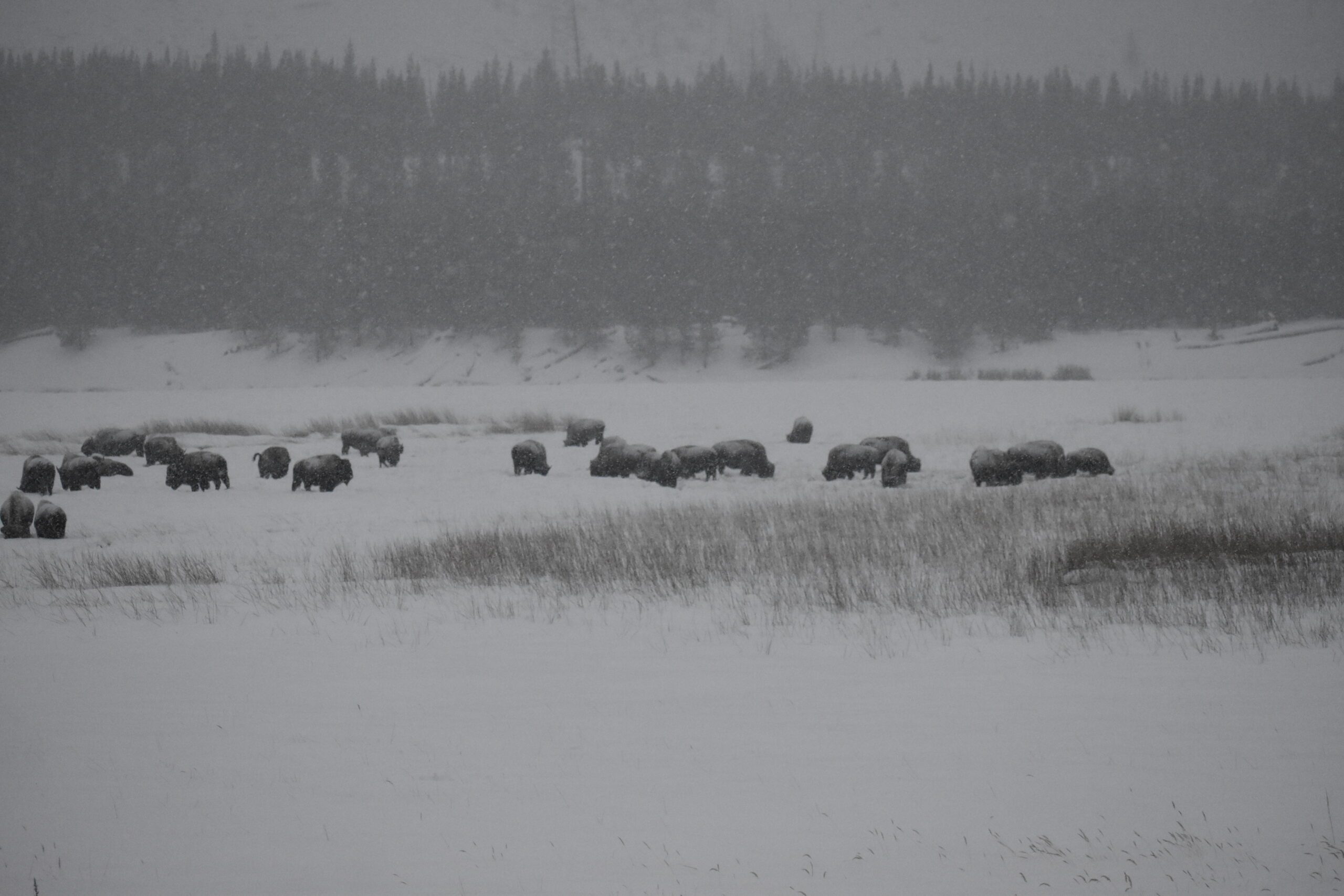
We came upon our first herd of bison in a meadow along the river, a group of about 15 or so mostly cows and calves, according to Owsley. Bison bulls tend to roam alone or in smaller groups during this time of year, she said. Bison use their massive heads — which make up 10% of their bodyweight, according to Owsley — to plow the snow aside so they can reach the grass beneath.
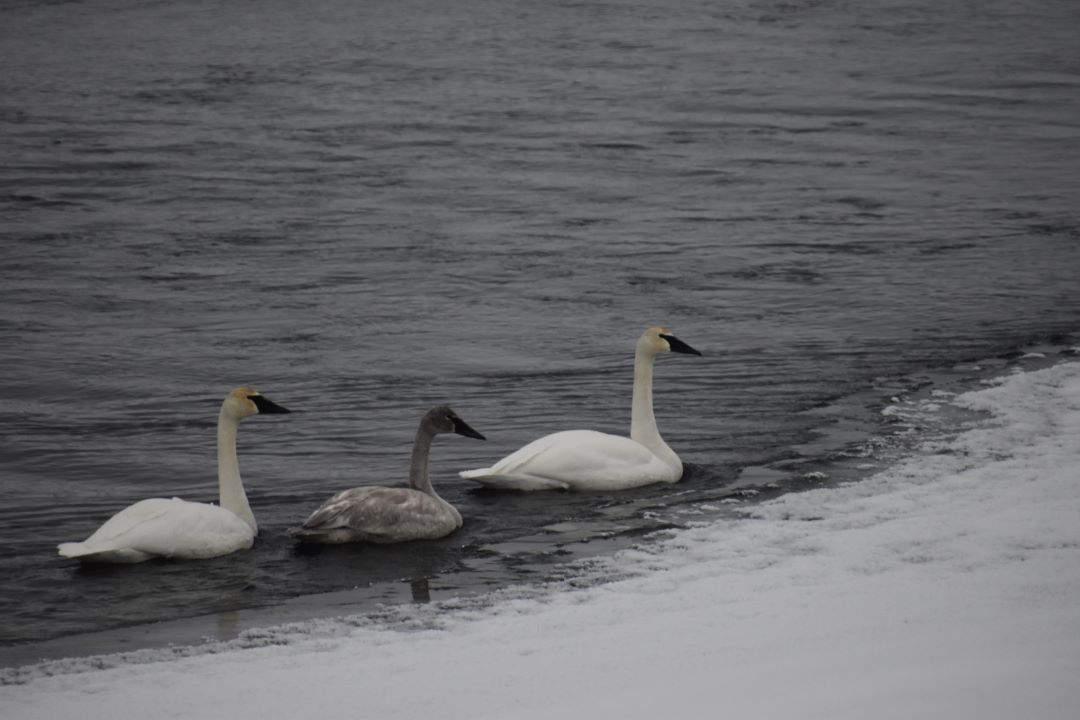
The rivers in the park were teeming with waterfowl, including trumpeter swans, ducks, and geese. The swans, Owsley told us, migrate from Alaska to the Yellowstone River in the winter because it seldom freezes.
Grand Canyon of the Yellowstone
Our next stop was the Grand Canyon of the Yellowstone. Created when the Yellowstone River, the longest undammed river in the United States, eroded rock weakened by the park’s hydrothermal activity, the canyon is between 800 and 1,200 feet deep and 1,500 and 4,000 feet wide.
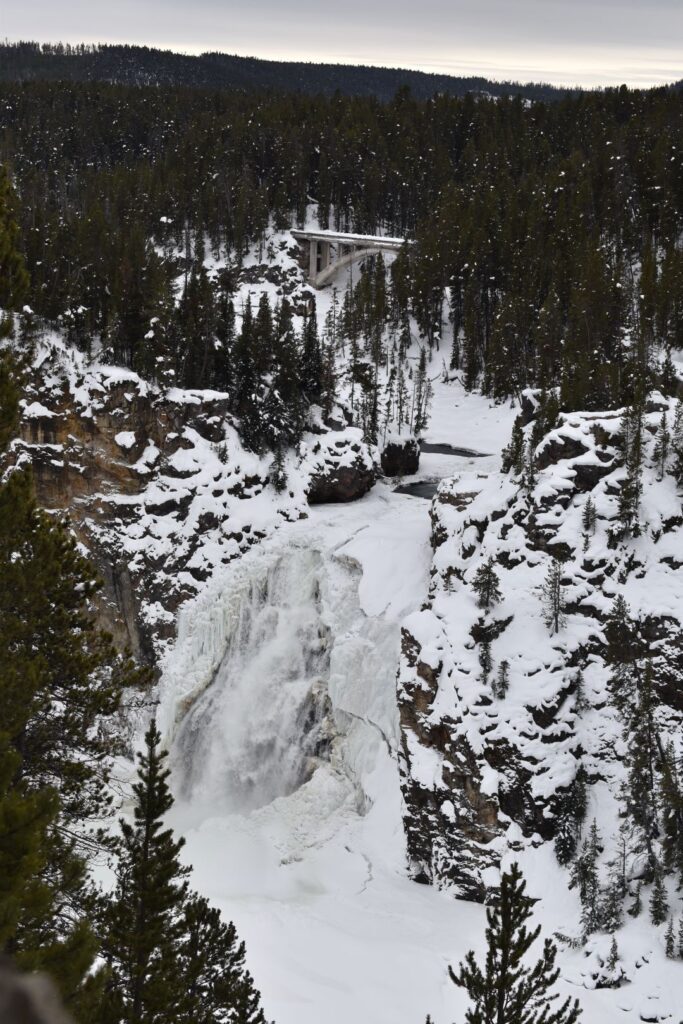
The canyon contains two waterfalls, Upper Falls and Lower Falls. In the winter, Upper Falls, with a 109-foot drop, is best observed from the Upper Falls Viewpoint. The 308-foot Lower Falls can be seen from Artist Point. Because the river curves between the two falls, there is no location from which both falls can be seen at the same time.
The canyon’s unique colors are also caused by hydrothermal activity. The rhyolite in the canyon contains iron compounds, and the heat from underground causes chemical alterations. When exposed to the elements, the rocks change colors; the canyon is actually rusting, and the Yellowstone River is continually eroding the rock.
Norris Geyser Basin
Norris Geyser Basin is the hottest, oldest, and most dynamic of Yellowstone’s thermal areas. The highest temperature recorded in any geothermal area in Yellowstone, 459 degrees, was measured in a scientific drill hole at Norris.
The Norris basin includes two areas, Porcelain Basin, which we visited, and Back Basin. Porcelain Basin in the winter resembled a moonscape, with steam leaking from various openings and thermal features.
We weren’t the only ones using the boardwalks in Norris — it was clear from the hoofprints in the snow that bison had come this way, and Owsley confirmed that bison often use the paths in the winter.
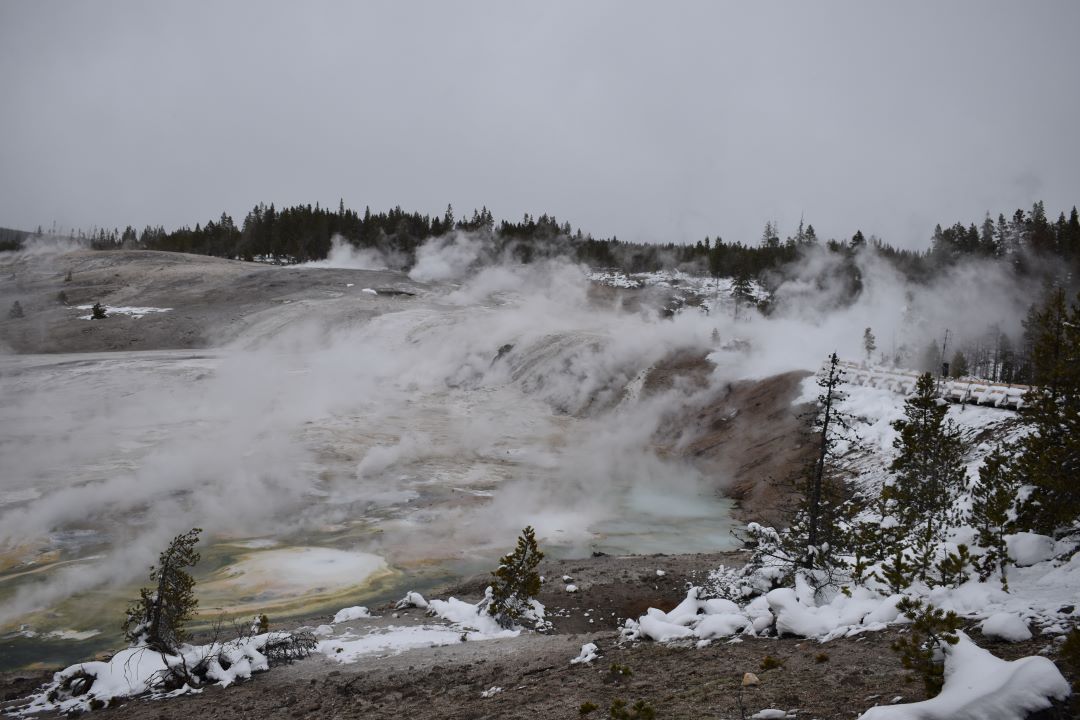
As we walked back toward our coach, the wind picked up and snow began to fall. The park’s weather often changes rapidly. The record low temperature is -66 degrees, with an average snowfall of 150 inches.
The snowfall picked up as we drove back toward West Yellowstone, although it seemingly had no effect on the wildlife. We saw, separately, three coyotes hunting for mice and voles under the snow. Standing stock still, they cocked their heads and listened for the sound of movement. When they heard something, their tails would start to flick and then they’d pounce, ramming their front legs and snouts into the snow. At least one coyote came up with a meal, which it polished off in seconds before resuming the hunt.
The bison, also, continued to eat, ignoring the snow piling up on their backs. We passed a small group that had bedded down on the ice, much to the surprise of Owsley, who said it was unusual for bison to be there. Eventually, though, as the snow worsened, they headed for the trees, and shelter.
Thank you Bonnie, for your detailed and captivating observations of one of my favorite National Parks. Beginning in 1986, over a span of 15 years, I led groups of summer visitors to Yellowstone. The year of the fires was challenging, but during the seasons that followed, the rewards of watching the growth and changes were more than worth it, and truly astounding. Yet I admit to being a bit envious of your visit to Yellowstone as a deep winter wonderland. At the same time, I’m pleased and thankful that you have shared with your readers this extraordinary, intimate and profound experience.