CRMC Tables Consideration of Cliff Walk Repairs
July 20, 2026
Share


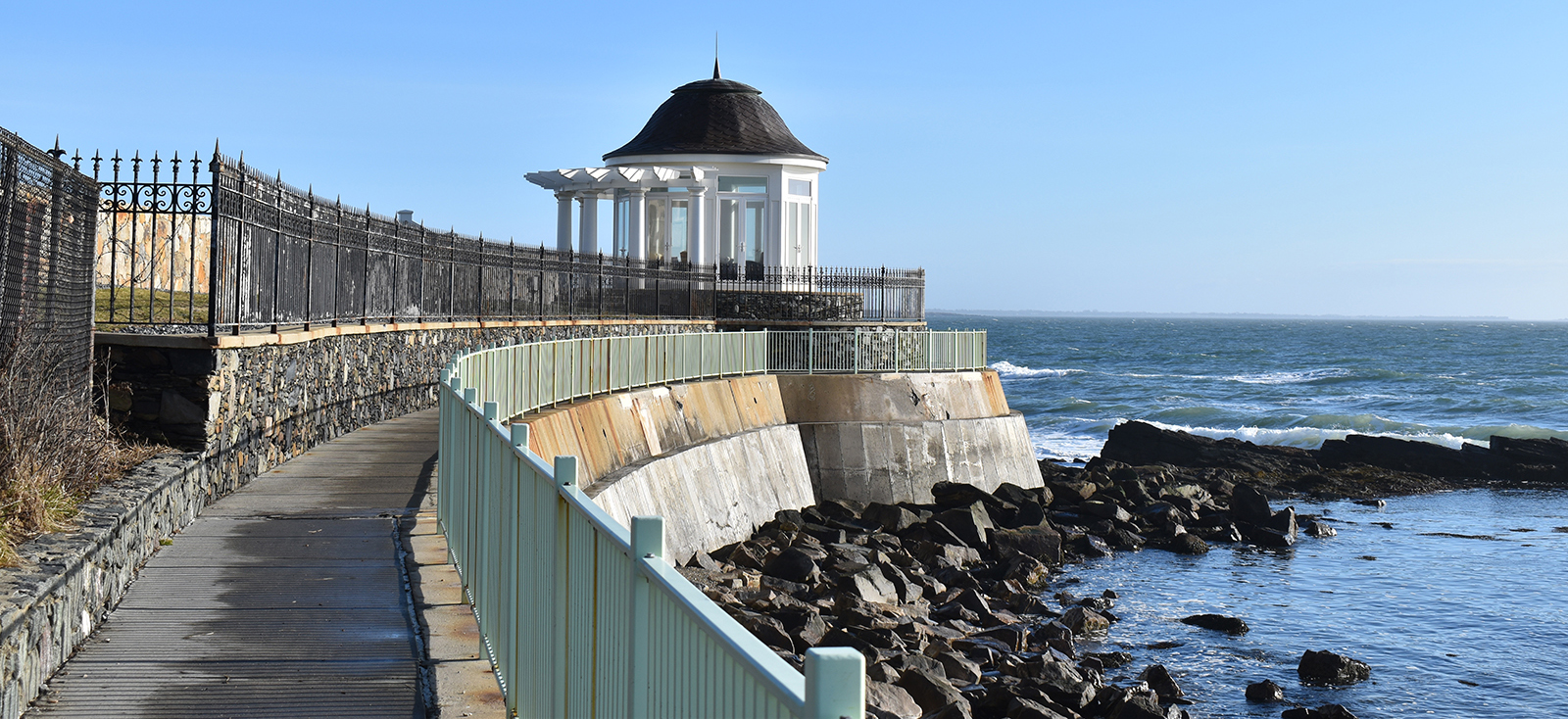
PROVIDENCE — It’s been more than four years since a storm collapsed a section of Newport’s famous Cliff Walk, and city officials have secured the money and engineering proposals to fix its most famous landmark. But a spat between coastal regulators and a Gilded Age dynasty threaten to wash the project away.
The sticking point centers around the inclusion of riprap for a bedrock outcrop upon which sits a 5,000-pound stone bridge and overlook in the city’s application.
Staff for the Coastal Resources Management Council recommended the agency’s executive board say the bedrock outcrop riprap exceeds the agency minimization of impacts and would require a separate assent and application rather than being lumped together with the city’s Cliff Walk repair proposal.
“It has long been staff opinion that supporting the overlook (private recreational area) will not be accomplished by the placement of rip-rap along the front of the bedrock outcrop in and of itself,” wrote Amy Silva, CRMC biologist, and Rich Lucia, CRMC engineer, in their recommendation to the executive council. “The area of fill/riprap is not considered to be the minimum necessary to prevent further collapse of the Cliff Walk.”
But the private owners of Southside, the Gilded Age mansion also known as the Ochre Point estate that occupies an entire block and section of the Cliff Walk that collapsed in 2022, have said they won’t allow contractors on their property to rebuild the landmark unless the riprap for the private outlook is included. The Cliff Walk is open to the public, but the mansions still held in private hands along its pathway typically are not.
In an email with city and engineering officials dated July 8 and forwarded to CRMC staff, Turner Scott, an attorney representing the owners of Southside, wrote that, “My client’s position is unless the overlook or nub is protected in accord with the submitted plans the City will not be allowed access the property even if the approval is granted by CRMC for the rest of the project, funding is available, and the funds available are sufficient to cover the costs of construction.
“Obviously the time for the city to exercise and [sic] political influence to guide the staff report in the correction [sic] direction is lost. I had hoped for and expressed the urgency of the city becoming more politically engaged with the CRMC so this juncture would be avoided.”
During the project’s hearing before CRMC on July 14, Scott denied to council members that any condition was put on the project.
“The only condition, if you can say this is a condition, is that we’d like to have it done correctly,” Scott said. “We’d like to have it done so it’s done in a global manner, and not a piecemeal manner that’s been approved for years by CRMC and failed.”
CRMC board members bristled at the tone and content of the email. In one exchange, council member W. Michael Sullivan expressed dissatisfaction with possible political pressure on the project engineer, but Scott said he took offense at the suggestion of “political pressure.”
“Your email, with all due respect, clearly extorts them to apply political pressure,” Sullivan retorted. “It’s your words, not mine.”
“I think there should be some political pressure here because you need to have it done correctly,” Scott said. “That’s what I said, you need to have it done correctly.”
“Correctly is different than politically expedient,” Sullivan replied.
City officials emphasized that they require access to the Southside estate to repair the Cliff Walk, because approaching from the sea would be far more cost prohibitive and change the plans being considered by CRMC. Kevin Gavin, an attorney representing the city, pointed toward a prior assent awarded by the agency in 1975 as proof the agency could include the overlook.
“This is not a new thing to have, this type of riprap along the area of the Cliff Walk,” Gavin said.
The city confirmed to the council it had secured the necessary funding, $22 million in total, to pay for the project. The pot of money includes a $5 million congressional allocation, $3 million from the 2024 green bond, $3.7 million from the city of Newport, and around $11 million in a federal highway protection grant, pending an approval process through the National Environmental Policy Act.
Council members ultimately voted to table consideration of the project, pending an analysis of other possible options.
The 550-foot-long section of the Cliff Walk in front of Southside has been closed since 2022, with the public having to take a detour around the estate back on the street to continue passage along the famed coastal walkway.
Because the only access to the Cliff Walk for repairs has been historically overland, city officials attached the owners of Southside, NRI TT RGG LLC, to the project. The LLC is actually a property holding company, and Newport property records list Goelet LLC, a wealth management firm for the Goelet family, as the company’s address.
The Goelet family is a Gilded Age-era dynasty that has owned Southside since 19th-century real estate mogul Robert W. Goelet commissioned its construction in 1882. A relative, Ogden Goelet, built Ochre Court next door, which was later gifted to the Sisters of Mercy who founded Salve Regina, its current owner.