Providence Communities Advocate During Comprehensive and ProvPort Master Plan Processes
June 18, 2026
Share


PROVIDENCE — On Nov. 24, 2025, people packed into the Washington Park Public Library to discuss the ProvPort Master Plan. Many were residents of Washington Park and other port-side communities, seeking updates or to provide their input within earshot of whichever city officials were also in attendance.
Signs one might imagine held aloft at a rally were hung throughout the library. “This place stinks, but it rocks,” one said. “Que es ese olor?” said another. Two signs read: “If you smell something, say something.” At the bottom of the sign was a phone number residents could call to alert the state Department of Environmental Management.
For decades, South Providence residents have been enduring more than just odors. These communities suffer from disproportionately high asthma rates and other health issues, which they’ve long attributed to air pollution from the nearby port. But it was largely odor reports that prompted the DEM to conduct a two-year Air Toxic Study on the port in 2020.
“What do we know after two years?” asked Meredith Hastings, the project leader of Breathe Providence, a hyperlocal air monitoring initiative out of Brown University. “Well, we know there’s a lot of bad stuff in the air. Sometimes it’s illegal. It’s definitely cancer-causing.”
But the study can’t assign blame, said Hastings. “There’s no way to backtrack to decide who’s making those emissions at the time and who should get in trouble.”
Near the back of the library, Linda Perri, head of the Washington Park Neighborhood Association, chatted with attendees. Perri spoke in a public hearing at Providence City Hall in September 2024, during the planning of the since-passed comprehensive plan, a far-reaching document informing urban planning policy in Providence over the next 10 years.
“It’s going to be a runaway train if we don’t address it right now, right here,” Perri said. She told councilors and planners, “We need to have a say in how the growth is going to happen, especially because we breathe the air and we live in the shadow of the port.”
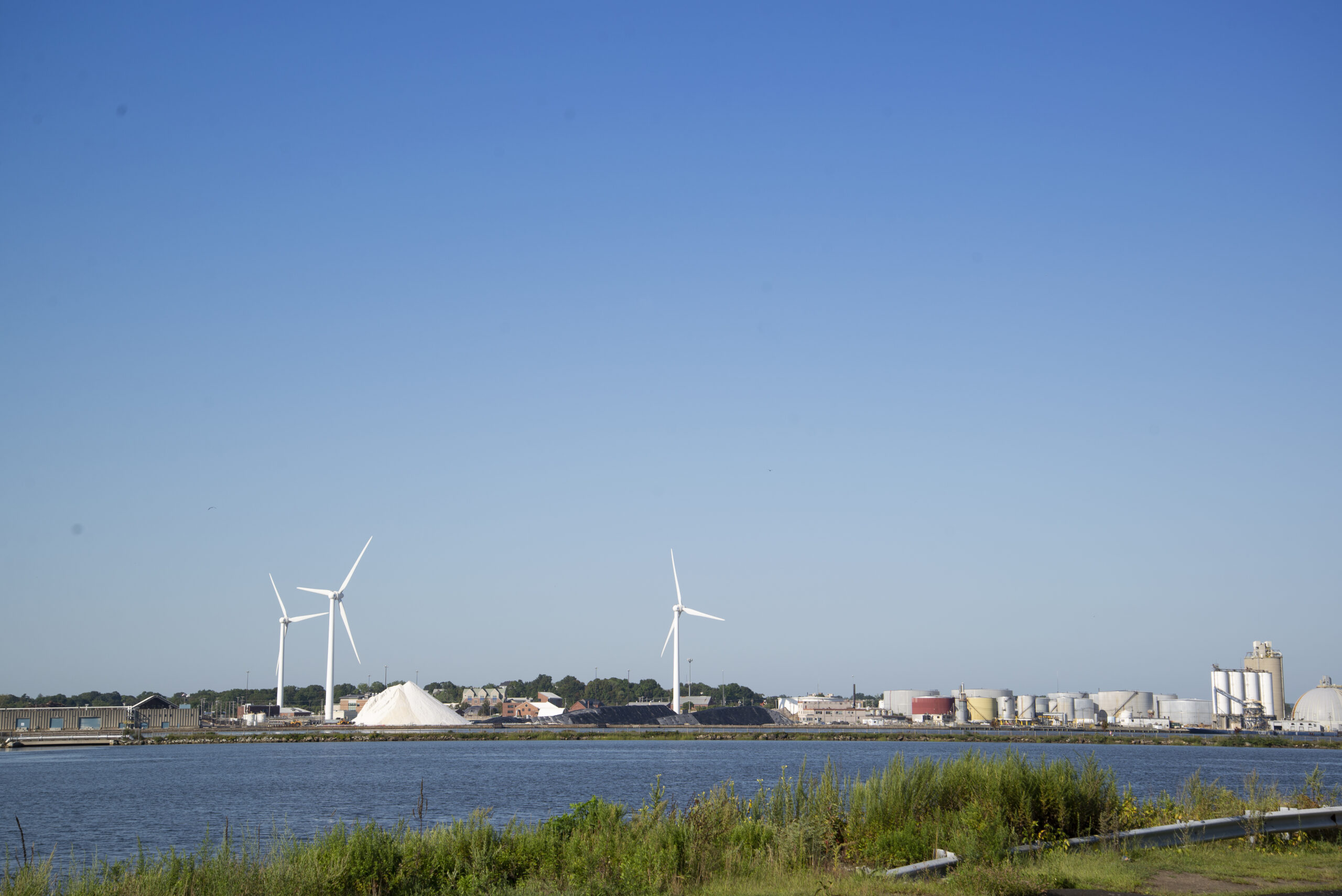
The growth Perri is referencing is that of ProvPort, a portion of the port of Providence leased from the city by a nonprofit of the same name, which is and plans to continue expanding blue and green industry to replace polluting, nonrenewable industries like fossil fuels.
Perri’s complaint is a common one among residents. Despite ProvPort’s and the comprehensive plan’s mutual agreement on a devotion to a “blue and green economy,” communities suffer from a lack of involvement or even awareness of port activities. And although the drafting processes of the comprehensive and ProvPort master plans require public meetings for community input, citizens often report a distinct lack of transparency in the actual planning process.
Still, the plan renewals are only every 10 and 30 years, respectively. These public meetings have provided rare opportunities for communities “living in the shadow of the port” to make their voices heard and influence policy.
In October 2024, the Providence City Council approved a draft of the comprehensive plan and awaited a signature from the mayor’s office. The draft included several additions based on input from residents living near the port, including an extensive list provided by community leaders of “banned uses” at the port, targeting industry long believed to be behind many harmful odors and toxic pollutants like medical waste incinerators, concrete processing facilities, and more. Though a comprehensive plan cannot remove existing businesses within an industrial sector, it can impose limits on growth and ban new companies from entering the fray. Fossil fuels, appearing on the list, were of particular focus, with ambitious goals set to halt the expansion of related industries completely.
But, in a surprise move, Mayor Brett Smiley threatened to veto the plan, forcing renegotiations and concessions.
Back at the Washington Park Public Library, another sign asked: “How many million more years until PVD goes fossil fuel free (‘We will’ > ‘we may’),” referencing a seemingly minor change to the comprehensive plan’s wording that could seriously limit its ability to halt the expansion of fossil fuels. The list of “banned uses” shrank from a broad myriad of polluting activities to just three specific uses.
Community leaders like Monica Huertas, who presided over the community meeting at the public library, thought the new ProvPort Master Plan could provide an opportunity to take back the ground lost to the mayor’s office during comprehensive plan negotiations.
“We want a definition of green and blue economy. We want to stop the expansion of fossil fuels and toxic chemicals,” Huertas said in an interview. “We want more community input into ProvPort and its workings.”
The master plan comes with renewal of ProvPort’s lease with the city, coinciding also with plans of expansion, both literally, as ProvPort begins construction across the water at the South Quay, and in industry.
“The master plan process was intended to both make recommendations for infrastructure projects, to improve operations, to support sustainable development and economic opportunities,” Manuel Cordero said at the community meeting. Cordero works for CIVIC, a multidisciplinary design firm working to facilitate public engagement with the master plan. CIVIC works alongside GZA GeoEnvironmental Inc., the lead consulting firm assisting with the master plan.
In addition to its influence over expansion and policy at ProvPort, the master mlan also concerns two funds – the Sustainability Benefit Fund and the Community Benefit Fund. Each fund receives 1% of ProvPort’s annual revenue, or a minimum of $120,000. The master plan determines how those funds are spent and how that funding will be directed. It was expected that these funds would largely finance projects, i.e., air monitoring, proposed to the community by GZA.
In accordance with the master plan process, community members have four meetings, organized by GZA and CIVIC, to navigate a complicated maze of drafts, policy, zoning, politics, funds, and planning. The last of these meetings was held on Oct. 21, 2025, at the Met High School. Attendees were directed to tables. Handouts were provided with color pencils. One included a blank cartoon silhouette that attendees were meant to color in as themselves.
“I put an X on it and said I was dead. How do you sit here and tell me to dream of me being 70 years old with chronic asthma that I have? The chronic asthma that my children have?” said Huertas.
Huertas and other leaders called the library community meeting separately from the official ProvPort master plan drafting process. It was at this meeting that Huertas unveiled the news that the Community Benefit Fund, half of the allotted funds, had already been spent.
“We were trusting in the process. And of course, there are so many things, so many moving parts, but we have a sense that this is a failure,” Huertas said. “We came in with good faith and now… not everything was about that pot of money, but so many things were tied to it.”
This story was published as part of a collaboration between ecoRI News and students in Brown University’s Science Journalism class. The stories examine the science, history, and human experiences connected to the Ocean State’s rivers — from water quality and wildlife restoration to flooding, pollution, social justice, and the communities working to protect them. To read more of these stories, click here.