Providence’s Premiere Avian Pit Stop in Peril
March 18, 2026
Share


PROVIDENCE — Sue Talbot, a longtime Rhode Island birder, says, “The only way is for people to stop dying,” as she walks through the woods with her partner Daniel Finizia.
That’s a tall order to save a stand of trees, but may prove to be the only hope of preserving some of the most important habitat for migratory birds in the city of Providence: Swan Point Cemetery.
The pair has spent decades observing the plethora of birds that stop in the cemetery each year during their annual migration in the spring and fall. Since Finizia first started looking for birds on the property around 1970, he’s recorded over 240 species here — more than has been seen at any other single birding hotspot in Providence County.
But this urban bird oasis, located on the East Side of Providence, is on the grounds of an active burial site. As graves are filled, demand for land increases to make space for more. In the past 15 years, nearly one fifth of the woods in the northwestern corner — the most significant wooded area on the property — has been cut down to make space for more grave plots, including four acres of woods cleared in April 2025.
The amount of suitable habitat on the property is already quite small: a wooded band around the perimeter of the cemetery is where the majority of birds are found, says Talbot. As expansion of the graveyard chips away at the remaining woodland, Swan Point’s ability to host its avian visitors could decline significantly.
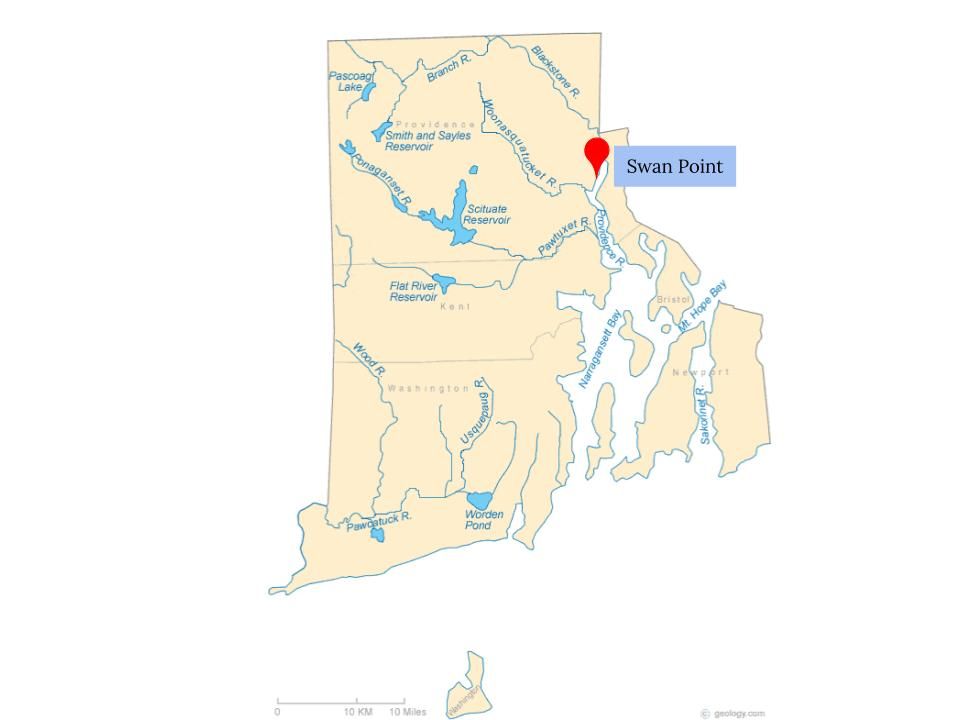
The reason Swan Point attracts such diverse bird life lies in its position along the Seekonk River, where it makes up a significant portion of the habitat corridor that also includes Blackstone Park and the smaller Riverside Cemetery. Each spring and fall, birds migrating between summers in temperate forests and winters in the neotropics flood into Rhode Island skies at night, many following the banks of the Narragansett Bay and Blackstone River. In the morning, they must find a place to land, shelter, and refuel, and Swan Point sticks out as an inviting green patch in a quilt of urban development.
“It’s probably the biggest chunk of habitat you have in that area of the city,” says Sam Miller, non-game bird biologist at the state Department of Environmental Management. “You get birds landing all over the place – by the time the sun rises, you’re bound to suck in all the migrants from unsuitable areas.”
Birds filter in from the surrounding city, and the ring of natural woodland surrounding the grave-studded lawns swells with birds during migration.
This habitat isn’t there by accident. Proliferation of wildlife, and specifically birds, are built into the fundamental ideals of the cemetery.
“The entire grounds are cared for in a manner to be as much for the living as for the dead,” says Kelly Perry, director of horticulture, greenhouse operations, and educational outreach for Swan Point.
Perry is in charge of carrying out maintenance and development projects on the grounds and says she tries to balance the needs of the cemetery with the health of the ecosystem. They leave dead trees intact to provide food and nesting cavities for animals such as woodpeckers, owls, and squirrels, and pesticide use is very intentional and designed to minimize harmful environmental impacts, Perry says. She says that even expansion projects such as the recent development in the northwest woods are carefully timed to avoid disturbing nesting owls and brown bats.
According to Finizia and Talbot, the relationship between the cemetery and local birders goes back to at least the 1940s, when a woman would come from the Lincoln School to lead bird walks. Finizia recalls that he learned about the bird life here from the Audubon Society of Rhode Island, which listed it as a good place to find birds in the springtime and led bird walks on the grounds when he first started birding around 1970.
Swan Point took a vested interest in the bird life the property hosted and commissioned ornithologist Charles Wood in 1981 to write “The Birds of Swan Point“, a report detailing years of his sightings. All the species seen on the estate are catalogued in a list on the cemetery’s website.
The estate gained a prolific reputation as a place to see a concentrated number of migrant warblers in the spring, so much so that it became the site of a 15-year study of warbler migration and populations, which recorded 27 species of the little multicolored songbirds. Finizia fondly remembers a day in the ’70s when he saw an astonishing 25 warbler species in a single tree on the north side of the property. Since the early 2000s, when songbird migration is at its peak in May, the gates open an hour earlier in the morning to accommodate birders eager to get an early start.
But there is only so much that can be accommodated without having to consider the needs of the institution.
“We are first and foremost an active cemetery,” Perry says.
Since Swan Point’s inception 178 years ago, the land was always meant to be used for grave plots, Perry says. Hung on the walls of the front office, maps of the cemetery from 1993 illustrate a sobering future for wildlife. In these drawings, the remaining woods at Swan Point are replaced by a checkerboard of dotted lines where hypothetical roads would lie.
Still, Perry is confident that unless there is a drastic change, those plans will never come to fruition. The natural buffer around the border is too important to the culture of the cemetery, she says. The question is whether enough of the woods will remain to not only preserve the buffer, but to support an ecosystem capable of providing productive habitat where birds can forage and shelter.
Although there is plenty of habitat in Rhode Island, with about 59% of the state covered in forest, Miller says that, “without a network of suitable stopover locations, especially in areas where there really isn’t much stopover habitat… the general migratory fitness of the migrants transiting these portions of Rhode Island would be reduced.”
Urban greenspaces provide pockets of sanctuary in an otherwise bleak homogeneous sprawl of concrete and industry, and small increases in available habitat have been linked to increased species richness within an area. But take away those patches, and biodiversity will instantly disappear.
This hurts not only the wildlife but nearby communities, which are then unable to engage with nature. Miller says that it’s important that birds are available to everyone, and that starts with having a space nearby where nature is accessible. Conservation efforts thrive on community engagement and commitment and that starts with real life interactions with the natural world.
Places like Swan Point offer the opportunity for people to get out and actually observe wildlife; they enable people who are just getting into birds to open a field guide, point to a bird, and then go see it, explains Miller.
This direct connection with nature instills a desire to protect it. So the continued presence of the woods at Swan Point is important, not only for the birds, but for the Providence community.
“The public benefits from having rich biodiversity, from having birds, from just having nice green spaces,” Miller says.
This story was published as part of a collaboration between ecoRI News and students in Brown University’s Science Journalism class. The stories examine the science, history, and human experiences connected to the Ocean State’s rivers — from water quality and wildlife restoration to flooding, pollution, social justice, and the communities working to protect them. To read more of these stories, click here.