
Tiverton Farmer Established Roots Back Home
Small-scale, organic farm survives with meticulous planning
May 21, 2026
Share


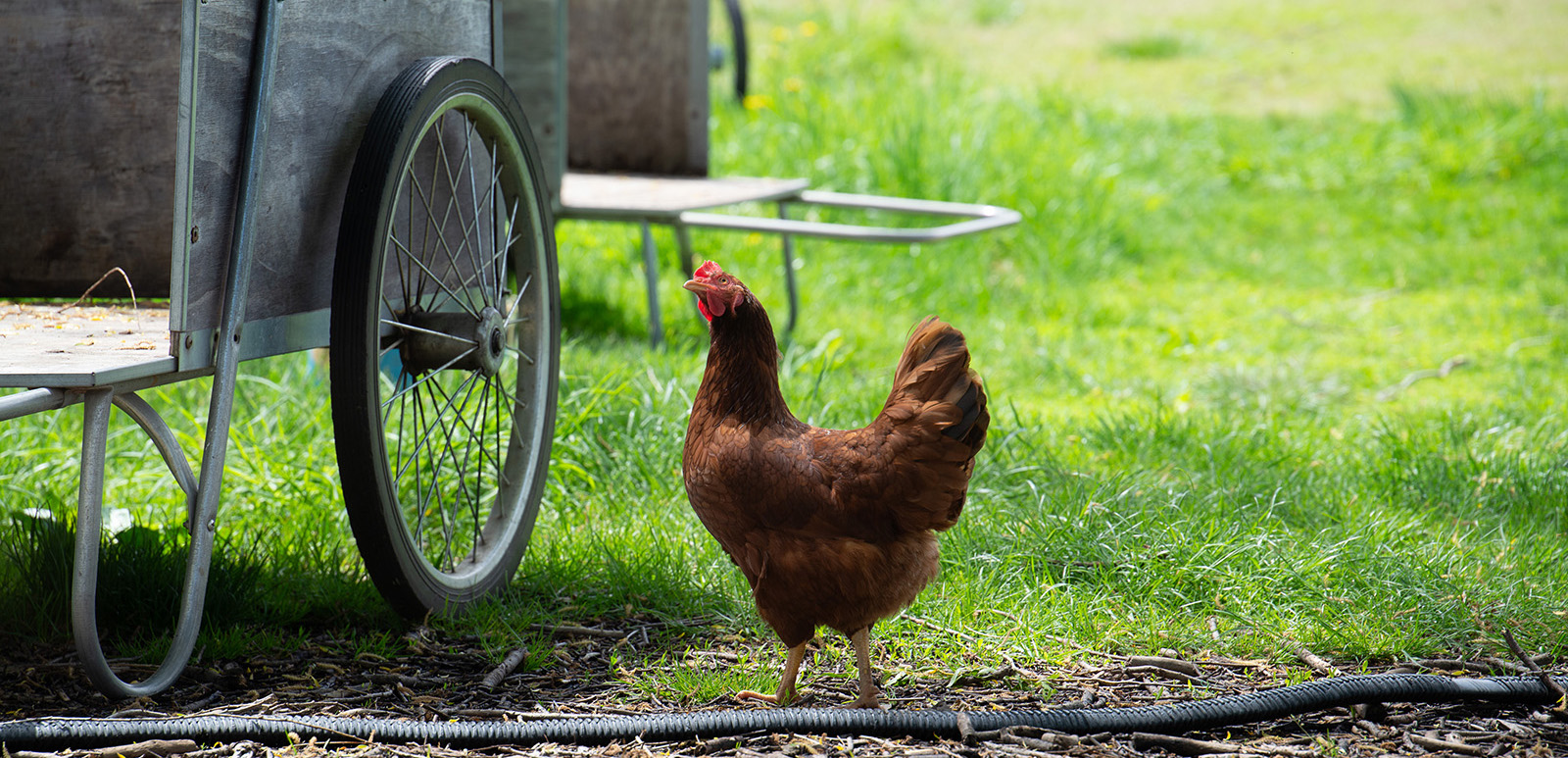
TIVERTON, R.I. — We were escorted onto the East Road property by Fabulous. The year-old hen seemed to have the run of the place, even as the 16 other hens, a rooster, and two ducks appeared content in their large, movable outdoor pen. Apparently, nobody puts Fabulous in a corner, not even if the spot is prime real estate on an organic farm.
The reason Fabulous is able to freely walk the premises is quite simple: “She hops out,” Kelli Roberts said.
The Robertses, Kelli and husband Mike, both 45, founded Roots Farm 16 years ago. Their descent into farming was delayed by graduation from the Massachusetts Institute of Technology and earning higher degrees. Kelli has a Ph.D. in material science engineering and Mike has a master’s degree in mechanical engineering.
After falling in love when they were MIT undergraduates, the couple then fell in love with farming. The seed was planted when Kelli was in graduate school at the University of Washington in Seattle.
“While I was out there, I started getting interested in food and food systems,” she said. “Didn’t think I would be a farmer, but we joined a CSA [community supported agriculture], and we started volunteering a little bit in different ways. By the time I finished, I realized I wanted to take some time to do something totally different.”
Their plans to be engineers were derailed when they decided to take a year off after graduate school to work on an organic farm in Maine. Their goal was to learn how to grow food for themselves and their future nuclear family, which now includes two sons, 13 and 10.
Their study break, however, changed their careers and life trajectory.
“We kind of just got hooked, [but] we went back to our other jobs,” Kelli said. “We moved to Ithaca. I was a postdoc at Cornell and he had a job as a mechanical engineer up there. The whole time we were missing farming, so we decided to make a little business plan. If we could start a farm, how to do it so that it could actually be a job and not just a hobby.”
Shopping at farmers markets in New York’s Finger Lakes region was the fatal blow to their engineering careers.
We would go shop at the farmers market and I would wish I was the person selling the kale instead of just buying the kale. I kind of knew. It just felt right. So we kind of got out of there sooner than originally planned, because we were just ready to start our farm.”
— Kelli Roberts, Roots Farm
(Kelli worked remotely to finish her Ph.D. Her advisor was a soil scientist, so he understood the allure of farming.)
After about five years of holding off-farm jobs to get their farm and their family established, they were able to transition to solely farming in 2014. They have been farming full-time and year-round ever since.
It’s not easy for a small-scale vegetable farm to maintain economic stability, pay the bills, raise children, and stay in business. Hard work, a passion for growing food, excellent staff, a bit of luck, and meticulous planning, which for the Robertses means lots of spreadsheets, are the key ingredients.
“It might not appear so from the untrained eye at viewing the chaos of what is a diversified vegetable farm, but having a tightly run operation really goes a long way,” Kelli said. “The main way we’ve achieved financial stability was by first, having off-farm jobs for the first few years to get started, and then also having a well-organized, well-managed farm that optimizes space and time.”
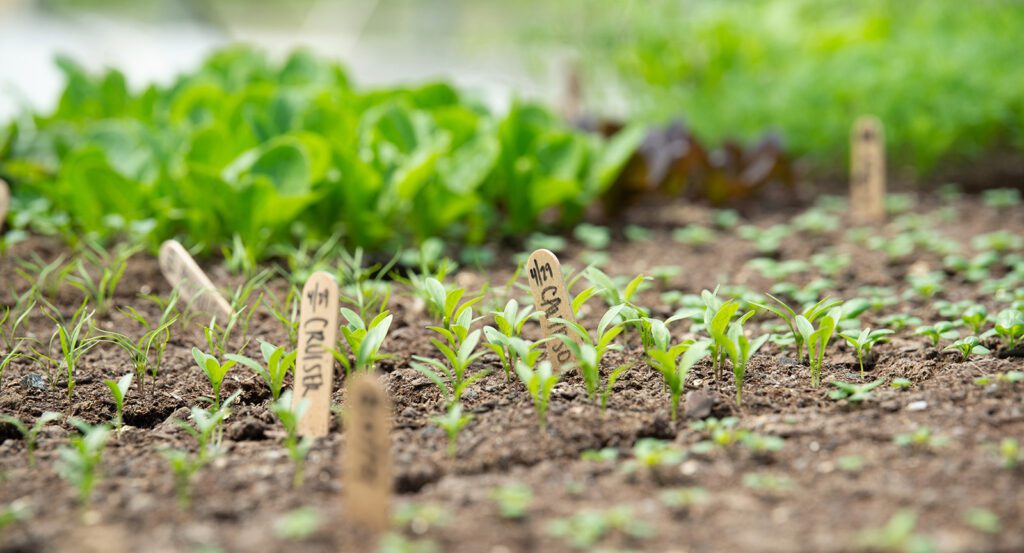
To the untrained eye of this reporter, who struggles to manage four raised beds of vegetables, the farm was immaculate. The rows of vegetables — outside, in greenhouses, and under various coverings to protect from disease, pests, and heat — were largely weed-free and the growing crops looked too beautiful to harvest, never mind eat.
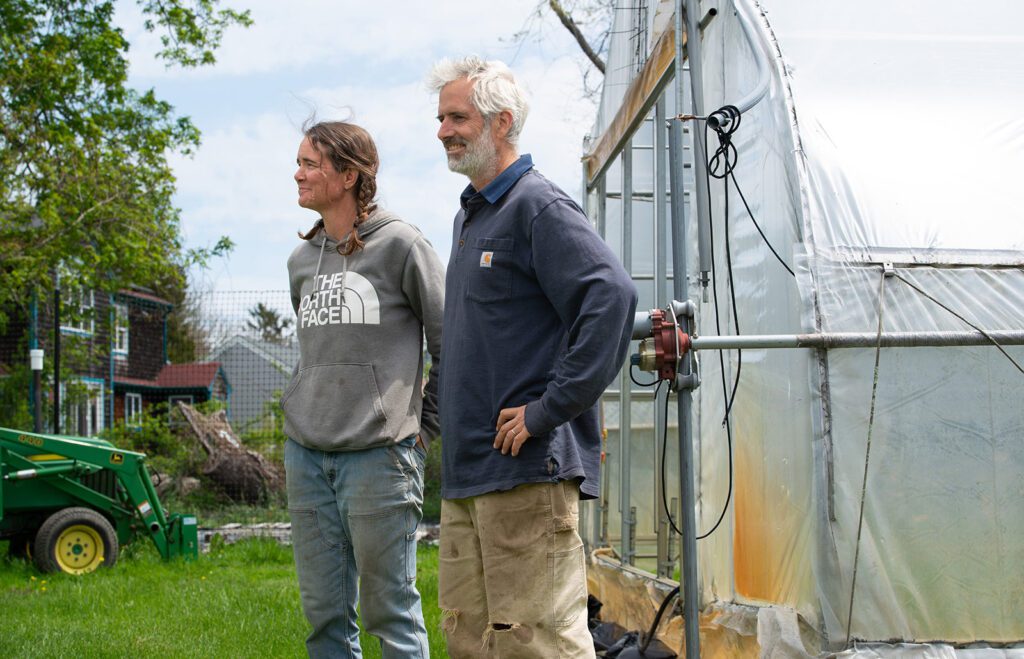
As for the farm’s long-term success, Kelli noted that focusing on direct sales to customers has allowed the operation to attain financial stability. About half to two-thirds of the farm’s sales are conducted at farmers markets. Roots also has a farm share program, with about 200 members, and an online store.
For Mike, being engineers has likely helped in some indirect way, “but I think the general mode of thought is being organized and methodical.”
The couple’s first foray into farming on their own cropped up in August 2009 on some leased farmland in Bristol. A year later, in November 2010, the operation was uprooted and moved to East Road, where their new house required some tender loving care and Roots Farm was established. The farm’s name derived from Kelli’s return home.
She grew up in Tiverton, graduating from Tiverton High School in 1999. When Kelli left for Cambridge, Mass., she didn’t expect to call the East Bay home again, especially as an organic farmer.
Her route home, however, took some twists and turns. She and Mike, who was born in Argentina and grew up in Danvers, Mass., moved from Greater Boston to the Pacific Northwest, then to coastal Maine, to upstate New York, finally landing in the Ocean State. Along the way they took breaks in their studies and research to work on farms. The call to be outdoors planting crops and tending to harvests slowly began to feel more natural than careers as engineers.
The Robertses were influenced by Eliot Coleman of Four Season Farm in Harborside, Maine. He defines organic farming as embracing the soil’s biological systems. He is the author of “The Self-Fed Farm and Garden,” “Miraculous Abundance,” and “Preserving Food without Freezing or Canning,” among other works.
Kelli spent six months apprenticing at the coastal farm, across Penobscot Bay from Belfast, where she learned the concept of market gardening, which revolves around the efficient use of a small space to grow a diversified selection of crops.
“I feel like a lot of farms in Rhode Island are like that because of the cost of land and cost of living as well,” Kelli said of market gardening. “You just kind of have to really get a higher production on a smaller footprint in the state. Not that everyone does that, but I’m just saying it is more popular here.”
Organic-certified Roots Farm is situated on 6 acres, of which about 2 are used for growing. The Robertses and their small crew of full-time and part-time employees produce about 25 tons (55,115 pounds) of arugula, beets, carrots, chard, cucumbers, eggplant, garlic, kale, lettuce, onions, peppers, potatoes, radishes, salad turnips, spinach, tomatoes, and zucchini annually. The farms also grows ginger and turmeric. The Robertses abandoned growing sweet potatoes, Brussel sprouts, pumpkins, flowers, and most fruits — largely for space reasons.
“Stuff that takes up a lot of space doesn’t make sense,” Kelli said.
Mike noted that “at one point we grew flowers and we were like, ‘No, we don’t know anything about that.’” Now that there is a flower farm down the road, Kelli added “we would never try that now.”
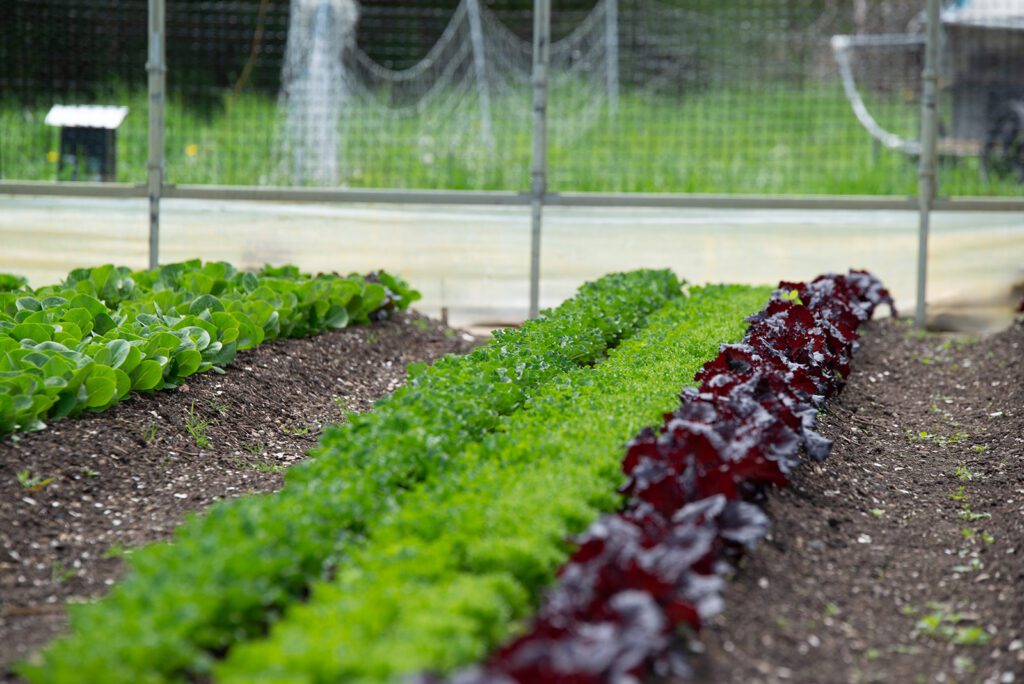
Roots practices no-till, intensive farming and makes effective use of six moveable high tunnels, which, according to the Robertses, maximize both time and space to optimize production year-round. A drip irrigation system controls well water use. A barn was built to mostly accommodate 36 rooftop solar panels. A perimeter fence installed this spring by Mike now keeps deer from dining.
With five full-time and two part-time employees, labor adds up to half of the farm’s annual costs. Depending on experience, employees are paid between $16 and $23 an hour. The full-time employees get paid time off, and everyone gets free vegetables. At the beginning, farm workers/volunteers were paid in veggies only. Being able to offer employees health care is the next goal, which at the moment remains out of reach.
“Health care is a huge challenge for farmers,” Mike said. “It’s a huge challenge for everyone. Issues that affect our employees then affect us, like cost of rent.”
The climate crisis is also deepening the small farm’s list of challenges.
“In the summer, with it being hotter than when we first started, we didn’t need shade cloth on our greenhouses, but now we feel like we have to have that on all of our tunnels,” Kelli said. “Summer is just really busy and hot, and it’s hard on the employees as well as the crops.”
Being hotter just creates more stress on the crops, according to Kelli.
“A lot of the fruiting crops, like tomatoes and peppers specifically, but also eggplants, cucumbers, zucchini, it can damage the pollen and blossoms drop,” she said. “You just get less fruit. It even slows ripening when it’s really hot.”
The rising regional temperature and southern New England’s infamous humidity have teamed up to increase the pressure.
“Humidity is the number one thing. It puts a lot of disease pressure on the plants,” Kelli said. “You have to put on rain boots in the morning even if it didn’t rain because it’s so humid. It’s so dewy until like 11 a.m. that the plants are just often drenched.”
Despite the many challenges of small-scale, organic farming and the back-aching work it requires, the Robertses have no regrets about what could have been.
“We do love growing food, so I think it’s just about adapting, making sure we have a plan, and accepting our limits to physically do the work,” Kelli said.
What a great hometown story from Tiverton! I recently joined Roots Farm Community Co-op and picked up my order last Friday at the farm.
The vegetables were very clean and perfect!! I exclaimed to my husband that “these vegetables look like works of art!” We’re so lucky to have farmers like Kelli and Mike locally who delingently work so hard to feed many their own organic vegetables.
Signed, grateful eater! ❤️
About 10 years ago the NY Times had a full page report on a 5 year USDA study at Iowa State. “A Simple Fix for Farming
By MARK BITTMAN, New York Times”
It concluded that farmers could reduce their use of fertilizer by 88%, and pesticides even more, while maintaining the same profitability. It was all done through proper crop rotation. Unfortunately, with the ethanol program fiasco, most farmer want to just grow corn.
Roots Farm is a local treasure 🙂