
Green Bond Provides ‘Critical’ Help to Land Trusts, Conservationists in Preserving Farmland
State funds helping to conserve Tiverton farm
March 9, 2026
Share


TIVERTON, R.I. — It’s 10:30 in the morning when the group assembles in the small parking lot of an outdoor sign and awning store, dressed more for a mountain wilderness expedition than Sunday shopping.
It’s a gray morning, overcast with lingering fog and temperatures in the low 40s and rising when the group crosses Main Road and heads down a barely snowy dirt driveway next to an auto repair shop. There are nine of us in total (plus one dog), mostly local residents, and everyone has come dressed in winter layers, hoodies, coats, snow boots and hiking poles.
The town line is only a mile away, and the Braga Bridge, as well as downtown Fall River, are only 10 minutes away by car. The surrounding area is thick with detached suburban homes, strip mall business and, further up the coast, massive white storage tankers.
The dirt driveway ends after 100 feet, and from then on the group of nine will be traversing over snow, slush and mud. There are no trails on the property where they’re heading; they follow deer tracks and snowshoe footprints.
Leading the way is Pamela Thompson, president of the Tiverton Land Trust, who has been organizing semi-regular tours of one of north Tiverton’s last remaining open parcels: Hicks Farm.
“It’s been a 20-year conversation,” Thompson, who’s served as president of the land trust since 2025, said in an earlier interview. “I wasn’t involved in the conservation when the family finally said ‘Let’s do it,’ but I think they’re ready to see this dream come true at this point in time.”
The Hicks family has owned the land for centuries; records show they first became stewards of the property sometime around 1732. The family has hung on to much of the land since, farming it at some times, and leasing small parcels for development along Main Road at other times.
The property is in the shape of a big rectangle, extending from Main Road to the east all the way to the shore of Mount Hope Bay to the west. At 81.4 acres in size, it’s one of the few, and biggest, remaining open space parcels left in Tiverton. It’s not open to the public yet, but Thompson organizes tours to spread awareness of the property and raise money for the land trust’s conservation easement.
Aside from a buried natural gas pipe, which runs east to west and under Mount Hope Bay, the land is almost entirely devoid of development.
Under the agreement Tiverton Land Trust has made with the Hicks family, the trust will pay $2.7 million for a conservation easement on the back 48.8 acres of the property, while the family will retain ownership of the land. The conserved area isn’t visible from the road, so the family will grant a right-of-way – the exact path is yet to be determined – across the remaining acreage.
The first half of our hike meanders through overgrown farm fields and meadows lined by stone walls, both familiar sights to anyone who ambles in preserved properties in southern New England. The land slopes gently downward, still covered with snow, and it will get steeper the closer we get to the half of the property that will have an easement, and the closer we get to Mount Hope Bay.
At one point, early in the hike, Thompson stops the group and asks what we can hear. We’re not deep into the property, but the vehicle traffic from Main Road is already much quieter than it was. Thompson said that’s what she likes about the property.
“You could be anywhere,” Thompson said. “You could be in Maine, you could be in Rhode Island, or Massachusetts, you name it. It’s an adventure of discovery as you hike down the slope.”
The other key markers of the first half of the property are brambles and thorns. The land trust hasn’t officially begun deciding where the trails will go, although one volunteer has helpfully tied pink ribbons that provide suggestions on where we should go. Thompson had suggested handheld pruning shears to combat the vines, but none of us have brought them. We do our best to stamp the thorns down.
Half an hour into our hike we stop at a pair of boulders, each one double the size of a sports utility vehicle. Thompson said this is where the right-of-way will lead, and they more or less mark the beginning of the land trust’s conservation easement.
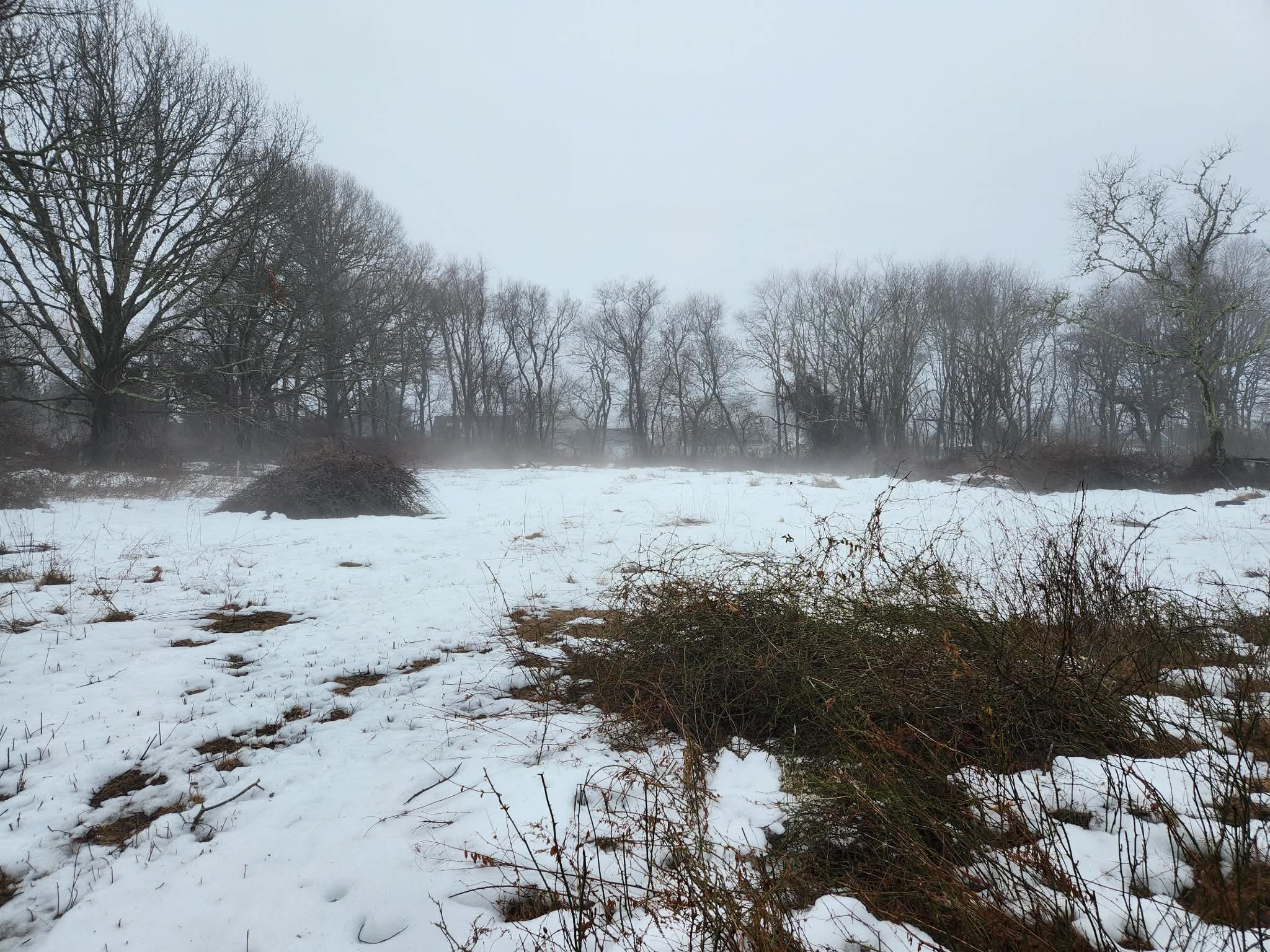
The easement is directly along the underground gas pipeline that will guide us down to the shoreline, and because the utility company routinely cuts back the vegetation, the group gets a break from bushwhacking.
As we descended the slope toward the water, Thompson began pointing out the different species of trees: birches, oaks, and one small grove she thinks is actually a big leaf aspen, one singular tree with the appearance of separate trees. It’s at the back of the property, near the water, where the biggest trees live. Thompson said the land trust is not sure of their age, but she guessed they were planted after the Hurricane of 1938, which trashed much of the nearby coastline.
“They’re maybe between 75 and 100 years old,” said Thompson. “They’re mature trees, but they’re not old growth by any means.”
At the bottom of the slope is a rocky beach, and Mount Hope Bay, our last stop before turning around and heading back to the parking lot. Bristol is faintly visible on the horizon across the water, and the group takes a break to skip the smoothly polished stones that litter the beach and take selfies.
“Isn’t this beautiful?” Thompson said of the beach and the view. “Unless you came down here, you’d never know any of this was here.”
The Tiverton Land Trust is no stranger to conserving land. It was founded in 1996 to block development of what is now Pardon Gray Preserve, a 237-acre field and forest. In the years since, the land trust has preserved more than 700 acres of green space in Tiverton, much of it clustered in south Tiverton.
If preserved, Hicks Farm would give the northern end of town its own green space to use and enjoy. While the property will remain owned by the family, conservation easements aren’t cheap, and like other land trusts around the region, the Tiverton Land Trust has been fundraising for 12 months to raise the money needed.
Thompson said the land trust had raised around $1.7 million of the funds it needs, most of which came from public money. The town of Tiverton chipped in the most, a cool $1 million, with the rest coming from a $500,000 grant awarded by the state Department of Environmental Management last month, as part of its local open space program.
“It would be near impossible to preserve Hicks Farm without the money from DEM,” said Thompson.
The state money that the Tiverton Land Trust received in a grant last month was funded by one of the state’s Green Bonds, debt the state government takes on to finance green-minded projects. Traditional programs funded include the brownfield remediation program also run by DEM, local recreational grants for parks, playgrounds and other spaces, and money for DEM’s own open space protection programs.
The local space acquisition program helps municipalities, and land trusts like Tiverton’s, preserve open space in perpetuity, a keystone state program at a time where many towns run very thin budget margins even in the best of times. It also helps unlock federal funding, which typically requires a local match or buy-in of some amount.
But that program is under threat. Gov. Dan McKee, in his budget and bond proposals for 2027, left out funding for the local open space acquisition and farmland preservation programs out of this year’s $50 million Green Bond. Without fresh infusions of cash, the programs will effectively shut down.
“The money is gone,” said Kate Sayles, director of the Rhode Island Land Trust Council, a coalition of the state’s land trusts, during a House Finance Committee hearing on the Green Bond last week. “The capital budget may show money in these programs, but I assure you this money is allocated to projects, and the money is being spent.”
Sayles was among many climate and environment groups speaking in support of making the Green Bond greener. If that phrase sounds familiar, it was the rallying cry from advocates when the governor’s 2025 budget proposal left out money for farmland preservation and open space acquisition. Lawmakers ultimately put the money back, adding $13 million in state conservation programs.
This week, Rep. Megan Cotter, D-Exeter, and Sen. Louis DiPalma, D-Middletown, have sponsored legislation (H8144) adding $17.5 million to this year’s Green Bond. The two lawmakers were also behind the legislative effort to increase land conservation money in the 2025 green bond.
“Our legislation ensures our state and local conservation programs can continue to save farmlands, forests and other vital resources that help protect our environment, maintain our state’s natural beauty and character and provide access to recreation and peaceful places that all Rhode Islanders deserve,” said Cotter in a statement.
Under Cotter and DiPalma’s legislation, the Green Bond would include $2 million for local open space and farmland preservation grants; $3 million for state open space programs and outdoor recreation grants; $5 million for renovating and preserving Fort Adams in Newport; and another $2.5 for programming at the Mariner Cabin and Program Center at Camp Rocky Farm, also in Newport.
Thompson acknowledged her land trust is unlikely to receive additional money from the next Green Bond, but said it was important to advocate for more funding in the program, calling it “critical” for conservation efforts; it’s public money, after all, that got the land trust to nearly two-thirds of their fundraising goal.
“We have less than a million left to raise,” said Thompson. “But I’m pretty confident we’re going to get there.”
“It’s important for us to advocate for more conservation funding,” she said. “It’s just critical.”
The next group walk of Hicks Farm is scheduled for Friday, March 20. More information on it and Hicks Farm can be found here.
This is such a tricky topic. In many cases, those who care about the environment and open space also care about providing affordable housing. I’m one of them, and have supported the Cumberland Land Trust for 40+ years. But the more land we save and protect, the more land we have taken off the market for possible housing, affordable or not. Rhode Island is running out of “easy land” for housing development, and the land supply shortfall will make housing less and less affordable in the years ahead. There is no easy fix beyond “building up” that I can think of. Affordable Housing, or Open Space? What’s the right choice?
While more land trust funding is good for RI, the money isn’t always used to protect RI Public Forests. It’s important to include specific language in Green Bonds and/or Open Space funding that expressly calls out the protection of RI Public Forest land. Without this language, RI Public Forest and large old heritage trees will continue to be cut down and lost forever.
I’m sympathetic to Tom Ward’s view that there is a housing impact to consider when funding purchase for permanent conservation, especially as advocates for Open Spaces have failed to put in place a mechanism for weighing the actual conservation value of one given piece of wild property against another. One may host a “State Listed” threatened species or more and therefore be of high conservation value, the other may not. But since DEM’s Nature Conservancy inspired Natural Heritage Program was cancelled in 2007, determination of State-Listed species and their habitats virtually ceased. For the environmental community and it’s advocates, such as Audubon, the Land Trust Council, and Save the Bay, it re-establishing the NHP should be of the highest priority.
But it isn’t.
The questions are first, why? And second, who will ask them?