
Trump Demands Shutdown of Revolution Wind Project
August 25, 2025
Share


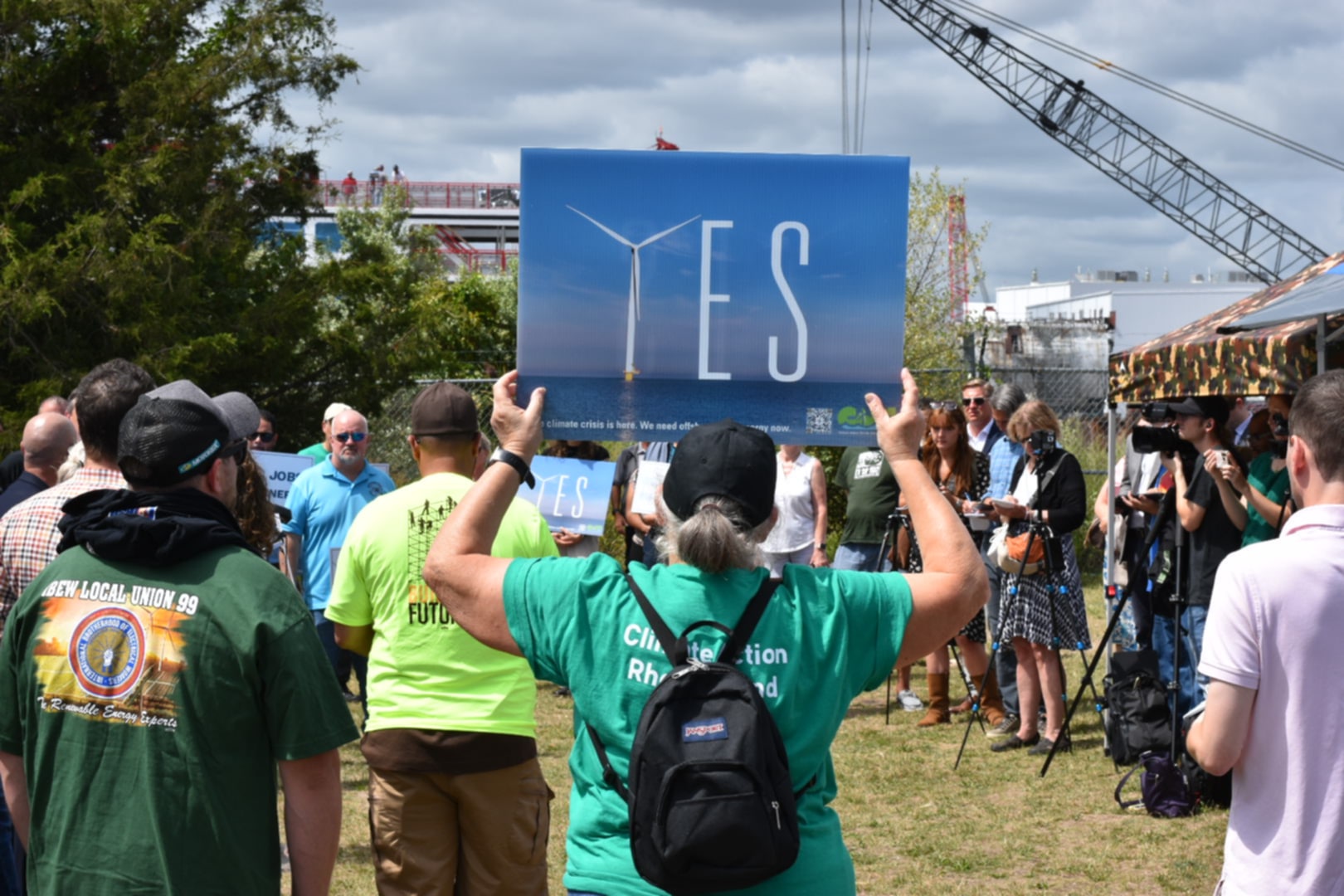
PROVIDENCE — The Trump administration decided to snatch defeat from the jaws of victory on Friday, announcing it was ordering a halt to construction of the Revolution Wind offshore wind farm with just a year left before completion of the multi-year project.
Acting director of the Bureau of Ocean Energy Management (BOEM), Matthew Giacona, demanded Ørsted cease construction on the project Friday, saying the federal Department of the Interior needed time to address concerns that have arisen since Trump was inaugurated in January.
(BOEM originally approved the 13,700-acre lease of the Revolution Wind area in early 2020 during the first Trump administration).
“In particular,” wrote Giacona, “BOEM is seeking to address concerns related to the protection of national security interests of the United States and prevention of interference with reasonable uses of the exclusive economic zone, the high seas, and the territorial seas…”
Rhode Island officials decried Trump’s order as undermining state efforts to expand its energy supply and provide jobs for the local economy. At press conference organized on Monday, Gov. Dan McKee, standing with labor leaders and Rhode Island’s entire Congressional delegation, said the stop-work order would endanger hundreds of local union jobs, and a valuable supply of renewable electricity for 350,000 homes.
“J-O-B-S, jobs,” said McKee. “That’s what is at stake in Rhode Island without this project.”
U.S. Sen. Jack Reed, the ranking member of the Senate’s Armed Services Committee, noted the national security concerns were unfounded. The Department of Defense had given its approval for Revolution Wind, indicating it had no national security concerns, last December. The stop-worker order, said Reed, will wreak havoc on Rhode Island’s economy and the region’s energy needs.
“It’s not about national security, it’s about this president’s insecurity,” said Reed. “Do you know what’s a threat to national security? Our reliance on countries in OPEC and other nations that have animosity toward us.”
Attorney General Peter Neronha characterized the stop-work order from Trump as “bizarre,” and noted that with half the state’s renewable energy portfolio expected to come from Revolution Wind, achieving state climate goals may be impossible.
“The Revolution Wind project is absolutely essential to meeting Rhode Island’s clean energy goals,” said Neronha. “Nearly half of the state’s clean energy portfolio, 400MW to be precise, is slated to come from Revolution Wind upon the project’s completion next year. Without Revolution Wind, our Act on Climate is dead in the water.”
Environmental groups, long bullish on the offshore wind project, also took Trump to task.
“It’s un-American,” said Christian Roselund, campaign lead for Yes to Wind. “It risks putting hard-working men and women out of a job and sabotaging our ability to contain sky-high energy costs. Rhode Islanders want this project to succeed because it means good-paying jobs, lower energy bills, and a cleaner, more resilient future.”
Revolution Wind, along with nearby Sunrise Wind and SouthCoast Wind, were seen as likely safe targets from the Trump administration’s efforts to undermine offshore wind projects. All three offshore wind farms had final major federal permits already in hand by the time Trump was sworn into office.
Even without a hostile administration in Washington, the East Coast’s wind projects had a rocky few years. Inflation and supply chain interruptions from the pandemic meant build times and material costs skyrocketed since 2020, with projects like SouthCoast Wind opting to pay a financial penalty, cancel power purchase agreements and re-bid in the future.
The “Big Beautiful Tax Bill” passed by the Republican Congress makes the math that much worse. Tucked inside one of the legislation’s provisions was an expiration date on the federal tax credits that make the financials for offshore wind work. Developers have until the end of 2027 to get their offshore wind farms online or risk losing out on those federal tax credits. Revolution Wind was likely to meet that deadline, but other projects off New England’s shore were unlikely to become operational by 2027.
The stop-work order is also a big blow to the Ocean State’s environment. Electricity consumption in Rhode Island accounts for 18.6% of all greenhouse gas emissions produced in the state. Cleaning up where residents and businesses source their electricity from is a key plank in curbing building emissions too, which combined account for around a third of all emissions statewide.
Rhode Island has also less than five years left on the clock to meet the next benchmark goal of the Act on Climate. The bill, which became law in 2021, mandates the state reduce its emissions by 45% below 1990 levels by the end of this decade.
The Revolution Wind project was originally one of the bright spots in an earnings call by Ørsted on Aug. 11. Executives of the Danish energy multinational announced they needed another $9.4 billion to finish the nearby Sunrise Wind project, after plans to sell its stake in the offshore farm fell through. Revolution Wind, meanwhile, which started construction in 2023, was approaching its final runway with around 45 of its turbines and all of the foundations for the turbines installed.
“We have continued making good progress and remain on track for commissioning in the second half of 2026,” said Ørsted CEO, Rasmus Errboe, on the Aug. 11 call. “We have made progress on the construction of the onshore substation, as well as the installation of monopoles and turbines.”
The company at the time estimated the 704-megawatt project was about 80% complete, and less than a year away from becoming operational, and becoming eligible for federal tax credits now set to expire by the end of 2027.
It’s not the first time the Trump administration has halted an offshore wind project. In April, Interior Secretary Doug Burgum issued a similar stop-work order to Equinor over the Empire Wind project being developed for New York state. The order was lifted a month later in May, but Equinor booked nearly a billion dollars in impairments for their trouble anyway.
Categories
Join the Discussion
View CommentsRecent Comments
Leave a Reply

Your support keeps our reporters on the environmental beat.
Reader support is at the core of our nonprofit news model. Together, we can keep the environment in the headlines.
Wind power has been proven by every study known to me (Texas, Ireland, Denmark) to not save any fossil fuel use or carbon emissions, because gas is needed to level out the unreliable, variable output of wind turbines. (See ERCTOT Bentek IV study.)
Further, it does not create jobs. For every temporary or permanent job created in wind farm installation, more are lost in the private sector.
Further, offshore wind in particular does not reduce energy costs. In increases them by a factor of 3-5. That drives even more jobs to China, who primarily uses coal.
Ben, read these then to fix your misperceptions.
Emissions per energy unit of power generation produced in Europe have gone down 60% since 1990 (https://www.eea.europa.eu/en/analysis/indicators/greenhouse-gas-emission-intensity-of-1) and net greenhouse gas emissions have dropped by 30% (https://www.eea.europa.eu/en/analysis/indicators/total-greenhouse-gas-emission-trends). Over that period renewables increased 143% while fossil fuels and nuclear sources in the EU generation mix have contracted by 28% and 33% respectively (https://www.eea.europa.eu/en/analysis/publications/renewables-electrification-and-flexibility-for-a-competitive-eu-energy-system).
The agreement of this project with the utility is to provide electricity at something like $0.097 / kWh over a period of (?) 20 or 25 years. Do you have any natural gas fired plant that will make that commitment? No, they play in the advance capacity market and charge the ratepayer more. The agreements that these wind farms made will guarantee a cost of power for the consumer over a long period time. What other energy company will make that commitment? Halting this nearly complete generation asset is counter to the national security emergency to produce US based energy to fuel the energy crisis. Also let’s be clear that the wind farm installation is done from the private sector and the delay is costing union workers and all other subcontractors money each day they are not working. This is money they would be spending in the local and national economies. All of the Texas, Louisiana, Alabama… license plates driving around RI now will have to loiter and spend their own money while this is sorted or go back to their home states and search for work there. It has been proven and demonstrated to this administration that the data centers can not be powered by fossil fuel power plants, we need a mix. If there is a demand spike in AI and data centers the demand occurs on the speed of electrons (light) but the request to meet this demand is on the order of the time scale for the control system to respond to these sudden demands. Otherwise you are going to need to size your production and transmission and distribution systems to cover this max expected load. Operationally, natural gas production will not cover data center demand even when a dedicated power plant is made for each data center. Why we are not just bringing online every possible power source is mystifying. Of all things, power is an enabling thing that really shows that “if you build it, they will come”. Hobbling or delaying any source of generation is a serious wound to the nation and to our energy independence.
If we are learning the record and sharing facts, China has been producing the most renewable capacity of any country in the world. China has manufactured and installed the largest wind turbines in the world at 18, 20 MW pushing the limits up to 25 MW. They are also exporting their technologies globally and building influence. Why, they are unified at the top level to develop and deploy these technologies. They have a dictator who is aligned with the global priorities and is transitioning their country to address concerns. There are many industry sources available to get the facts of the energy industry, you have to want to find the information that is not biased. Please do your research and look for unbiased sources of data. Look at all of the data and make an informed decision.
Touche, George Washington. You missed only one hole in Mr. Riggs’ argument, that of wind’s “unreliable variable output.” Advances in flow battery and iron-air battery tech are welding that one shut quite rapidly—battery techs that are much cheaper and safer than lithium battery storage to solve the that old chestnut of the wind and solar critics, “when the sun don’t shine and the wind don’t blow.” The largest iron-air storage battery in the world was announced just short of a year ago by Form Energy, an American company based in Boston. On the site of a defunct paper mill in Lincoln, Maine, the battery will store 80 megawatts. Senator Susan Collins will be in deep trouble if Trump cancels it.