
No Trespassing: Gould Island is for the Birds
August 14, 2025
Share


Gould Island is one of the last undisturbed nesting sites in Narragansett Bay. This isolation from human slobbery has resulted in decades of successful breeding for a number of at-risk bird species. The health of this important bird habitat, however, is being threatened by plans that would open Gould Island to recreational use and overnight camping.
Since Gould Island’s transfer of ownership to the state of Rhode Island nearly 40 years ago, the island has been deed restricted as a wildlife sanctuary. It’s a vital breeding ground for a number of colonial-nesting species — birds that nest in large numbers. These Gould Island birds obtain most of their food, such as fish and invertebrates, from Narragansett Bay.
Gould Island, according to the Audubon Society of Rhode Island (ASRI), serves as one of the most significant breeding sites in the state for great black-backed gulls, American herring gulls, black-crowned night herons, American oystercatchers, and double-crested cormorants. The island is also a popular spot for egrets and other heron species.
Many of the species who breed on Gould Island have experienced long-term population declines in Rhode Island and across North America, according to the ASRI.
Jeffrey Hall, the organization’s executive director, has noted the ASRI manages wildlife refuges that are open to the public and has some 100 properties that are closed to humans. He believes some places need to stay wild, saying “If you take habitat away, they can’t just pick up and move to a new one that they’re unfamiliar with and nest successfully.”
“This is a highly important bird nursery,” Hall recently told me. “Everyone knows how important this spot is.”
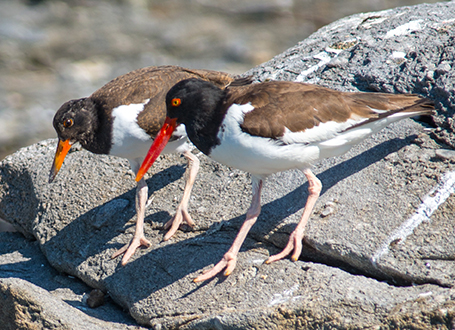
The black-crowned night heron population experienced a 24% decline across the United States from 2012 to 2022 and a 31% decrease in Rhode Island during that time, according to the ASRI. It noted American oystercatchers are gradually regaining a foothold in southern New England, with one to three breeding pairs present on Gould Island every year since 1984.
Many of the birds that can be found on Gould Island are listed in the Rhode Island State Wildlife Action Plan as species of “greatest conservation need.” This designation means these birds require multiyear conservation strategies to rebuild populations and mitigate habitat loss.
As for the species that breed on Gould Island, the state’s Wildlife Action Plan lists “recreational activities” and “increased human disturbance of nesting habitat and foraging sites” as primary threats to their long-term survival.
The 53-acre island in the East Passage of Narragansett Bay, which along with Conanicut and Dutch islands comprise the town of Jamestown, is unequally divided between state and federal government. The southernmost 39 acres are managed by the Rhode Island Department of Environmental Management as a sanctuary for migrating birds. The island’s nesting activity has been monitored by DEM’s Division of Fish and Wildlife since 1964. The island’s northern 14 acres are owned by the Navy.
A plan to repurpose 17 of Gould Island’s southernmost acres from a wildlife sanctuary to public recreation has been unanimously endorsed by the Jamestown Town Council. Two council resolutions approved in the past year or so supporting the idea ask the state to: collaborate with municipalities to ensure a plan that provides for the removal of the wildlife sanctuary deed restriction; remediation of physical hazards to enable public access; provision of potable water and sanitary facilities; creation of transportation infrastructure to enable public access; and construction of fencing from the wildlife sanctuary to the north.
The city/town councils in Newport, Middletown, Portsmouth, North Kingstown, and Narragansett have passed resolutions in support of again ruining Gould Island for human use.
Jamestown officials have said the reason for the proposed split of the island’s southern half is because Gould Island is closed April through August to allow migrating birds to breed. We can’t have that. Humans are entitled to be in Mother Nature’s bedroom whenever we desire.
(Kayakers and boaters are allowed to visit the island September through March, but overnight camping is prohibited.)
Project supporters have whined that outside the bird breeding season, few people would be interested in visiting. Good. By dividing the island, they argue, it would allow both sections to operate simultaneously during the summer when the island would be the most attractive to visitors. Bad.
Rhode Island seems determined to open every scrap of green space it isn’t bulldozing to public trespassing. Mountain biking, camping, hunting, fishing, hiking, and foraging are fine activities, but the natural world deserves some peace and quiet.
Unfortunately, we relentlessly tighten our grip around Mother Nature’s throat. We can’t properly protect biodiversity if we keep trampling and fragmenting habitat.
Kim Keough, DEM’s chief public affairs officer, said there are no imminent plans or funding for Gould Island “beyond a master planning process intended to gather and evaluate ideas.”
“There are strong opinions on both sides, and this planning effort is meant to help understand those perspectives,” she wrote in an email. “However, even that process is dependent on securing funding, so nothing is expected to happen in the near future. It will take time just to develop a preliminary vision, and any actual changes are likely years away. Importantly, habitat for breeding birds will be a key factor and will absolutely be a major consideration throughout the process.”
The Gould Island idea, according to the Audubon Society of Rhode Island, flies in the face of DEM’s stated goals of conserving the declining bird populations nesting there.
Hall noted overnight camping isn’t allowed on Prudence Island, while Gould Island doesn’t have any infrastructure to support such an activity. Prudence Island, a part of Portsmouth, has seasonal homes, a variety store, and a dock, but overnight camping would disturb the human inhabitants already there. Better to bother the birds somewhere else. Hall said Gould Island allows birds to breed in tranquility because there are limited predators and few human visitors.
“It would be nice if we had one spot in the state that was disturbance-free for bird habitat,” he said. “We don’t need to open every island to humans. Some should be left alone for wildlife use.”
Hall noted the plan, at least at the moment, doesn’t take into account any sort of wildlife considerations. It’s likely been that way for most of the past 368 years.
The Narragansett Indian Tribe named the island “Aquopimokuk.” Colonist Thomas Gould stole, err, bought it from the tribe in 1657.
In 1919, the Navy requisitioned Gould Island from the Haughton family to expand its nearby torpedo station on Goat Island. An airbase with hangars and a seaplane landing site for naval torpedo planes was built. Portions of the island were paved over to make way for concrete piers. It was used to store and refurbish torpedoes until the 1950s.
Nature has since been reclaiming the island from abandoned military structures, asphalt, and concrete. Native plants are battling for survival against the invasives that quickly invaded when the military retreated.
Hall said the state and public need to understand that Gould Island has been identified as an important nesting area that needs to be conserved.
Let’s hope Rhode Island decides for once to choose Mother Nature over human amusement.
Note: A community discussion titled “Why Gould Island Needs Protection” led by Charles Clarkson, birding tour coordinator for the American Bird Conservancy and former Audubon Society of Rhode Island director of avian research, is scheduled for Aug. 27 at 6 p.m. at the Jamestown Philomenian Library, 26 North Road in Jamestown. The discussion is free and open to the public.
Frank Carini can be reached at [email protected]. His opinions don’t reflect those of ecoRI News.

I have a friend who moved from RI to Long Beach CA for a while. I remember she wrote that every square inch of land was cultivated, and that there were no wild places at all.
Humans already have ample areas with easy access for recreation. There is no need to ruin Gould Island with human presence. Just because birds don’t breed there during September through March does not mean that there will be no effect from human occupation. Where we go, we either destroy or remake. This island is not easily accessible and lends itself well to control and preservation. Leave it that way. I shudder when I think of DEM being involved with the decision to open the island to human recreation. It has a long history of yielding to pressure from interests where money or possible income is concerned. As for the towns of Newport, Narragansett, Portsmouth, Jamestown, Middletown and North Kingstown I suggest you look elsewhere to satisfy your insatiable greed for tourist and recreation dollars.
I think this is very well written and I completely agree. I have recently moved back to Rhode Island and I am discouraged by the lack of interest in nature preservation here. The opposition to the bottle bill is another example of this. There is no need to disturb one small island so people can leave their mark (whatever it will be that they choose to leave. )
More reason to use Dutch Island for recreational use.
There’s also so much history there that should be part of the experience. interpretive signage……
Thanks for this article, Frank. With all the places in RI to camp, walk, swim, and recreate, it seems as if this place can be left for the birds without any human sacrifice. People stupidly do not appreciate what they have until it is gone!
Is there no end to greed?
Is there no end to avariciousness?