Dead and Buried: Advocates Mourn Passing of Environmental Bills
June 30, 2025
Share


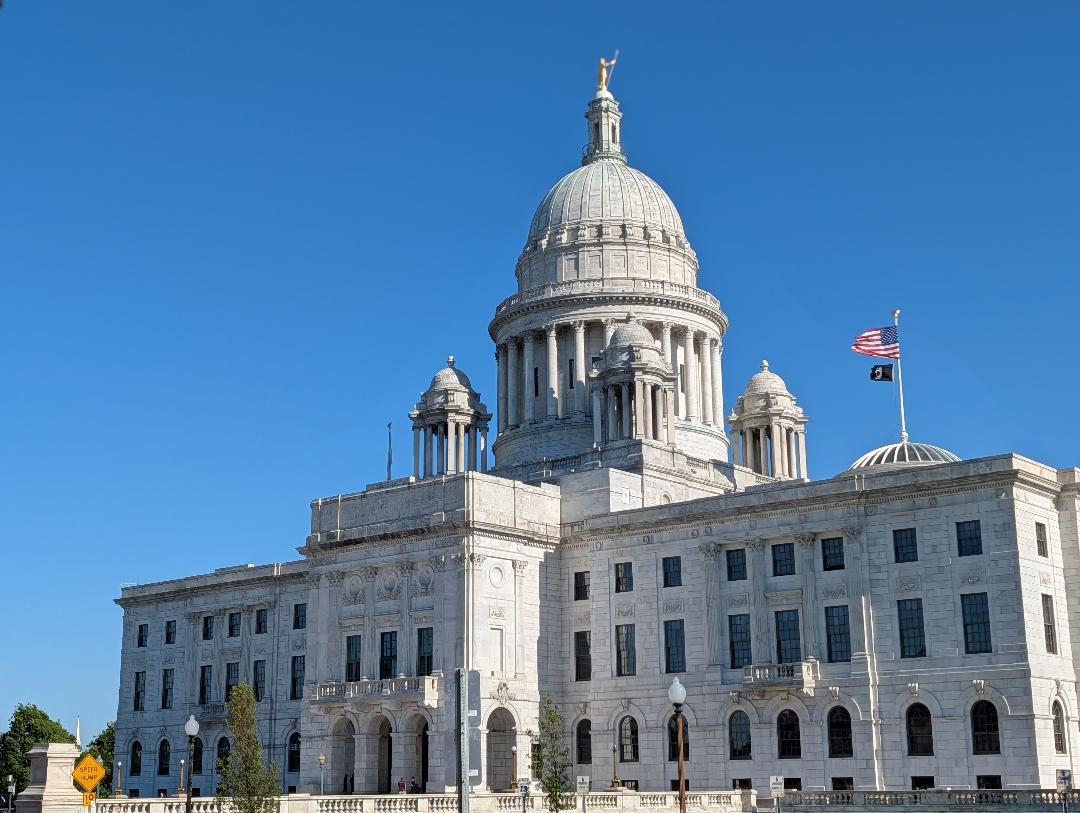
PROVIDENCE — Sunday was a beautiful summer day for a funeral: clear, sunny, and hot.
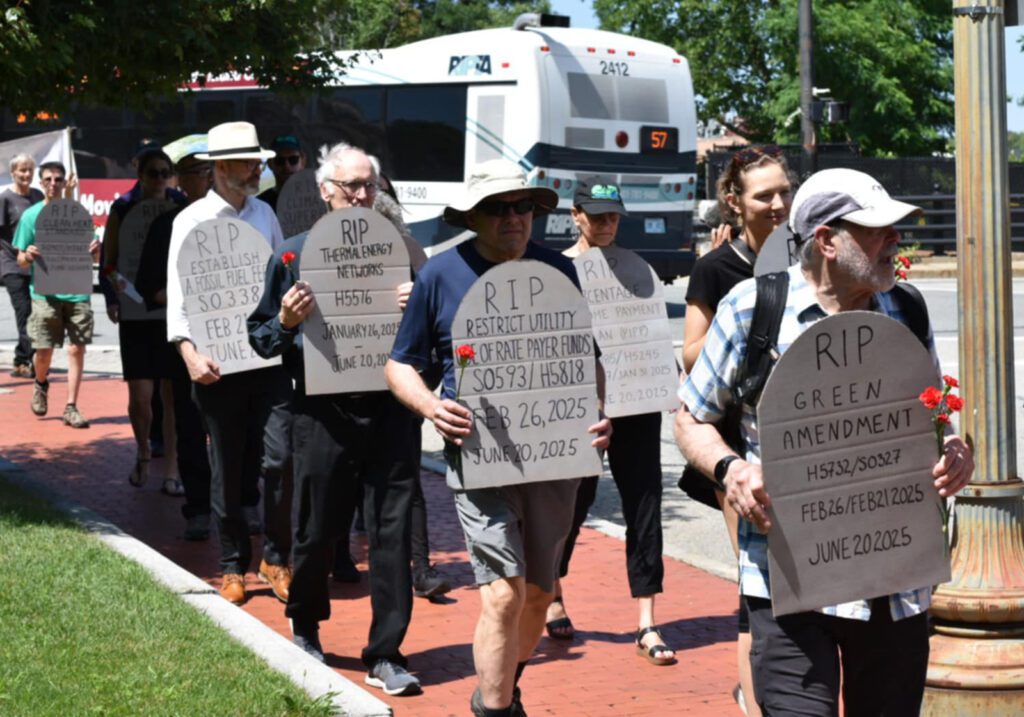
On the north side of the Statehouse, mourners, dressed in black, gathered around a coffin, and carried cardboard tombstones, each inscribed with the name, bill number, and legislative dates for 19 separate pieces of environmental legislation that failed to pass in the General Assembly this year.
Early in the afternoon, the mourners — members of Climate Action Rhode Island (CARI), the Green Energy Consumers Alliance, and a few other environmental groups — even held a funeral march, with pallbearers carrying the coffin and circumambulating the Statehouse while playing dirges on a bluetooth speaker.
The Statehouse itself was quiet — lawmakers had vacated the building a few weeks ago, concluding the session in mid-June after passing the state budget. While mummers of future federal budget woes have suggested a special October session, legislators won’t return to consider future environmental legislation until next year.
Less than a week before, on June 24, the temperature in Providence reached 99 degrees, breaking the city’s record for the hottest June day on record.
As the procession returned to the front of the Statehouse steps, CARI co-president Jeff Migneault, dressed like a preacher, gave the eulogy. It was part theater, part spectacle, but full-on protest.
“We cannot, in our grief, face away from the frightening reality of greed, and climate denial,” Migneault said. “Rhode Island has a shamefully undemocratic legislative process.”
CARI endorsed 20 pieces of legislation this year, many of which were also backed by different environmental groups across the state. Only one of the bills, legislation that eliminated Rhode Island Energy’s restrictions on net metering, the program that allows homeowners to install solar panels and sell it to the utility company, passed both chambers of the Legislature and became law.
It was a bad year for environmental legislation, with no major bills backed by the state’s environmental advocates making it out of chamber, or committee. General Assembly inertia couldn’t come at a worse time. The next benchmark mandate of the Act on Climate law, a 40% reduction in greenhouse gas emissions, has to be met by 2030, and lawmakers this year took a pass on giving the state the tools to achieve it.
To drive the point home, Sunday’s mourners held a tombstone depicting each bill, said a few words in tribute to the environmental actions it would have spurred, and placed the tombstone in a makeshift graveyard of dead legislation on the Statehouse steps.
The chief bill that would have helped the state’s climate goals this session? The Building Decarbonization Act (S0091/H5493), a priority bill for CARI, the Green Energy Consumers Alliance, and the Environment Council of Rhode Island (ECRI), that would have set up a statewide energy tracking system for the state’s largest buildings and required new construction to be electric-ready instead of fossil fuel-ready.
Tracking energy use in big buildings, officially known as benchmarking, would have allowed policymakers to pinpoint where improvements could be made in reducing buildings emissions, which combine to account for a third of all greenhouse gas emissions produced in the state.
It was the only major policy proposal to handle all emissions coming from the state’s building sector. The state has implemented a Renewable Energy Standard to reduce electricity emissions and passed rules to phase-out gasoline-powered cars by 2035, but lacks any kind of proposal ready to be implemented for the state to reach the next climate goal in five years.
Lawmakers also failed to pass legislation expanding the state’s offshore wind procurement. Another priority bill for both CARI and ECRI, the legislation would have required Rhode Island to buy another 1,200 megawatts (MW) of offshore wind by the end of this decade, doubling down on the renewable source at a time when it is facing increased hostility from the federal government.
Another big failure from lawmakers? Legislation that would boost, defend, or save the Rhode Island Public Transit Authority from budget cuts, service interruptions, and layoffs. The House raised the gas tax by 2 cents, and adjusted the proceeds from it to give an additional $15 million a year to RIPTA, but the allocation leaves the transit agency with a $17 million deficit, making cuts to service guaranteed.
“We needed $32 million in a $14 billion budget, and the state decided to pass [on funding RIPTA],” said Greg Gerritt, holding the tombstone for the bill that would have fully funded the transit agency. “It’s like they want to kill RIPTA slowly, and it will be a very painful death.”
Here are some more highlights on what lawmakers didn’t pass:
S0327/H5732: Would have added a Green Amendment, guaranteeing the public’s right to clean air, clean water, and environmental protection, to the state Constitution on the ballot in a future election.
S0378/H5815: Proposed legislation to fund and award grants to nonprofits and other entities to participate in utility regulator dockets, such as electric or natural gas rate increases.
S0407/H5167: Legislation to implement a Clean Heat Standard, which would have created a credit system, similar to the Renewable Energy Standard, to push natural gas, heating oil, and propane suppliers to lower emissions from fuel sales.
S0185/H5245: Would have created a percentage income payment plan (PIPP), allowing low-income residents to pay a small percentage of their income to satisfy their utility bills instead of the current flat rate.
The full list of CARI endorsed bills can be found here. ECRI’s list of legislative priorities for 2025 can be found here.
Despite the doom and gloom of the eulogy, Migneault and the advocates ended on a hopeful note.
“We will speak truth to power again, we will write again, we will testify again, and yes we will legislate again,” Migneault said.