
What’s Old Is New Again: Age-Old Practice of Composting Gains Traction in R.I.
May 21, 2025
Share



CHARLESTOWN, R.I. — Mike Merner, one of the faces of composting in Rhode Island, originally planned to become a golf course superintendent.
His father had been one in New Jersey, where Merner is from, but after studying agriculture at the University of Rhode Island, he realized he didn’t want to be around the country club scene and preferred landscaping.
Merner started a landscaping business in the early 1970s, but quickly had another realization: the chemicals he had been taught to use, various pesticides and fertilizers, degraded the soils he was working with instead of making them better.
That’s when compost enters his story. A combination of food scrap, grass clippings, hay, and wood materials, when layered, mixed together, and given the right amount of time to mature, turn into an incredible resource for farms and gardens, Merner explained on a rainy May afternoon at Earth Care Farm, the oldest operating farm composter in the state, and his home.
Many credit Merner as one of Rhode Island’s pioneers in composting, but he noted many before him and Mother Nature herself have been at it a lot longer.
“Nature has been composting before we even had Rhode Island,” he said.
ecoRI News, which funded its early operations with a residential compost business, recently sat down with several Rhode Islanders, including Merner, to learn about the state’s history with composting, an age-old practice that in recent years has been making a pretty serious comeback.
Composting’s Indigenous origins
Indigenous people practiced composting here long before white settlers arrived in what is now known as Rhode Island.
“Composting, the way that we do it today, is not really how we did it then,” Tomaquag Museum executive director Lorén Spears said.
Spears, a member of the Narragansett Indian Tribe, described traditional Indigenous agricultural practices that were in line with nature, including using natural fertilizers, crop rotation, and diverse planting (think the Three Sisters foundation of corn, beans, and squash).
“We used shell and seaweed and fish in the soil to give it the nutrients it needed,” she said. Tribes also used burned wood to enrich the soil, and archaeologists often find midden piles in historically Indigenous areas, where food scrap was reinterred and reused.
Stephen Porder, a professor of ecology, evolutionary, and organismal biology at Brown University, noted that for most of human history, composting was the rule and not the exception.
Researchers have found evidence of early forms of composting going back as far as the Stone Age, and the first written records of the practice are from ancient Mesopotamia.
“In the olden days, right, most people lived on farms or near farms, and so most organic waste from the production of food ended up sort of near where the food was grown,” Porder said.
But as people moved into cities and away from where food was produced, getting nutrients that crops needed to grow, in the form of food scrap and waste, became more challenging, as they instead ended up in sewer treatment plants or other waste streams.
“That leads to a fundamental imbalance where you’re removing more of those elements, those nutrients, from the soil than you’re putting back in,” he said, “just like a bank account, if you take out more than you put in consistently, you run out.”
Then science stepped in.
“In the 1910s and ’20s, we became the first — little Earth history piece for you — we became the first multicellular organism in the history of life on Earth to be able to pull nitrogen out of the atmosphere and turn it into usable forms,” Porder said.
There was a lot of good to come from that, he said. It helped humans grow enough food for everyone on the planet (although we haven’t figured out how to get it to everyone yet), but it also comes with pollution, both from the chemicals themselves and from the fossil fuels used to create them.
Those problems have helped push people back toward composting, but it’s a work in progress from a logistical point of view, according to Porder. “We haven’t yet figured out about how to build a sustainable food system … close the circle,” he said.
Earth Care Farm
Closing that circle was what initially inspired Merner, whose studies of those chemical fertilizers also helped him understand and optimize the science of composting.
“You see all the steam coming off the compost, all that vapor,” he said, pointing through the screens of his covered porch in Charlestown to the large pile of organic materials in view, “that’s a product of the microorganisms … they eat that food and break it down to become the best part of our soil.”
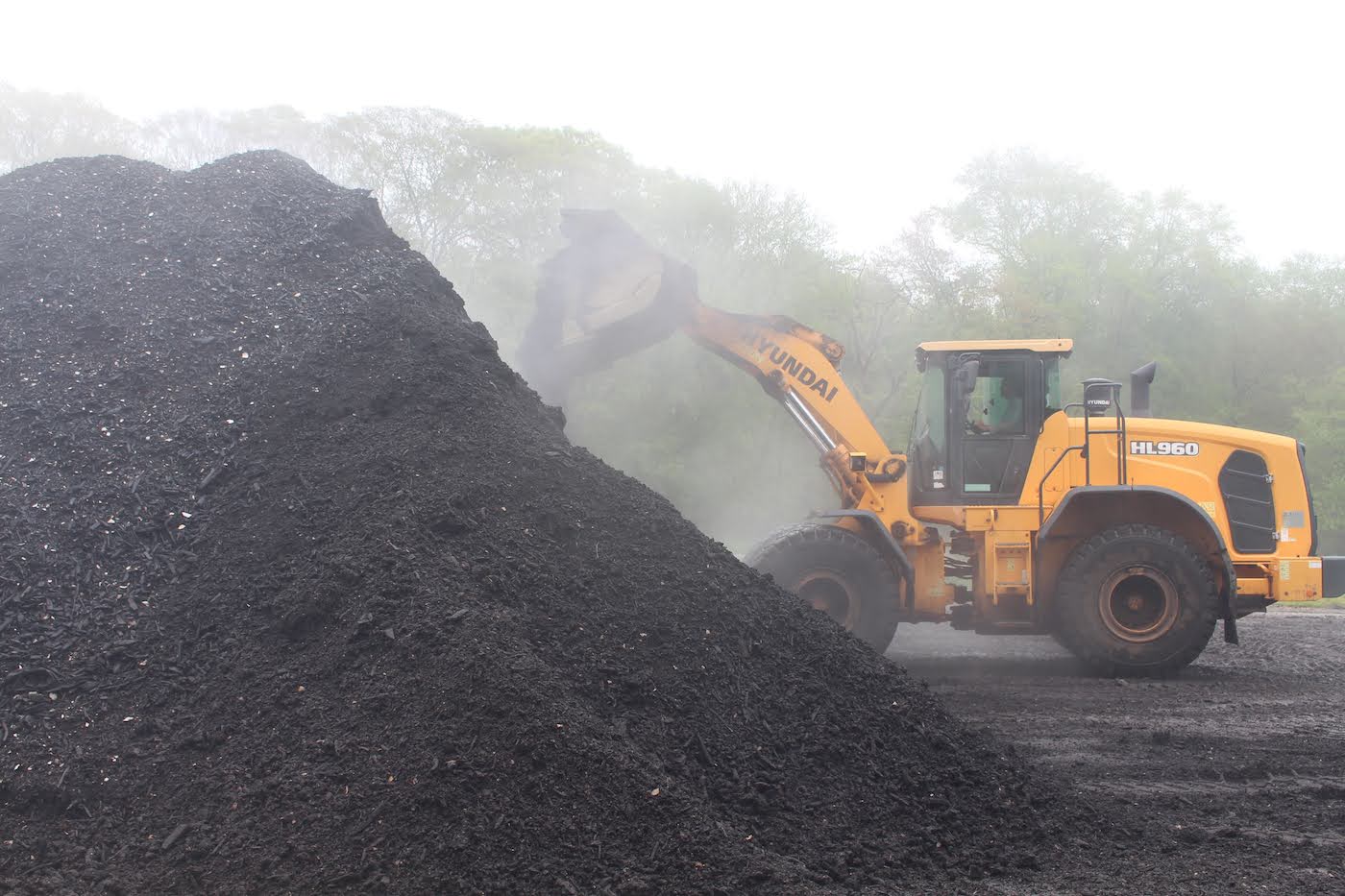
Merner learned the process from older gardeners and farmers who had continued composting, despite the popularization of fertilizers, and through lots and lots of reading.
By the early 1980s, he was running his compost business full-time, with nine municipalities on his client list. The arrangement worked for all parties because the towns saved money on the tipping fees at the Central Landfill by diverting their waste. Merner charged them less than the landfill per ton, sometimes nothing if he was sure the leaf litter they brought him was of good quality.
But in 1994, the Rhode Island Resource Recovery Corporation in Johnston started taking in municipal leaf litter.
Even though that was a step in the right direction for composting in the state overall, it hurt Merner’s business, but all these years later, he called it “almost a blessing in disguise.”
As scientists developed later-generation herbicides, expanding their half-lives, the ability to naturally break them down through the composting process became more difficult.
“They can kill plants, these persistent herbicides,” he said, explaining he has visited facilities that have accidentally composted materials with the potent chemicals, leading to a product that hurts what it’s supposed to help grow.
So, Merner turned to the fishing industry, starting to take their gurry, or the unsellable parts of the fish, to supplement the material he had lost.
He said he has been able to stay in business by maintaining a quality product. That reputation and legacy is now being continued by his daughter Jayne, who officially took over the farm a few years ago, though he still “putzes” around the farm, he said, jokingly.
Urban composting
Michael Bradlee, creator of the nonprofit Community Compost Depot and owner of for-profit composting business Earth Appliance Organics, was first introduced to composting as a child by his grandfather.
“We would collect a little bit of coffee grounds and banana peels and eggshells, and then bring it to my grandfather’s place and throw it in the pile,” he recalled. “I thought it’s fascinating that it would just disappear. That curiosity stuck with me and grew into, you know, a bit of an obsession at some point.”
Bradlee trained as a chemist, so he knows the ins and outs of the biology behind composting.
The turn away from composting in the 1950s and ’60s, Bradlee believes, was a combination of streamlining waste systems and increased waste regulations.
“They started to just sort of, I would say, marginalize the practice of composting and discouraged it in cities,” said Bradlee, although he knows gardeners now in their 80s and 90s who continued to compost back then even when the practice fell out of favor.
As Bradlee learned more about composting, with his scientific background, he began to think about how to compost on a larger scale, developing his own, more sophisticated methods for collecting and managing the resource in an urban setting.

“If we had gold leaf that was like falling from the trees, or, you know, sort of sloughing off something, people would gather it, but they wouldn’t be putting it in their trash, right?” Bradlee said. “So, we have to think of it as a resource, as something that has value.”
By the 2010s, Bradlee started working with others in the composting sector, advocating for and eventually helping change policy to increase the implementation and impact of composting.
Bradlee and others pushed for state regulation changes that made mid-sized composting facilities, which are larger than backyard operations and smaller than industrial composting companies, legal.
Bradlee’s Community Compost Depot at Frey Gardens in Providence became the first facility of its kind. The nonprofit, initially a part of an abandoned city composting demonstration project, has grown from collecting food scrap from 30 families to about 150.
Although the collecting was challenging, Bradlee said it taught him that local, community-based composting operations are possible and helped him refine his composting methods.
Bradlee has patented a composting process through his for-profit Earth Appliance Organics. He has a test composter at Billy Taylor Park, off Camp Street in Providence. As the sun came out on a Thursday afternoon at the park, he got ready to show the process to some kids who were visiting the community garden there after school.
The three-segment composter replaced several earthenware containers that the garden used to compost with, producing more than double the compost but using half the space of the previous method, allowing the addition of several more vegetable beds.
The advantage of composting over other environmental initiatives, he said, is that it’s more intuitive for people to understand.
“There’s not one kid I’ve met that didn’t get it within 30 seconds,” Bradlee said. “They’ll tie into it, I think, more organically. Sorry for the pun.”
While Bradlee was fighting for better regulations and starting off his business and nonprofit, longtime environmentalist and Providence resident Greg Gerritt was also in the composting scrum, trying to pool resources in Rhode Island to get more people to compost.
Gerritt had learned about composting when he farmed in Maine before moving to Providence in the 1990s. As he got more politically involved in Rhode Island in the early 2000s, joining the Food Security Coalition and running for mayor of Providence, he eventually became a part of the Urban Agriculture Task Force, publishing articles about local food systems, including how to create and use compost.
After receiving part of an Environmental Protection Agency grant, Gerritt was able to start a composting initiative in 2009. The following year, he hosted the inaugural Rhode Island Compost Conference as a way to bring people in the burgeoning industry together.
In addition to changes to regulations regarding mid-sized composting facilities around that time, Gerritt said increases in waste fees have also helped push the growth of composting.
“Raising tip fees in Rhode Island is wicked complicated,” said Gerritt, recalling the process. The issue had to go before the General Assembly, and it wasn’t always popular among constituents. Eventually, an increase in the tipping fees, which is the cost to dispose of waste at the Central Landfill, passed and pushed municipalities to divert their waste through methods like composting to save money.
“All the time, I just kept doing these conferences, and that was the only place that composters were coming together,” Gerritt said. “Whenever I’d hear about somebody that was thinking about coming to Rhode Island to do compost work, I’d invite them to the conference and get them there so that they could meet other people and talk.”
The conference has grown over the years, acting today as a trade show, showcasing a new generation of composters who have been able to get into the business because of outreach and policy changes made in the past.
“I spent many years trying to just help the forces align, knowing that we weren’t ready, and just kind of plowing soil a little,” Gerritt said. “And to see it all in this stage is very gratifying.”
Composting’s future
“In another 15 years, composting will be everywhere,” Gerritt predicted. “The pressure on the landfill will be part of the reason … and food security will be another reason why. It’s one of the best things you can do if you’ve got problems, you know, is keep resources circulating locally.”
Gerritt said another difference happening now is that the benefits of composting, through the Rhode Island School Recycling Project, are being instilled in children. “If kids learn right in elementary school about why this is done, why this is important, they teach their parents, and that will create an incredible upswell,” he said.
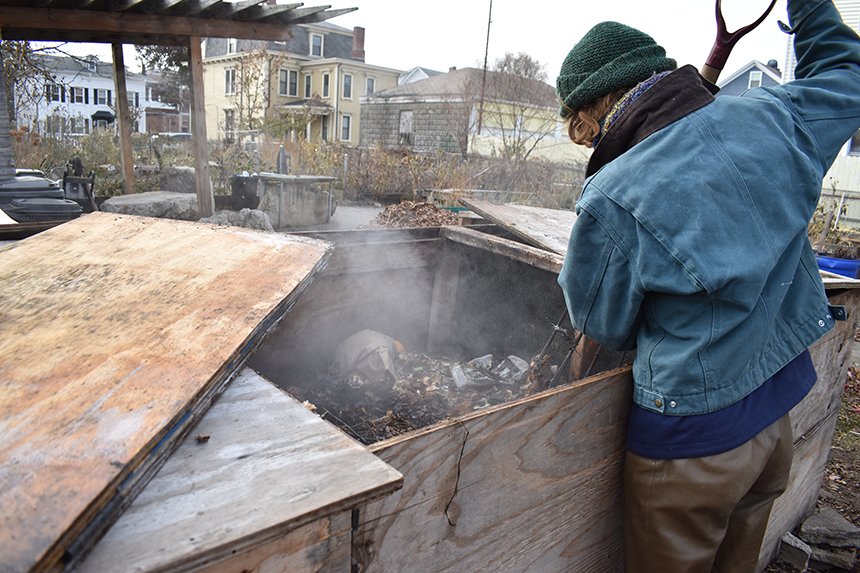
Bradlee believes increasing composting is starting to become an urgent need. “We need to repair soils. We need to do composting at all scales, much more comprehensively,” he said.
Merner agreed and is worried there’s not enough being done, or in some cases too much, to help out the younger generation continue the practice.
Sitting on his Charlestown porch, Merner brought out a binder, three or so inches thick, filled with permitting paperwork for a composting facility his daughter Jayne is working on opening just over the border in Connecticut.
That state charged an application fee of $10,000 for the project, he said.
“Young people, they’re having their hands tied behind their backs,” Merner said, “the fee to apply, and the amount of paperwork,” even though it’s all “well-meaning.”
When discussing the people who taught him about composting and helped him start his business, Merner suddenly stopped speaking and his eyes welled up. He cleared his throat before he said, “It has got to be passed on.”
This story is part of a series “Black Gold Rush: The Race to Reduce Food Waste and Save Soil.” The series is sponsored by 11th Hour Racing.


awesome
Love earth care s compost. Buy a few yards every couple of years for the gardens and landscaping
I attended a meeting about human composting ~ one of the newest and most earth friendly ways to dispose of remains upon death. This email will allow you to inquire about this and ask questions
[email protected]
I am thrilled to see this funeral option being offered
I realize it is not for everyone but I found it to be exceptionally practical and sustainable.
Great story about history of composting in RI and key players. Ideally we will eventually have curbside composting for all, but meanwhile, our house will keep going with our backyard composting.