
Proposed Bill Would Add Teeth to Rhode Island Law Mandating Food Waste Diversion in Schools
The current statute is basically an unfunded mandate
May 15, 2025
Share


PROVIDENCE — Every year, the United States spends billions of dollars and writes millions of words about what exactly goes into our schools.
The way students learn, what they are taught, and what they eat have been the subjects of debate since the inception of public education. But when it comes to what comes out of the schools — i.e., trash and food waste — and where that goes, there’s less discussion.
Schools are sources of large amounts of waste, including food. On a single day this year in Rhode Island, schools across the state will produce somewhere around 27,000 pounds of food waste.
By the time the final bell rings in June, and the last student steps on the bus, Rhode Island’s schools will have wasted roughly 5 million pounds of food — 776,700 of which is perfectly edible.
It’s a massive resource gap. Instead of being diverted to compost piles or other organic digesters, the food waste produced by Ocean State schools is going directly to the rapidly filling Central Landfill in Johnston.
“The net effect of throwing food in the garbage is that we’re paying for it,” Rep. Lauren Carson, D-Newport, said. “We buy the food in the schools, we pay people to serve it, the kids don’t eat it, we throw it away, and we pay to get it taken to the landfill, which is running out of space.
“It’s a real cycle of poor management, and a tremendous loss of money.”
It’s also against the law. In 2021, Carson was the main sponsor of a bill to require schools — so long as they were 15 miles from a composting facility or anaerobic digester — to divert their food scrap from the Johnston landfill. But the vast majority of Rhode Island’s 305 public schools and 66 charter schools don’t comply with the law.
Less than 5 miles west of the Statehouse is Rhode Island’s last and only remaining landfill, and the only waste management site in Rhode Island equipped to take in the serious amounts of waste Rhode Islanders generate every year.
Food is a big part of what we throw away; around 16% of everything that goes into the landfill could be diverted to compost piles or anaerobically digested, according to a 2015 study by the Rhode Island Resource Recovery Corporation (RIRRC). Besides filling the landfill, buried food scrap also worsens the state’s greenhouse gas emissions problem.
“A pound of food waste rotting in the landfill will produce 3.6 pounds of methane,” said Warren Heyman, organizing director for the Rhode Island School Recycling Project. “If you push the supply chain back by one pound, you save 3.6 pounds of methane, because of all the emissions generated in growing the food, transporting it, processing it, and getting it to the school. The real action is pushing it back.”
Though it’s also known as the RI School Recycling Club, it isn’t really a club. It was originally created in 2001 to help schools bring up their recycling rates. At the time, only 18% of material eligible for recycling was heading to the state’s materials recycling facility (MRF) in Johnston. By the time the original program ended, the organization raised the school recycling rate to 68%.
Jim Corwin was one of the club’s original founders and he brought back the organization in 2019 with a pivot toward reducing school food waste. Heyman joined the following year.
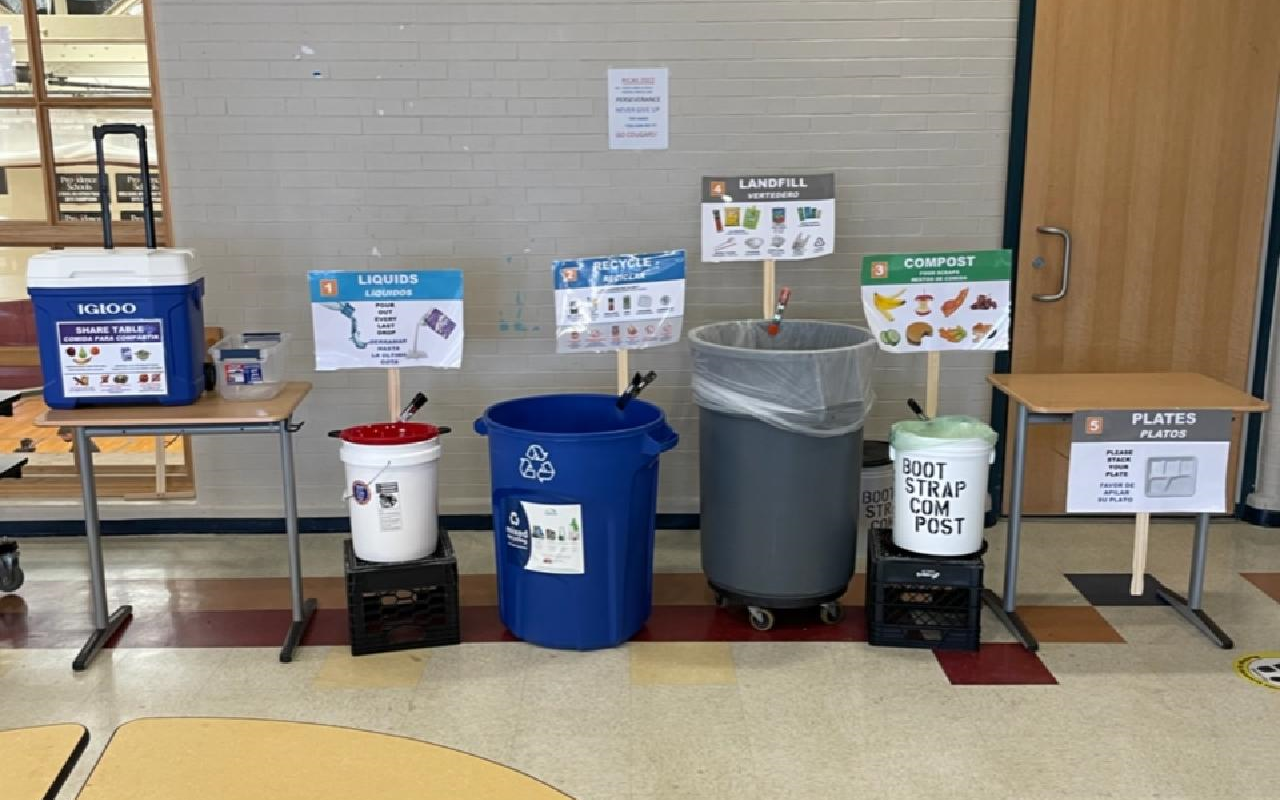
Students are especially productive food-wasters. Elementary school students often take top honors for wastage, with the average elementary student throwing out around 47 pounds of food per year, according to a 2019 food waste estimate performed by the club. Middle school students waste around 39 pounds per student per year, and high school students generate the least, 15.6 pounds per student annually. The club has a food waste calculator, so students and teachers can determine how much food is thrown away at their school.
Heyman and Corwin spend most of the school year going into schools and, with the help of their staff and other volunteers, educate students, teachers, administrators, custodians, and kitchen staff how to divert their food scrap from the landfill and feed hungry students at the same time.
Thanks partly to the 2021 law requiring schools to divert food waste, demand for the project’s help has exploded in recent years. Heyman said the program is in 52 schools, many of them in the East Bay and Providence areas. It’s around one-sixth of all public schools in the state, but still far from complete compliance with the law.
So why aren’t more schools doing it? Two words: unfunded mandate. The law includes no funding mechanisms for new food waste services, no reporting requirements on behalf of the schools, and no penalties for school districts not in compliance.
The original law as written is effectively toothless.
Under new legislation introduced by Carson, H5422, the 4-year-old law would be given some bite. The bill has three parts: it requires schools to train, certify, and designate an environmental custodian to handle the food waste diversion program; it prohibits food service companies from bidding on new or additional contracts in school districts if they’re already non-compliant with the law in their existing contracts (the companies also have reporting requirements to the state Department of Education); and it removes the 15-mile radius designation and simply applies the food waste diversion requirements to all schools unilaterally.
“For example, the school district in Lincoln right now has Chartwells,” Heyman said. “But right now Providence is out to bid for their food service, and everyone wants their business. Chartwells is doing back-of-house composting in four elementary schools [in Lincoln], but not the middle school and high school. This law, if passed, would prevent them from bidding for another town’s contract if they’re not 100% compliant across the entire district.”
There’s still no additional funding to help schools transition to a new system. Heyman noted the Recycling Club is heavily reliant on grants and private sources of funding to keep the program going. Many school districts across the state have found themselves with rising budgetary deficits in recent years.
Tim Duffy, executive director of the Rhode Island Association of School Committees, an advocacy nonprofit for the state’s elected school boards, told members of the House Education Committee at an April 4 hearing he had concerns about the bill’s designation of an environmental custodian and the costs it could incur.
“With no mandated reimbursement from the state, the cost would fall to the schools. … That’s a substantial number and I don’t know how much of a financial burden this is going to be on the locals,” Duffy said. “I understand the intention of the bill, to compost food waste. My problem is with the expense.”
Duffy wasn’t the only one with concerns about the new bill. The Department of Environmental Management, one of three state agencies the bill empowers to certify environmental custodians, didn’t oppose the bill, but wrote “we are concerned the bill does not provide resources to implement this requirement … we do not believe that we can implement this legislation with existing resources.”
Further funding on the part of the state is unlikely. The House’s version of the state budget, which is likely to be unveiled in the coming weeks, has to close a $170 million spending gap, meaning cuts to programs and state services are more likely than expansion.
Heyman said he expects the environmental custodian piece of the bill to be spun off into its own piece of legislation, but maintains that diverting food waste represents a huge cost savings for school districts by reducing the amount of dumpsters or pickups from waste hauling companies.
In Hoxsie Elementary School in Warwick, Heyman noted, the school was putting a dozen bags of trash a day into the dumpster behind the school. “On the first day we implemented our program at the school, the school only took out two bags of trash, around 10 pounds,” he said. “That’s 50 less bags a week. That’s one less full dumpster of trash a week.”
Meanwhile, the Central Landfill continues to fill up, and the clock is ticking.
“I passed the original bill years ago, and I learned that schools do not comply with it,” Carson said. “This is a real thing, we have to do this. The lifespan of the landfill is very limited, and everyone should be recycling in this state, including schools.”
H5422 was held for further study. It doesn’t have a companion bill in the Senate.

I think it says a lot about the food being served at the schools
I think hospitals are probably second in food waste.
Overall a huge problem. Block Island Conservancy recently started a compost program for the island.
The state is so blasé and irresponsible to issue what amounts to mandate after mandate without assistance both in funding and management. Hard to take a mandate seriously when it amounts to: Just be a proper person and do what we say and do it on your own dime. As if schools are not already overwhelmed with the pile of both federal and state mandates.
Yet another unfunded requirement, however well intentioned. When I became aware of this two years ago I contacted school committee members and school superintendent and got zero responses. I than researched what compost companies are charging and got severe sticker shock! The ultimate solution would be for the schools to implement their own composting programs as part of science or environmental education. Find room for compost bins of different types on school property and have the kids actually compost food waste. They would learn by doing which is by far the most effective teaching tool. The resulting compost could be sold at cost or given away. Initial costs could be covered through grants or donations.
The problem is trash pick up services are treating this as not their job. In some states, the city trash pick up service includes a large green bin you put out right next to the recycling bin. They compost the food waste and sell it back to the community. It can be done if the people demand it from the powers that be.
Check out Recology San Francisco for more info.