
Federal Funding Woes Stunt Rhode Island Climate Research
"They just stopped responding and paying any bills"
April 24, 2025
Share


At first, the federal government didn’t outright cancel a project Brown University professor Stephen Porder was working on, funded by the U.S. Department of Agriculture.
“Long before they canceled the program,” Porder said, “they just stopped responding and paying any bills, which, of course, shuts down any work that you can do because you can’t front, you know, tens of thousands or hundreds of thousands of dollars.”
Porder is a professor of ecology and evolutionary biology, as well as environment and society, at the Ivy League institution. (“My professor title is like five words too long,” he joked.)
He is also Brown’s associate provost for sustainability, although he spoke to ecoRI News only in his capacity as a professor, not as an administrator at the Providence university.
For a long time, his research focused on tropical rainforests and agriculture, but recently it has come to include more work on sustainability, he said, including his work on the USDA Partnerships for Climate-Smart Commodities grant program.
Eventually, in mid-April, the Trump administration canceled the grant program altogether, just one part of the millions of dollars of spending that has been stalled or outright axed by the federal government because it includes climate and environmental research.
“USDA Cancels Biden Era Climate Slush Fund, Reprioritizes Existing Funding to Farmers,” the headline on the USDA press release stated, announcing the cancellation of Porder’s grant and many others.
The irony, Porder said, is that there was plenty of funding for farmers in the project. Porder declined to go into details about the canceled grant because the USDA has said it will allow them to reapply, although he isn’t confident in that process.
“We’re hemorrhaging the future of science in our country as we refuse to support things that have nothing to do with whatever AI buzzword the government, at the moment, seems to be using to filter these things out.”
— Stephen Porder, Brown University professor
For the post-doctoral students on the project, the funding pause and then cancellation has thrown their careers and lives into uncertainty.
“For several months we said to them, ‘Well, we’re not sure if we can pay you.’ And then we sort of struggled to find some bridge funding and an exit ramp,” Porder said.
Porder believes that a large part of the reasons for the program’s cancellation is about targeting people the administration doesn’t agree with, because the process of cancellations itself has wasted money, an idea allegedly antithetical to President Donald Trump’s stated mission of efficiency and cost savings.
“If you get a $7 million grant and you spend $3 million of it, it means you’ve started and you’re on your way to completion,” Porder said. “Then, if they cancel the last bit, you’ve essentially thrown $3 million down the drain because you can’t finish what you started.”
During a Zoom interview, Porder spoke to ecoRI News from France. Usually when he goes abroad, foreign researchers ask him about Ph.D. and post-doctoral opportunities in the United States.
“This time,” he said, “nobody wants to come.”
Some academics Porder has spoken with told him they are being advised not to travel to the United States.
“We don’t know what the future holds, but I am not optimistic that American leadership in science will continue in the face of this,” he said. “And this is not just about environment, obviously, but it’s about everything.”
In addition to pauses and cancellations of funding at the USDA, the Environmental Protection Agency, and the National Oceanic and Atmospheric Administration, the Trump administration is also halting some work at the Food and Drug Administration and National Institutes of Health, as well as targeting higher educational funding more broadly.
Brown University stands to lose half a billion dollars in federal funds, on top of grants it has already lost, if the government follows through with its threat to take away money for the country’s top institutions.
Although the Trump administration has specifically targeted Brown and other Ivy League schools, it’s also going after spending at departments that impact other large research institutions, including the University of Rhode Island.
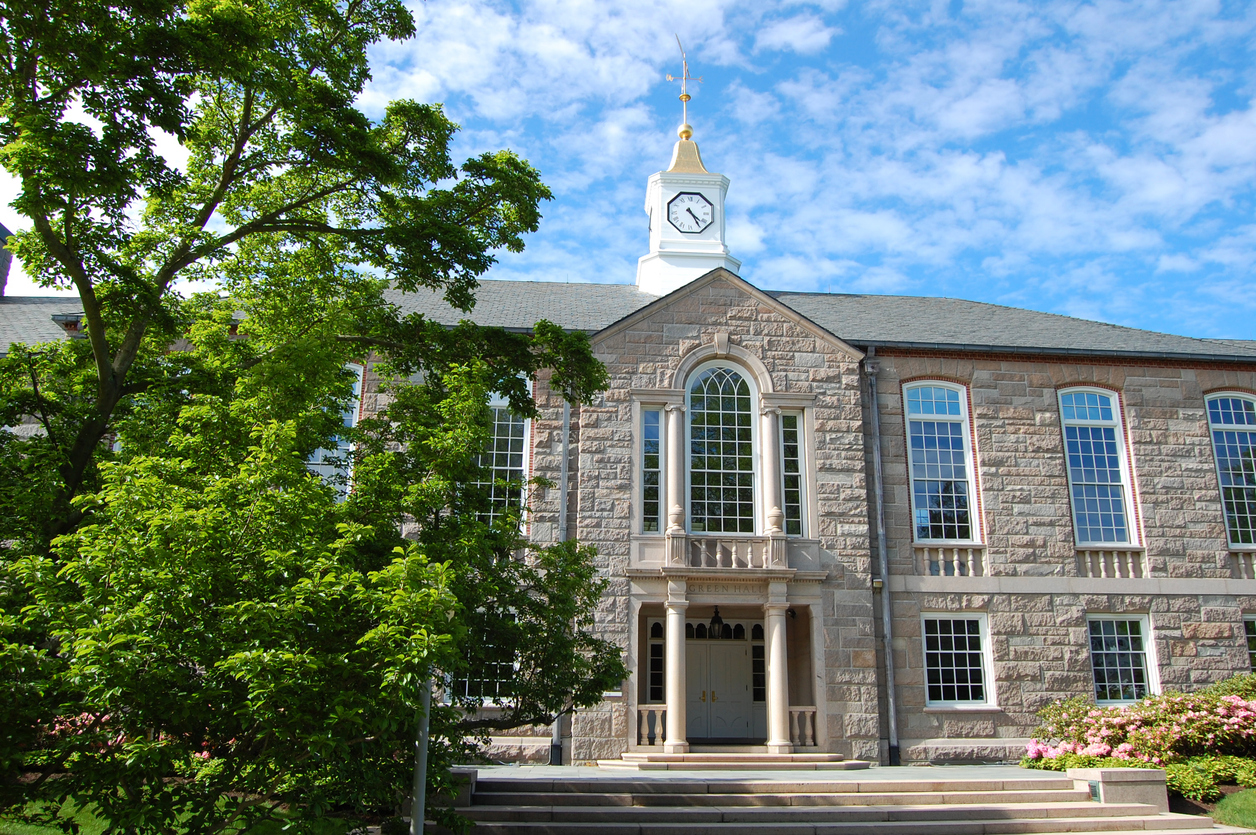
Rainer Lohmann is a professor of oceanography at URI and runs the Sources, Transport, Exposure & Effects of PFASs (STEEP) center. Although Lohmann isn’t working specifically on climate change issues, his work is still being impacted by federal pauses and cuts to environmental research spending.
“Initially it was the panic, and now it’s basically just uncertainty, because nothing that I have has been officially cut,” he said in a recent phone interview. “And now it seems as if things will keep as they have been, I assume, at least for this fiscal year.”
“I’m guessing,” he added.
However, colleagues who he works with at the U.S. Geological Survey and EPA aren’t certain how long they will keep their jobs.
For example, Lohmann said he suspects that one of his grad students who is an EPA fellow will likely be terminated by the end of the summer.
“We assume we have a few months and then things will start falling apart,” he said.
He’s spoken with his doctoral students and told them they should consider getting a master’s degree instead because he can’t guarantee funding their positions to finish out their Ph.Ds.
Lohmann described the situation for URI graduate students as triaging: as more funding gets cut, those who are closest to getting their doctorates will be the most likely to keep their funding, while those who are the farthest away will probably be the first to lose it.
“Some of my new students were in the first or second year,” he said, “I have no guarantee anymore that I can pay them for the three or four or five years.”
If they get their master’s along the way, and the government cancels their funding, he’s told them, “at least you’ll have a degree.”
As of last week, none of Lohmann’s funding had been cut, but other academics at URI have already lost grants or seen work stalled while the government evaluates its research priorities.
Jaime Palter, an associate professor of oceanography at URI, said she has been affected by the funding cuts, even though they haven’t hit her directly yet.
She has a National Science Foundation grant application examining ocean oxygenation “that’s been just pending for ages.”
Palter said she’s also awaiting word about another grant she applied to NOAA for in November. (“It’s not really even about climate change,” she said. The grant would look at the intensification of storms in the Gulf Stream.)
Although some programs and grants aren’t being explicitly canceled, budget reviews, firings, and resignations are stalling the process.
“The program manager at NOAA that runs another one of my grants was fired. The deputy program manager was fired,” she said, “and the [person] that was running the program that I applied to that I haven’t heard back from, she resigned, she said, for health reasons.”
The grant applications are starting to feel like time and money wasted, Palter added.
“It’s normal to not get funded, they might have a 20% or 30% success rate or less. That’s fine,” she said, but to see whole programs left completely unfunded is “a little disheartening.”
Palter is on a URI committee that has to let talented graduate applicants know they won’t be accepted, even though they are qualified, because of budget constraints and uncertainty.
“I’m trying to understand our planet, trying to help plan for a future that might be — that will be — altered by the changes that we’re making to the atmosphere,” Palter said, “and exposing students to how we think about these things and how scientists approach these questions and the possible solutions.”
She said Trump’s attack on research funding undermines her work and the work of future generations of scientists.
“Being in an atmosphere where that work feels unvalued … it’s not the best feeling,” Palter said.


Climate crisis not! state officials in New England especially in Massachusetts and Rhode Island don’t believe in climate crisis. why ?because they closed our largest non carbon emitting energy source which provided 62% of all non carbon electrical generation in Massachusetts which was Pilgrim nuclear and Plymouth MA. But they couldn’t close it when they announced it in 2015 because it might cause blackouts on the cape, so what they did was build a number three unit at Cape Cod Canal Electrical gas generation plant that came online in 2019 September three months after Pilgrim closed climate crisis you lie! $37 Trillion in debt increasing 3 trillion every year == the United States is bankrupt.
Trump wants to boil the planet and the destruction will be huge, get worse on almost a yearly basis, and not covered by FEMA. Many of the first round of victims will be his own voters. Very sad.