
Lead By Example Program Helps Make Government Buildings Energy Efficient
April 17, 2025
Share


NORTH KINGSTOWN, R.I. — When Ralph Mollis was hired as town manager in 2017, he didn’t have an office in Town Hall; in fact, the town didn’t really have a Town Hall.
The year before, town officials and the state Fire Safety Code Board of Appeals and Review ordered Town Hall closed, citing about 30 violations and deeming it a safety risk to town employees and the public.
It’s a common problem in a state where much of the construction, whether public or private, dates back decades or sometimes centuries. North Kingstown Town Hall dates to the 1880s, and like all older buildings, presents unique problems bringing them up to modern building codes.
Mollis said his priority from the start was finding a way to renovate the building, bringing it out of the 1800s and into the 21st century.
“I wanted to bring that building back to life,” Mollis told ecoRI News. “But I wanted to do so in an energy-efficient manner: all LED lighting, all rooms where after you leave the lights go off automatically. The windows do not open, so we had to have it all climate-controlled too.”
In 2018, town voters approved a $5 million bond to renovate Town Hall, but a later estimate from an outside architectural firm put the actual cost at somewhere around $12.5 million. Town officials had less luck the next time around, when voters rejected a second bond, this time for $7.5 million, to make up the difference. The town just had to make do with what funding it had.
“There were a lot of things we did in that building, which makes it really energy-efficient considering its age and historic nature,” Mollis said. “It was a delicate balance, but I think we were able to do that and not compromise on the historic nature of the building.”
Energy-efficiency improvements to public and government buildings are a rising trend in Rhode Island. On its face, it’s not sexy government policy but, thanks to a series of executive orders, and some assistance from the state Office of Energy Resources (OER), more and more state agencies, municipal governments, and school districts are leading by example.
Executive order 23-06, issued by Gov. Dan McKee in 2023, is the most recent nudge from state officials to help Rhode Island meet its climate mandates. The order, known as the Lead by Example program, “supports the public sector (state agencies, public schools, municipalities) in lowering greenhouse gas emissions and reducing energy costs across Rhode Island through holistic investment in energy efficiency, renewable energy, and clean transportation technologies.”
It requires state agencies to reduce greenhouse gas emissions, improve energy efficiency, and increase renewable energy procurement and electric vehicle charging infrastructure.
The program also offers funding for municipalities to reduce fossil fuel emissions and total energy use, improve efficiency of facilities, and support the renewable energy economy through its Energy Efficiency and Conservation Block Grant. Every municipality is eligible to receive funding through the grant program.
In fact, North Kingstown’s renovations of its Town Hall, replacement of 2,500 streetlight bulbs with LEDs, and other improvements netted the town a Lead by Example award from OER in 2023.
While the state is unlikely to penalize itself for not reaching a goal, there’s real targets outlined in the Lead by Example program. Like the Act on Climate, there are benchmark goals every decade until 2050.
By the end of this decade, at least 25% of the state’s fleet of vehicles is expected to be zero emission or electric vehicles; state agencies are expected to reduce their building and transportation emissions by 40%; and increase their energy efficiency in facilities by around 20%. One out of the five goals has already been met: a requirement to procure all state electricity from renewable sources.
“As of 2023, significant progress has been made against these targets, positioning the state to meet or exceed its 2030 benchmarks,” wrote OER in its annual report on the Lead by Example program.
David McLaughlin is no stranger to sustainability initiatives. The former founder and head of Clean Ocean Access, an environmental nonprofit focused on Aquidneck Island and Narragansett Bay that closed last year, McLaughlin heads the Lead by Example and other sustainability initiatives within the Department of Environmental Management.
“It’s a little bit about looking at our portfolio of options as an agency, seeing the venues that we have, and then finding a fit,” he said.
Electric vehicles are one such success area. DEM owns and operates 143 vehicles. McLaughlin said the department is already ahead in its goal to convert its fleet to EVs. The department had a goal to convert 15% of its vehicles to electric, and the department is currently at 21% and is projected to reach 28% conversion by end of the decade.
The infrastructure for charging EVs is almost as important as the vehicles themselves. While the state reports it has 72 stations on state-owned facilities, the state’s electric vehicle charging network is still pretty fragmented. DEM installed nine charging stations at its park headquarters in South Kingstown, but in many areas options for charging are slim.
North Kingstown has a desperate need for more charging infrastructure, according to Mollis. Any town resident with an EV has few options, whether on public or private properties. The town installed four charging stations at its municipal golf course in Quonset, which Mollis said are “heavily used.”
“We don’t really have that many in town whatsoever, and we hope many more will come,” he said.
It gets a little more complicated when it comes to DEM buildings. The agency’s properties and offices are more widespread than most, and they aren’t always state-owned. DEM’s main headquarters are in The Foundry, an office building just a stone’s throw away from Providence Place and the Statehouse, so any rooftop solar or energy efficiency upgrades are ultimately up to the landlord.
Smaller changes, said McLaughlin, are more easily doable inside The Foundry offices. In his time at the department, McLaughlin said, he had the Rhode Island Resource Recovery Corporation perform a waste audit, which showed DEM headquarters had a waste diversion rate from the landfill of about 30%, a number which puts it ahead of most of the state’s 39 cities and towns.
But McLaughlin said he knew the office could do better, so he chose to swap out individual waste bins at employees’ desks for resource recovery stations, around 18 across DEM’s three main office floors. As a result, the waste diversion rate jumped up to 53%.
“That’s something we should celebrate,” McLaughlin said. “I’ll be the first to admit it could be a lot higher. But just by doing a few things like recycling, diverting organics like that, if we could achieve that across the state in the coming years that’d be fantastic.”
Outside the main Foundry office, 10 DEM facilities have rooftop solar, the bulk of them installed in 2013, with another three coming online in 2022. But McLaughlin wants to explore other options, including installing rooftop solar panels at state beach properties that are guaranteed plenty of sun, or installing solar canopies at the department’s trout hatchery.
“I think DEM is in a really fortunate situation that we have such a diverse array of facilities that we are looking to expand,” McLaughlin said. “How we generate power, how we save power, implementing charging stations not only for private use, but for the greater benefit of the state and our visitors.”

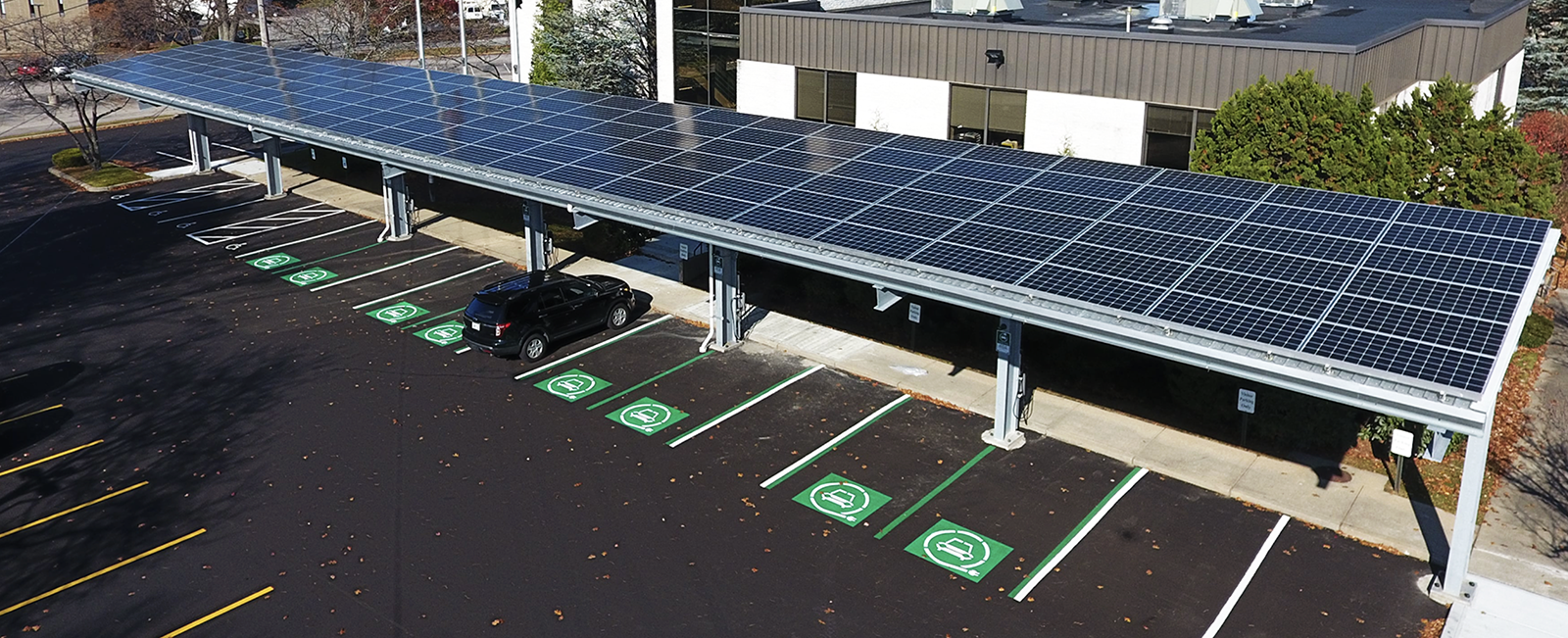
That solar carport is what we could use in so many places. Why can’t we have that all over the Warwick Mall parking lot? Our school parking lots? Our beach parking lots?
Hi Pam. Warwick put in restrictive solar ordiances a couple years ago, basically restricting solar development to rooftops and parking lots. City ordinances make it more difficult for carports because they can only supply on-site power and not to the grid. The Warwick Mall could host a ton of solar carport capacity, much more than the Warwick Mall could ever hope to use. The City ordinances need to be revised to let these projects happen!