
RIPTA’s Next Stop: Fiscal Cliff or Full Funding?
Agency warned 300 employees could be laid off if $32M shortfall isn't addressed
March 13, 2025
Share


PROVIDENCE — As another legislative session winds on, so too does a campaign to save the state’s public transit agency from a major deficit.
For the second year in a row, the Rhode Island Public Transit Authority is facing a funding shortfall in Gov. Daniel McKee’s budget proposal, to the tune of $32.6 million for fiscal 2026.
At a recent meeting at the Statehouse, RIPTA CEO Chris Durand laid out the financial situation in stark terms.
“Where we are today, if nothing else changes — and I do think there’s opportunities for us to generate new revenue — I’m not seeing anything in front of me right now that would solve that in full,” Durand said of the shortfall. “We’d have to be looking at service reductions or modifications, potentially fairly large ones.”
That could translate to about 300 RIPTA employees losing their jobs if the agency does not receive additional funding, according to agency spokesperson Cristy Raposo Perry. Currently, the agency is budgeted for about 900 employees.
“While a finalized reduction plan is not yet in place, it would involve significant service cuts statewide,” Raposo Perry wrote in a statement to ecoRI News.
But those cuts aren’t certain. Advocates and legislators, as a part of the Save RIPTA campaign, have put together a package of bills they hope will not only prevent the authority from falling off an immediate fiscal cliff but will also help sustain the agency into the future.
Funding RIPTA now
When RIPTA faced a funding gap last year of $18 million, about $10 million from the state’s federal pandemic funds and an allocation from the General Assembly kept the agency’s budget balanced and prevented layoffs and service cuts.
This session, a bill (S0342/H6020) would apportion money to plug the new, larger hole in the authority’s budget. The allocation would allow RIPTA “to continue current service throughout the State, hire and train more bus operators, and implement the State’s Act on Climate goals,” the bill states.
Transit advocate Daria Brashear said the bill would be a lifeline for the agency. “That or something that otherwise fills that gap needs to happen or we’re going to have service cuts,” she said.
“The unfortunate bit about it is things are in the best shape that they’ve been in a long time” at RIPTA, added Brashear, noting increases in reliability, the turnaround in the driver shortage, and Durand, the newly appointed CEO.
The agency is preparing an efficiency study, which staff have said they aim to finish this spring. Brashear said she hopes the study will show RIPTA is already running efficiently and that the General Assembly will reward the authority for its performance.
At a House Finance Subcommittee on Environment and Transportation meeting March 11, longtime driver and union leader Thomas Cute came to testify and voice his concern about what cuts could mean for his fellow RIPTA workers and the people they transport around the state.
He said that if more $32 million must be cut from RIPTA’s current budget, most of that will probably come from driver’s positions, which in turn will lead to service cuts.
Last year, with a smaller deficit, many lines in the Pawtucket area were on the chopping block, said Cute, who lives in Pawtucket, but a new plan could eliminate service to the area altogether.
“There’s a lot of folks who depend on RIPTA,” he said, from workers to students, people getting to the grocery store or doctor’s appointments, and many of them could be impacted.
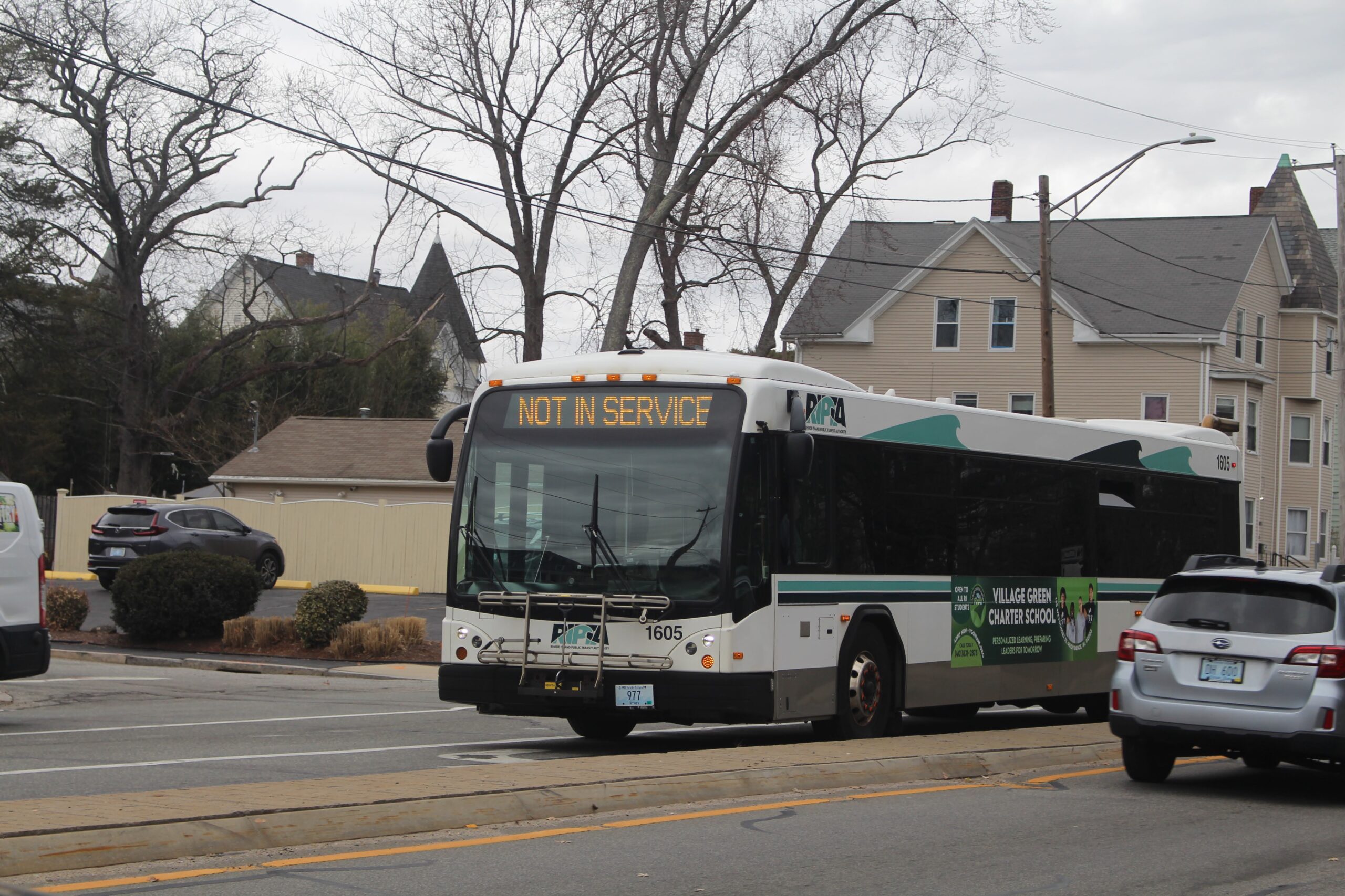
As for himself, after working 45 years for RIPTA, he is close to retirement age, so he isn’t concerned that much for himself. He worries instead “for my brothers and sisters because many of them just got here and thought it was a stable job … now we have a catastrophic financial situation.”
Future transit funding
On the docket for the 2025 legislative session are six other bills, most of which would create new avenues to fund RIPTA operations.
Currently, RIPTA receives a significant amount of money from the state gas tax, which advocates have said has led to underfunding, for a few reasons.
The percentage of the gas tax allocated to RIPTA has stayed stagnant since it was set in 2015. Initially, RIPTA received 30% of the gas tax, but because inflation has increased, the agency now only gets 24% of the tax’s revenue.
Bills sponsored by Sen. Samuel Zurier, D-Providence, would bring that percentage back up to 30%, as well as require the state to use more up-to-date information to keep the gas tax more in line with inflation.
Using the gas tax as a resource is a funding problem because as cars become more fuel-efficient and more electric vehicles get on the road, revenue from the gas tax is expected to dwindle.
To try to address this, Rep. David Morales, D-Providence, introduced a bill that would allocate the 7% sales tax on rideshares (Uber and Lyft) to RIPTA’s operations budget.
Sen. Meghan Kallman, D-Providence, has also proposed legislation that would add an additional 75-cent surcharge to rideshares, half of which would go toward infrastructure improvements in the communities where the rides began and half of which would go to RIPTA.
Although these pieces of legislation have been introduced, they haven’t yet been heard before the committee.
Constituents have already testified on House and Senate versions of a bill sponsored by Deputy Speaker Raymond Hull, a Democrat representing part of Providence and North Providence, and Sen. Jacob Bissaillon, D-Providence.
The proposed law, which was heard before the House Finance Committee at the beginning of March, would require companies with 500 employees or more to offer a pre-tax transit pass benefit. Employers required to participate would have to set up a system for their workers to buy fare passes through their paychecks, pre-tax. Or, employers have the option of paying for employees’ passes themselves, something some employers like Brown University already do.
Of the 23 letters of testimony submitted to the House committee, 21 were in favor of the bill, and two — from the Northern Rhode Island Chamber of Commerce (NRICC) and from Rhode Island Department of Transportation director Peter Alviti — were against it. Alviti’s concern, according to his letter, was that RIDOT is not the best agency to administer a public awareness campaign “encouraging the public to contact employers about commuter transportation benefits,” which is required by the bill.
NRICC lobbyist Lenette Forry-Menard said establishing such a program would “create another mandate” for employees.
“What happens if you’re in a business where nobody really wants to use it and you still have to go through the machinations?” Forry-Menard asked the committee.
Morales, a member of the House Finance Committee and a sponsor or co-sponsor of some of the other Save RIPTA bills, pushed back on the idea that employees wouldn’t want to use the program.
“I think it is important to note that of 500 employees, there would certainly be a dozen or more that would benefit and have greater benefits going to that respective employer, because they now offer this,” Morales said.

For those who wrote and spoke in favor of the bill, many said they currently or in the past used a program similar to the one proposed by the legislation.
Archana Ramanujam, a Brown University graduate student who testified before the committee, said using the bus pass Brown provides her has been a game-changer. She still drives sometimes, she said, but having the pass makes hopping on a bus a much easier choice.
“It opens up another option,” Ramanujam said.
“The transit pass means that I don’t have to think twice about how many times I take the bus, or whether it would be more economical to drive,” she testified. “It’s difficult to overstate how great a method it is. It gives me more freedom to move around the city.”
The last bill within the Save RIPTA campaign’s package is a $100 million bond referendum that would fund elements of the Transportation Master Plan such as improved bus shelters and stops, access to stops (ramps, crosswalks), and passenger facilities (bathrooms, indoor waiting areas).
Unlike the other bills, the bond focuses on RIPTA’s capital expenses, rather than its operational funds. Capital funds pay for large, often one-time expenses, like the building of a bus station or purchase of an electric bus, while operational spending pays for the salaries of the workers that keep the agency going.
The bill was introduced at the end of February but hasn’t had any hearings so far. If passed, it would place the $100 million transit bond on the ballot in November 2026.
Liza Burkin and Dylan Giles of Providence Streets Coalition, one of the organizations within the Save RIPTA coalition, said they feel hopeful about the proposed legislation and that it can get through the General Assembly this year.
The Save RIPTA coalition itself, which includes union representatives, youth groups, older adults, advocates for people with disabilities and activists for the environment, “really runs the gamut,” Burkin said.
“There’s so many different reasons to be supportive of better public transit,” she said.
The wide swath of interests supporting the campaign as well as the inclusion of forward-looking initiatives make it a strong push, Giles said.
“Every year just felt like asking for more money, more money,” he said. “Finally, we have some solutions. We’re offering solutions that weren’t things that were being brought to the table before.”
They both acknowledged that the state budget is tight this year, but said they don’t believe letting RIPTA take the brunt of cuts will be worthwhile in the long run.
“There’s so many needs and so many strains on the budget, but I think that not funding RIPTA is guaranteed to only grow the budget deficit in the future,” Burkin said, “because people will lose their jobs and sign up for unemployment, that is just guaranteed. When people can’t act, use public transit to access their services and to spend money in their communities, that’s guaranteed to lower state revenues across the board.”
Alviti is a crook and should have been fired years ago. I have heard Forry-Menard testify many times at the state house. Her clientle are among the biggest polluters in the state. You should have heard her blather on against electric cars. You should have heard her defend polluters. Working for supposedly innovate business leaders she helps us understand how the rich are the most criminal members of society and among the least innovative. They tout American innovation but when it comes to innovations that help eliminate fosssil fuels, they are so anti innovation it makes you sick. They are the least willing to help us move into a safe future because they want to keep stealing. And they have no comprehension of how economies really work best from the bottom up or how climate catstrophes threaten all of the economy and must be prevented.