
Proposed Study Commission Would Examine Whether State-Owned Utilities Are Feasible Alternative
February 24, 2025
Share


PROVIDENCE — Should Rhode Island own its own utilities? It’s a question at least one state lawmaker wants the General Assembly to consider this year.
Legislation (H5161), introduced by Rep. Megan Cotter, a Democrat who represents Exeter, Hopkinton and Richmond, would assemble a 15-member study commission of lawmakers, state energy regulators, utilities, consumer groups, and unions that would investigate the feasibility of publicly owned utilities on the local, municipal, and state level. Commissioners would have until April 16, 2026, to report their findings and recommendations to the General Assembly.
The proposed legislation comes as Rhode Islanders are weathering their third straight winter of high energy prices, and discontent with the state’s majority utility company for gas and electricity, Rhode Island Energy.
In an interview with ecoRI News, Cotter said she wanted to start putting people first when it came to basic utility services.
“You can tell the difference right away between someone representing a publicly owned utility, because the for-profit utility companies are always talking about their shareholders,” Cotter said. “I think we can do it cheaper because we don’t care about the shareholders, we care about doing the right thing. And I think we’re really past the breaking point right now.”
Cotter said publicly owned utilities were nothing new to Rhode Island, citing the Clear River Electric and Water District, formerly known as the Pascoag Utility District, as a small-scale model of what she hoped to accomplish in other areas of the state. She also cited a more unusual inspiration in the conservative farm state of Nebraska.
Despite being a deep red state, Nebraska has owned its own electric utilities through the Nebraska Public Power District since 1971. The district serves 81 communities and about 1 million state residents by providing low-cost power.
“We have goals that we may not meet, and we have to think about what we can do as a General Assembly to meet those goals,” Cotter said. “And honestly, the middle class is eroding more and more by the day. It’s our job to come up with solutions.”
Lower-cost power is a powerful attractor for Rhode Islanders. According to the federal Energy Information Administration, residential homes in the state on average are paying about 28.7 cents per kilowatt-hour (kWh) for electricity. Nebraska residents, meanwhile, are paying 12.3 cents per kWh.
In an emailed response to ecoRI News, a spokesperson for Rhode Island Energy downplayed Nebraska’s example, citing the state’s ownership of power plants, reliance on coal and natural gas; a completely different environment than “supply-constrained” New England.
“Managing a power grid requires deep expertise, resources, and long-term investment, which our utility has provided for Rhode Islanders for over 100 years,” said Evelyn Garcia, a spokesperson for Rhode Island Energy. “Public power could put 1,400 jobs at risk and leave gaps in critical community funding, impacting local nonprofits, schools, and shelters.”
“If the goal is to control costs while ensuring reliability, we want to focus on meaningful discussions that build on our strengths rather than gamble on an unproven alternative,” she added.
Rhode Island Energy’s parent company, the Pennsylvania-based PPL Corp., came under scrutiny recently when it posted earnings of $888 million for last year, up from $740 million in 2023. That news prompted Cotter to introduce additional legislation to cut the allowable profit margin of Rhode Island Energy to 4%.
Garcia called the bill to cap the company’s profit “unconstitutional” and said the company was focused on lowering everyday costs whenever possible.
“Utility ROE is not driving costs in Rhode Island, it is a small portion of an overall bill,” Garcia said. “On an average electric bill, only about $3 is utility profit while $36 covers public policy costs and taxes.”
So how could the state come to own its utilities? Cotter said she doesn’t favor seizing existing assets by eminent domain. Her favored approach would be building microgrids and investing in the green economy to create new utility infrastructure.
Microgrids have been studied at the federal and state level for years, mostly as a way to build the resilience of the country’s aging electricity infrastructure. In broad strokes, the way the electric grid works now is that homes and businesses get their electricity essentially from the same few massive power plants churning out tons and tons of electricity every hour. It’s basically a one-way system.
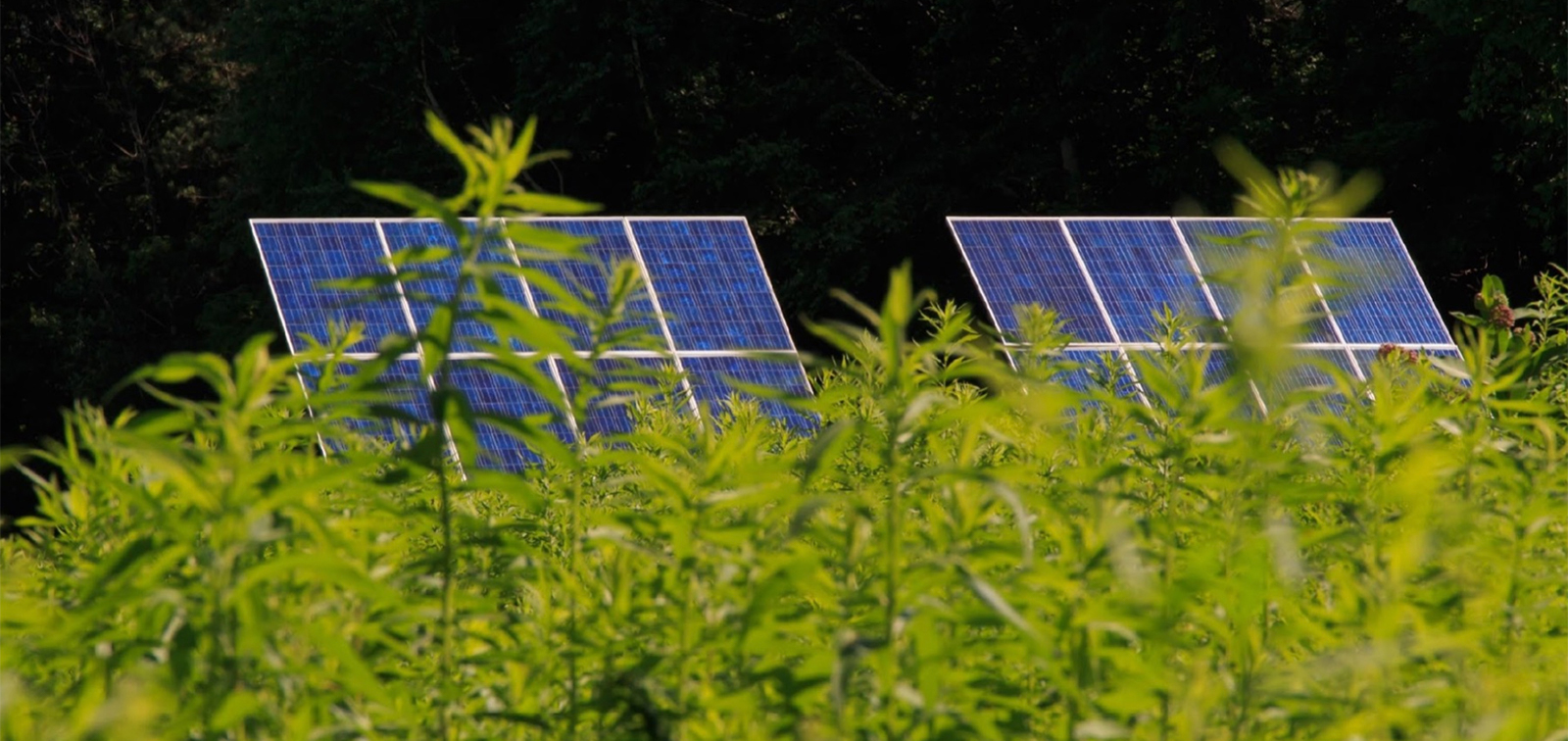
In a microgrid system, smaller power plants would be installed in certain areas; think of a nearby solar array, or wind turbines. Instead of getting power from the same handful of power plants, grids could be localized and weather bigger outages if their electricity was generated locally.
The Public Utilities Commission received some money to study microgrids in last year’s budget, but has not produced a final report. A 2023 report prepared for the state Office of Energy Resources by Celtic Power outlined the different kinds of microgrids that could be used in Rhode Island.
H5161 was assigned to the House Corporations Committee but has not yet received a hearing date.
Categories
Join the Discussion
View CommentsRecent Comments
Leave a Reply

Your support keeps our reporters on the environmental beat.
Reader support is at the core of our nonprofit news model. Together, we can keep the environment in the headlines.
Incredibly naive to think the government could take over our utility services. Can’t keep bridges and roads in decent condition, but they can run utilities? God help us.
Ther private sector is incapable of providing the necessities of life properly. I support public power.
RI Energy could be better run by an Elementary School student than the current administers.
Their billing system is always incorrect. Their meters are either broken or not read. (My meter is outside – installed by them. I received threatening letters for 8 months, saying they didn’t have access to read it – even AFTER I called them to say “it ain’t so!”)
I am still waiting for them to credit my account after 8 months of exorbitantly overcharging me with estimated reads – even though the meter is outside!!!)
Now they want ANOTHER rate hike? National Grid where are you?
Sandra Lee
23 Western St.
Providence, RI
The corporate spokesperson boasts that “Utility ROE is not driving costs in Rhode Island, it is a small portion of an overall bill,” and that “On an average electric bill, only about $3 is utility profit while $36 covers public policy costs and taxes.” She does not mention that that those “public policy costs” include her salary and the high fees for the lobbyists who prevent cost-cutting legislation at the State House at every opportunity. Earnings of $888 million for last year, up from $740 million in 2023 — while low and moderate income family across the state live in poverty and children go hungry. They should be ashamed.
Energy, for the most part, is the source of our overload of heat trapping emissions. We need to regulate a transition to clean energy that is fairly distributed across the country. Otherwise, many states will not be able to afford the initial cost of clean energy. It’s a global crisis not a state crisis.
Lord save us from those politicians who believe the shareholders are the reason electricity cost are so much in RI. Taxpayer funded electricity is not a bottomless pocket for you to raid. Remove all of the mandated RI fees to fund energy saving programs, low income programs, etc from RI Energy bills. Then the average customer would understand the true cost of these RI taxes bring collected by RI Energy as mandated by the state. Years ago local towns and cities managed trees along roadsides. Now RI Energy is responsible for tree maintenance. This adds greatly to the cost. RI Energy also must have crews on standby for all storms. That cost real dollars. Please tell me how much energy is created from solar panels when they are covered in snow or on days without sun. Windmills do not produce energy on windless days. Federal Government regulations impact the cost of energy. The state of RI will have to follow those regulations. Historically, everything the government gets involved in increases cost for the individual. For example, Section 8 increased the cost of rent for all individuals because the government is willing to pay more which increased the cost to those renters not on Section 8. Federally guaranteed student loans increased the cost of college degrees because colleges/universities knew they could continually increase tuition and fees. Obama Care increased the cost of health coverage for individuals who did not qualify for Obama Care, it also increase out of pocket expenses for those individuals. So no a taxpayer funded electrical grid is a poor idea for RI taxpayers. Remove all of the hidden RI taxes from the bills and RI ratepayers will experience relief from high bills.
I agree in that ALARM BELLS must be sounded! The Crime Town City State on Smith Hill has a track record of grift, maleficence, incompetence and corruption. As such can not be trusted to manage or maintain the local RI electric grid. Their lack of collective knowledge exhibited in this area is self evident. Their latest pet project The wind , solar and batteries industrial complex is a seriously flawed and inferior concept having created an environmental and economic calamity with far reaching negative consequences. The build out of additional installs amplifies those short comings. The companion Law “The Act on Climate” is predicated on a far fetched cult like misunderstanding for the earths natural climate/GEO cycles. To select an inadequate energy/power-electricity approach based on the requirement for excessive semi skilled labor content as justification is repugnant. The USA has recognized such and pivoted to realistic energy/power and electricity means and methods for modernization. This while RI political establishment choses to double down ignoring a serious mistake that will increase cost over 5X. Yes, affordability, predictability and availability and reliability becomes unachievable. The companion promoted home energy saving programs promoted is another example of costly kluge with very marginal outcomes at best in the local seasonal weather and climate. Yes, it is time to recognize and retire the Green SCAM and companion climate grifters. Yes, address restoring the seriously damaged underpinning for the state of RI and our modern nation.