URI Studying Jonah Crabs to Learn about Offshore Wind Turbines’ Effect on Underwater Ecosystems
July 27, 2026
Share


NARRAGANSETT, R.I. — Since the first offshore wind project was developed in Rhode Island in 2016, University of Rhode Island researchers have been attempting to understand their impacts on local marine ecosystems. That work is continuing with first-year URI Ph.D. student Emmanuel Oyewole’s study of the artificial reefs that are often found at the base of turbines.
It’s been established through research surrounding offshore wind that the base of turbines serves as a foundation for algae and coral, which acts as a base for a booming ecosystem.
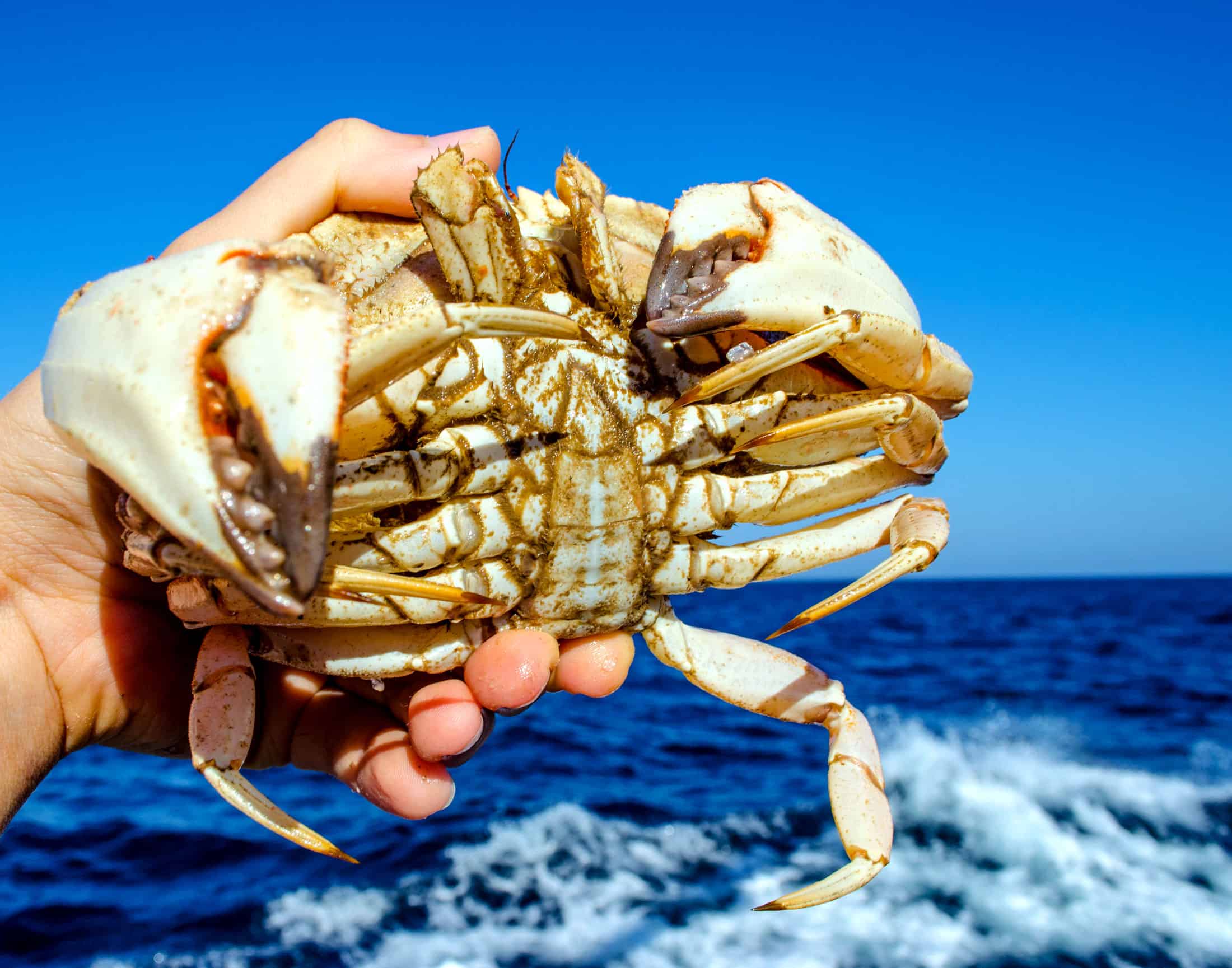
In an attempt to find the cause of this blossoming of aquatic activity, Oyewole is studying the movement and dietary habits of one special creature found at the base of offshore wind turbines: Jonah crabs. He’s working with his academic advisor, Kelton McMahon, an associate professor of oceanography.
“It’s really, really important for understanding the impact of these wind farms on biodiversity, on ecosystem structure and function, and on fisheries production,” McMahon said.
Jonah crabs were often overlooked by Rhode Island commercial fishermen and were thrown away when caught in lobster traps, according to Oyewole, but as the local lobster population has declined due to overfishing and warming waters, the Jonah crab population has become a viable source of income.
Oyewole said Jonah crabs have seen an increase in market value and about 70% to 85% of all Jonah crab stock is from the Rhode Island area. Jonah crab fishing doesn’t require new equipment or infrastructure; lobster boats can use the same lobster cages to catch the crabs. Although the market for Jonah crabs is new and growing, understanding the impacts of offshore wind is important in understanding the future of the market.
“If [the turbines] are aggregating different biomasses from different areas, that means that you’re having a lot of stock like Jonah crab stock coming from fishable areas to that particular area, which is less fishable,” Oyewole said.
To study the crabs’ movements, Oyewole and McMahon are using isotopic analysis, which can be used to understand the flow of energy through a food web and reconstruct past environmental and climatic conditions. The analysis is an “internal or intrinsic biomarker of where you live and what you eat,” according to Oyewole and McMahon.
“I’m sure you’ve heard the age-old adage you are what you eat,” McMahon said. “We actually record chemical information about the food we eat, which can change depending on where you get that food. As you live and feed in an environment, you take on the isotopic or chemical signal of that local food source, and we can use that to track organisms and they move across different places and eat different things.”
Jonah crabs are easy to track using isotopic data due to their hard shell, or carapace. When a Jonah crab sheds its carapace and molts, which happens annually, the softer new tissue takes on the isotopic properties of the place where the shell was developed. Then, as the shell hardens, that isotopic signal is frozen. Oyewole compares this data to isotopic data taken from the muscle fiber of the Jonah crab and maps them both.
“This map can tell me if the Jonah crab was here when it was born,” Oyewole said. “So if a Jonah crab migrated from place to place, the carapace reading would be [different from the turbine’s location] and the muscle reading would be [at the turbine].”
The opposite is also true; if the carapace and the muscle reading are the same, that means the Jonah crab was born and raised next to the turbine, and wouldn’t have migrated. Additionally, Oyewole is also gathering metabolic data from Jonah crabs’ stomach acid to see what they have been eating to better understand why they might be drawn to offshore wind projects.
McMahon said the experimental process is not exclusive to Jonah crabs, as Oyewole has also been running similar tests on black sea bass. According to McMahon, black sea bass are historically found in temperate subtropical waters like that found off the coasts of Delaware and the Carolinas, but as the water around Rhode Island warms due to climate change, researchers are starting to see more bass in the same ecosystems created by offshore wind turbines in which Jonah crabs are found.
“Everyone when they see me asks about my research. [They ask], ‘Is it good or bad?’ I’m just trying to understand what is happening so people can know,” Oyewole said.
As part of his research process, Oyewole has gone out on fishing boats at 4 a.m. with Rhode Island fishermen to gather Jonah crabs for testing. Oyewole said he has enjoyed his time spent with the fishermen and described his time on the water as both serene and beautiful.
He said his research is important because it will better inform both policy and Rhode Island residents, while also helping to demystify offshore wind. Both Oyewole and McMahon said the public’s impression of offshore wind farms has been skeptical, and they described how some fishermen are concerned about fishing near the turbines.
“I think the impression right now is complicated, and I think rightfully so,” McMahon said. “There are a lot of really important values that things like renewable offshore wind provide and there are always challenges that come with it. There’s nothing that we do in the world that’s all good or all bad, and I think that the way we bridge those challenges is with sound, reproducible scientific information.”
Oyewole’s own understanding of science is what allowed this research project to take the shape it has. Oyewole, who came to America from Nigeria in 2023, graduated from URI’s School of Oceanography program with a master’s degree in marine affairs, and he did his undergrad studies in fisheries and aquaculture. Oyewole said he has always been interested in the way that science can be used to help better inform policy and society at large. He has used his interest in social science to better inform the outcome of the research process.
He said he envisions this work being used for both developing future offshore wind projects and better informing fishermen on the best spots to fish and which specific fishing industry is strengthened because of the unique effects of the turbines.
Oyewole explained that if the study finds that the Jonah crabs are in fact migrating to the turbines, then it could be concluded that there’s less of a Jonah crab population in the current fishing areas without turbines. If the turbines are drawing Jonah crabs away from hot spot fishing areas, Oyewole said the recommendation would be that turbines be developed further away from those spots. If the Jonah crabs are instead being born at the base of the turbines, then there will be a spillover effect in the region where even at the hot spot fishing spots there will be a growing population of Jonah crabs.